all work, all play

Last Friday CCNMTL hosted a mini-conference on New Media and Education (pics). Me and my colleague Dan Beeby co-presented a marathon series of workshops on Sakai and Web Services. We repeated each of our two 35 minute talks 3 times over the day (2×3 talks == a very long day), and I can’t wait for the video’s to be published so I can see the rest of the conference 😉

The first talk unfolded into a conversation about Course/Content Mgmt systems, open/community source ecologies, and the purposeful use of tools w/in those environments. The second talk covered rss, blogging, delicious, flickr, odeo, and the balance between push and pull. The participants were attentive and engaged, and I although the pace was brutal, I really enjoyed working on these presentations.

The funny thing about giving 6 talks in one day, is that by the third talk in, I couldn’t remember if I had used a particular phrase two slides back, or two hours back… Luckily, Dan and I knew the material cold, had a good rapport, and were very comfortable swapping lines and improvising. The only glitch was due to flickr not refreshing their feed for over 24 hours… can’t expect much more from an external service (more on that in a future post).

The slides got a little mangled on the html export, but here they are: An Instructors Guide to Sakai & Courseworks Remodeled.

Dan has a great touch in photoshop, so careful what sorts of pictures you leave laying around his desk.

A red guitar, 3 chords, and the truth

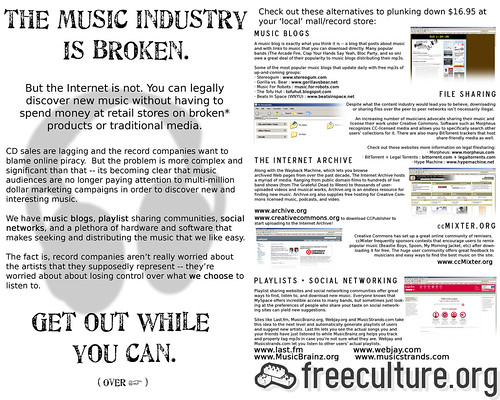
This weekend I participated in the NYC free culture summit and learned a few refreshing radical activism tricks from the class of ’06.

In stark contrast to the scholarly focus group I attended last week, this group explicitly understands that they need to create social spaces for like-minded activists to congregate, learn, and plot. The tools of the revolution were revealed in the speed geeking session – Once someone in the 21st century finds the truth, all they need is a mailing list, a blog, a wiki, irc, and rss (with a dash of delicious and flickr, to taste). Remarkable how quickly and easily people with real communication needs figure out how to use this suite of tools, understand which is good for what and when.

Highlights included a Riot Folk performance, a talk by Siva (“Space. Hope. Imagination. Potential.”), a talk by the Creative Commons gang, and suprise appearance by Cory Doctorow .

The most fun had to be not-protesting (you need a license to protest) outside of Time Sqaure’s Virgin Megastore, and reverse shoplifting DRM info into the stacks of damaged cds.

The revolution might not be televised, but it could very well end up on flickr.

His Master’s Voice

I recently read that Guglielmo Marconi envisioned the radio being used primarily for 2-way communications, and Alexandar Graham Bell imagined the telephone being used to broadcast concerts to large audiences. Whether or not this is true, it’s interesting to wonder if the inventors of technology are really the best at predicting its eventual usage.

Today I attended a focus group organized by the Marconi Society and EPIC which focused on the next generation of scholarly tools, and the future of research and the journal. Most people in the room were completely overwhelmed by the amount of information they were supposed to track, and many thought that better filtering tools would help. People also talked about the real problem of knowledge quality and credibility, and some sort of map for navigating the various layers of information in the world.

What I kept hearing in people’s remarks was that people really need spaces, not maps. Researchers need virtual watering holes to gather around. The quest for knowledge is not a search for data, it is arrived at through dialectic. Communities of like minded researches will naturally perform the task of filtering, highlighting, and vetting important information. It will take AI a long long time to accomplish the comparable task with advanced search and filtering portals….

Seems to me like the Marconi Society should consider funding the development of a specialized distribution of a well established CMS, perhaps modeled on drupal’s CivicSpace, or Shuttleworth’s SchoolTool. CivicSpace is basically a drupal bundled and configured with some modules that are geared towards operating an NGO. SchoolTool a Zope3 app designed for operating a small-mid size k12 school. The work might also benefit from considering the social software design patterns we worked on in Ulises’ course this past fall.

I also met some really cool people, doing really interesting and socially important work with technology.

Closing Thoughts on MSTU 5510

Ulises recently asked us to summarize our thoughts for the semester in our blogs. Considering that this blog was started for this class, I was surprised by my own initial resentment at being asked to post something so specific here. During the course of the semester, this forum has become a place for me to speak, not to answer. Even when I was posting assignments for class, they were items and issues which I selected and chose. This initial emotional reaction indicates how engaging these tools can become, and helped me answer some of the questions on Uilses’ list.

Its been great fun! Best of luck to everyone, and see you on Tuesday.

>> What is ‘social’ about social software?
to paraphrase: Social Software is made of people

>> How is the notion of community being redefined by social software?
>> What aspects of our humanity stand to gain or suffer as a result of our use of and reliance on social software?

Radical redefinitions of memory, identity, personal space, intimacy, and physical interaction.

>> How is social agency shared between humans and (computer) code in social software?


>> What are the social repercussions of unequal access to social software? >> What are the pedagogical implications of social software for education?

stay tuned.

>> Can social software be an effective tool for individual and social change?

See above. I think the pedagogical value of a tool follows from its potential for individual and social change.

Pimp my dilapidated, third-world, ambulance

On Tuesday November 29th I attended a presentation of The Diary of Angelina Jolie and Dr. Jeffery Sachs in Africa (watch it here). Angelina couldn’t make it, but Sachs (author of The End of Poverty) is a rock star in his own right, and it was the first time I have ever seen him talk.

He is an energetic and inspirational leader, who still believes we have the power to make the world a better place, and is actively working on operationalizing this vision. Some may be skeptical about MTV’s pro-social initiative, think.mtv.com, but whatever their corporate parent’s intentions, it has the potential to do some real good.

Notable moments included Dr. Sachs using the phrases “Open-Source politics” and the “wikipedia of foreign policy” to refer to an emerging form of democratic self-determination. It was also great when an audience member questioned an mtv vp on sending a pimp team over to kenya to help them fix the village’s only ambulance.

« Previous Page
/* reset the net - http://resetthenet.tumblr.com/post/84330794665/the-reset-the-net-splash-screen */