If I forget you, O Palestine…

I just returned from the eduventure of a lifetime in Palestine and Israel.  I travelled to the Palestine Technical University of Kadoorie  to consult on a World Bank funded project to help enhance technology education. The details of this project are inspiring and provocative, but before discussing educational technology, media literacy, and capacity building I need to talk about my direct experience of The Occupation.

As I anticipated before the trip, my understanding of the Israeli-Palestinian conflict was transformed by my first-person experience of the occupation. Within an hour crossing the Kalandia checkpoint into Ramallah, I began to experience a harshness that is almost impossible to capture in a snapshot. Superficially, life in Palestine seems almost normal. Everyone we met was warm and friendly, and I did not encounter extreme third-world poverty. However, during my visit I learned how virtually every aspect of ordinary Palestinian life is occupied.  Electricity, fuel, mobility, connectivity, information, and water are all tightly rationed and controlled by Israel.

Before the trip I had heard about the checkpoints, but it is difficult to capture the feelings of intimidation and harassment until you are stuck in checkpoint-traffic watching a Palestinian adolescent being handcuffed and manhandled on the side of the road. I began to feel the harsh gaze of the guard towers, and the spit-in-the-face of the  Israeli flags, waving  arrogantly.

The most shocking reality I learned about is the Palestinian water situation. Many Palestinians only have running water a few days a week. One quick way to tell the Arab homes apart from the settler’s homes is that the Arab homes have big black water tanks on their roofs to capture water while it is running.  In contrast, the settlers homes have water 24×7, and many have swimming pools and lush lawns.

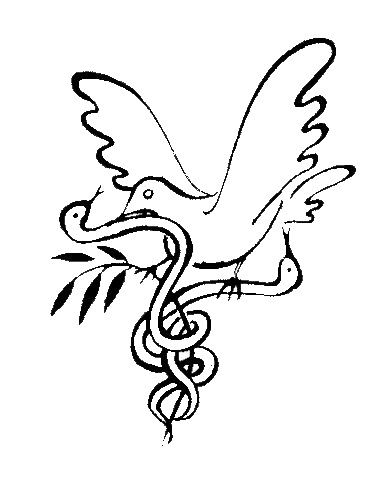
I kept thinking of this iconic image:

and its visually gripping corollaries:
Comparisons between the occupation and South African apartheid are common, but on this trip I began to relate the struggle to Jim Crow, the civil rights movement, and racial profiling and injustice that continue to oppress  US minorities.

I also learned about the regulation of information flows. On an Egged bus in Israel, I had a better connection over free wifi than anywhere in Palestine, including the universities. Palestinian telcom companies are currently forbidden from rolling out 3G networks, building new communication lines between cities is notoriously difficult, someone I met was not allowed to import routers, and Palestine cannot connect directly to the Mediterranean backbone.  [Incidentally, a local group of activists is trying to set up free wifi in Ramallah, but they are being thwarted by Palestinian telcoms!] Like their physical borders, all Internet traffic into and out of Palestine must cross through Israel first.

Serendipitously, Richard Stallman was visiting Palestine while I was there!  Unfortunately, I missed his lectures, but I met up with a few people who saw him speak, and they reported that his  message of freedom and liberation resonated strongly with his audience. I also connected with ma3bar.org – a society for Arab free and open source software, and ArabEyes — an Arabic-FLOSS translation project . I developed fresh insights into the role of free software in resistance and activism — especially as I appreciated the strength of the human networks that power free software, and the relative safety of engaging in this kind of organising (as opposed to being tagged by the authorities as an peace activist). More about this in future posts.

Scholarship such as Eyal Wiezman’s Hollow Land and Helga Souri’s work attempt to describe the Palestinian experience of the occupation, but the situation is so complex and hyper-mediated I recommend that anyone who wants to learn more should visit the West Bank themselves (special thanks to Dalia Otham for the conversations and introducing me to this work). Anyone with the smallest compassionate bone in their body will undoubtedly sympathize with with the Palestinian cause.

There is so much more to write. The specifics of our educational technology workshops, travelling and working with my advisor and a fabulous team from TC , the hospitality of our hosts at PTUK, the amazing sweet deserts, my tour of the graffiti on the Palestinian side of the wall,  the culture shock of leaving the West Bank and visiting my sister (and my four amazing nephews and brother-in-law) on a zionist kibbutz, the Israeli friends and family I connected with across the ideological spectrum, my visit to Sheva Chaya’s mystical glass blowing studio/gallery, diving an underwater museum in Caesarea, whitewater rafting down the Jordan with my nephews,  and Mushon’s personal guided tour (complete with analysis!) of the incredible housing protests erupting across Israel.

To be continued…

Crossing the line

This week I am heading to the West Bank for work (!?!): Enhancing Technology Education in Palestinian Universities (etep).

I will be spending a week at Palestinian Universities participating in capacity building workshops around educational technology. The University I am visiting is preparing to set up a group like CCNMTL and we are going to consult and share our experiences around these efforts.

I am anxious and excited about the trip. I have visited Israel numerous times in my life, but have never crossed the green line. My knowledge of the situation on the ground has been hyper-mediated, and witnessing the it in person will likely be transformative. I am doubtful that my first-person accounts will lend much more credibility or persuasiveness to future debates, but I anticipate that my own understanding and assurance will grow.

There are times and places for protests and flytillas, but I am hopeful that collaborating around shared objectives, working together on projects, and introducing radical pedagogical interventions will have a significant impact on promoting peace over the long-term.

Mobility Shifts: teaching & learning w/ video

Michael Preston and I have co-authored a chapter— Teaching and Learning with Video Annotations —for the recently released anthology, Learning Through Digital Media: Experiments in Technology and Pedagogy. This chapter recapitulates the history of multimedia annotation projects at CCNMTL, focusing especially on the pedagogies and learning outcomes that have motivated much of my work at CCNMTL work over the years. We discuss curricular activities which have stimulated the development of our VITAL and MediaThread multimedia analysis environments.

Learning Through Digital Media was edited by New School Professor Trebor Scholz in preparation for the upcoming Mobility Shifts: An International Future of Learning Summit (Call for Workshops: submissions due by July 1). The peer-reviewed book contains a series of practical applications of digital media to formal and informal learning situations, with a focus on teaching techniques across a range of services and tools. The “ambition of this collection is to discover how to use digital media for learning on campus and off. It offers a rich selection of methodologies, social practices, and hands-on assignments by leading educators who acknowledge the opportunities created by the confluence of mobile technologies, the World Wide Web, film, video games, TV, comics, and software while also acknowledging recurring challenges.”

Trebor throws a great conference. Mobility Shifts is part of a bi-annual conference series on Digital Politics.  The conference topic ’09 was digital labor, and in ’13 it will be about digital activism. Trebor is truly a performance artist when it comes to organizing conferences. He works really hard to get people talking to each other before the conference starts, so that when people arrive they are already in the middle of a conversation.  For the Internet as Playground and Factory he produced a series of short videos introducing participants to each other (mine is here).  This year he published a peer-reviewed anthology, available in a variety of formats, including hardcopy, PDF, ebook, and web-based.

Learning Through Digital Media was published in March 2011 by the Institute of Distributed Creativity under a creative-commons license (CC-BY).

Pick a corpus, any corpus

A few weeks ago I participated in a brainstorming session exploring the kinds of academic research projects the WikiLeaks archives might generate. Beyond the substantive specifics of the leaked cables, the media coverage of Cablegate, and their  impact on geopoltics, a central concern we recognised is the challenge of transforming torrents of qualitative data into narratives, arguments, and evidence .

The impact that technology is having on what’s knowable and how we go about knowing is a theme I have been chewing on for years – one that goes well beyond journalism, and cuts across the social sciences, law, education, etc. There is an urgency to this problem since the tools and techniques involved in these analyses are unevenly distributed.  High-end corporate law firms, marketing agencies, and political parties are all embracing new approaches to making sense of petabytes. Unfortunately, impact law firms, social scientists, and journalists often don’t even know these tools exist, never mind how to use them.  Part of what I call the organizational digital divide.

During our brainstorming I formulated a new twist on a possible research agenda. I realized how daunting it has become to evaluate and calibrate the emerging suites of digital instruments. There are many digital tools emerging that can be used to analyze large troves of data, but it is difficult to determine what each tool is best at, and if it does its job well.

One good way to benchmark our digital instruments is to select a standard corpus, and spend lots of time researching and studying that corpus until the corpus is fairly well understood. Similar to the role that the Brown Corpus played in computational linguistics, data miners need a training ground we can test, hone, and sharpen our digital implements. If we bring a new tool to bear on a well understood archive, we can evaluate its performance relative to our prior understanding.

Currently Wikipedia serves as the de-facto benchmark for many digital tools, though, since its a moving target, it is probably not the best choice for calibration. In many respects the selection of this kind of corpus can be arbitrary, though it needs to be adequately sophisticated, and we might as well pick something that is meaningful and interesting.

The Wikileaks documents are an excellent contender for training the next generation digital instruments and data miners. The AP is hard at work on new approaches for visualizing the Iraq War logs, and just last week there was a meetup for hacks and hackers working on the wikileaks documents Data Science & Data Journalism . It is easy to see how Knight funded projects like DocumentCloud converge on this problem as well. Ultimately, I think these efforts should move in the direction of interactive storytelling, not merely an passive extraction of meaning. We need tools that enable collaborative meaning-making around conceptual space similar to what Ushahidi has done for geographic space.

That way madness lies

Bossewitch, J. (2010). Pediatric Bipolar and the Media of Madness. Ethical Human Psychology and Psychiatry, 12(3), 254-268. doi: 10.1891/1559-4343.12.3.254

I am finally published in a peer-reviewed journal! Ethical Human Psychology and Psychiatry (available for purchase here – but my cut is exactly 0%). I wasn’t expecting much, and it’s mildly anti-climactic, but I have heard from a few people I never would have communicated with otherwise, and worked really hard to polish up this paper. Anyway, now its traditionally citable, which still means something (for the next few years, at least).

This paper is at least 2 years in the making.  It began when Rasmus Nielsen forwarded me a call for papers about drugs as a form of media for NCA ’09, and I participated in a panel  organised by Robert MacDougall (my slides). Around the same time as NCA, I also attended ICSPP and had the pleasure of meeting James Tucker and Peter Breggin. This meeting eventually led to my submission to EHPP – a journal that typically publishes articles by and for psychologists, psychiatrists, and social workers.  I was thrilled to help bring a dash of media and communications theory/research to that audience. Special thanks to Annie Robinson, Sascha Scatter, Bonfire Madigan, Brad Lewis, Biella Coleman, Philip Dawdy, Nicholas Mirzoeff, Julia Sonnevend, Ben Peters, and the Icarus Project for ideas, inspiration, and edits.

I have also reworked the main arguments in this essay into a chapter in the upcoming: Drugs & Media: New Perspectives on Communication, Consumption and Consciousness (edited by Robert C. MacDougall). I even worked on a McLuhanesque Tetrad around Prodromal diganoses (a.k.a. Psychotic Risk Syndrome).

Unfortunately, I was unable to convince Springer to go open access with my paper, but I tried and was able to deposit an open-access pre-print in the Columbia institutional repository, and also have a pre-print available here. If enough people make noise about open access, I hope the editors and publishers will eventually start to get the idea.

The issues raised in this paper are beginning to percolate into the mainstream. Last month Harpers published a (flawed) long  piece on predictive diagnoses: Which way madness lies: Can psychosis be prevented? Wired just ran a great piece on the backlash against DSM5, especially Psychotic Risk Syndrome, by one of the DSM IV contributors: Inside the Battle to Define Mental Illness. A good friend of mine from the Journalism school also just produced an investigative short-documentary on antipsychotics use among foster home children that just aired this weekend on PBS: The Watch List: The medication of foster children.

Finally, Crooked Beauty is coming to town next month for the 3rd  annual Reelabilities Film Fest – c’mon out to the launch party or one of the screenings:

Thursday 02/03/2011 1:00pm JCC of Mid-Westchester
Friday 02/04/2011 1:30pm Bellevue Hospital Center
Friday 02/04/2011 6:00pm New York City College of Technology
Saturday 02/05/2011 7:00pm The JCC in Manhattan
Monday 02/07/2011 6:30pm Solomon R. Guggenheim Museum
Tuesday 02/08/2011 7:00pm JCC of Staten Island

It’s going to be a great year.

Memory Leaks

12-01-10wikiFD
WWIII – A TV guerrilla war with no division between civil and military fronts.

– Marshall McLuhan *


As you enjoy the Wikileaks reality show circus, please remember to support to the Bradley Manning defense fund.

This week’s drama has been riveting and surreal. For years I have been describing the era we are embarking on as the End of Forgetting, and imagining the repercussions of this transformation on the fabric of social life. But my relationship with this saga goes well beyond the theoretical and is much more personal.

In December 2006post-Diebold memos and, synchronously, within weeks prior to Wikileaks’ launchI began researching the ZyprexaKills campaign (slides), a whistleblowing action implicating the drug company Eli Lilly which soon became the EFF’s first wiki case. That case was a significant milestone in life. The experience was a crash course in First Amendment Law, exposed me to the hybrid dynamics of new and traditional media, prepared me for epocal epistemic shifts, and confirmed the power of my information flow models.  On the ZyprexaKills case no one wanted to be forgotten more than the anonymous John Doe, and Eli Lilly undoubtedly wishes the world would forget that they marketed Zyprexa off-label to children and the elderly, even though their executives knew Zyprexa causes diabetes.

Which brings us to today. I am amazed at the wide speculation across the mainstream press around Assange’s motives when his own writings are widely available. Apparently, we are still transitioning to the age of  Scientific Journalism Assange dreams about. Bloggers and tweeters have finally helped  mainstream news outlets pick up the story–as Todd Gitlin writes, we should “Credit him with a theory”.

The potential fallout of the leaks goes well beyond the substantive contents of any particular document. To understand the potential impact of this communication its important to consider the different types of messages conveyed to various receivers. Some commentators, like Umberto Eco, have taken up the message of the medium itselfWhat do leaks of this type communicate? Beyond any specific cable or document, what messages do the leaks send, and to whom?

I don’t think the Wikileaks collaborators have much faith in the US political processes.  Like the Tea Party, I imagine they aim to usurp the agenda and change the language of the conversation itself.  I doubt they are overly preoccupied with any particular exchange.

Some have alleged a preventative coup against Hillary, but I think we need to read this in a more global context. Beyond the narrow lens of partisan, or even geo-politics, there cultural and ideological battles are raging. Wikileaks’ actions model and embody the maturing, politically conscious, hacker ethicand their actions alter people’s conception of the real and the possible. Their actions are floating and actualizing crucial thought experiments just in time for the showdowns around net neutrality, kill switches, and the future of journalism and the Internet.

All the more reason why They have to try to make an example here. Is the US Govt already caught in a chinese finger trap?

Whatever the outcome, at least its different. Last week’s media-policy talks at the Columbia J-school (Wu/John and Copps) articulated the historic challenges we face at this critical juncture in order to avoid the fate of all previous media revolutions. At this point I’m willing to try just about anything that might snap us out of the repetition compulsion of the 20th century. But, I like backgammon better than chess 😉

BTW – I love that my fact that my idea for this post’s image had already been drawn, and was discoverable within 10 second search. Long live the open, neutral, unkill-switchable,  World Wide Web!

Ongoing collection of my favorite Wikileaks coverage here.

Playing Doctor

4377960192_6172b31a88I recently saw Plug and Pray at the opening night of the Margaret Mead film fest. The documentary spotlights the late Joseph Weizenbaum, a brilliant computer scientist who went rogue after realizing that his discipline was being weaponized.

Weizenbaum is most famous for his work on the deceptively simple Eliza program, an artificially intelligent psychotherapist. He intended the program and paper as a tongue-in-cheek critique of AI and the Turing Test. He was disconcerted to learn that Eliza had brought some interlocutors to tears, and that it inspired psychologists to discuss replacing human therapists with machines. After learning that his research had made its way into cruise missiles, he left MIT and became a vocal critic of blind technological advance.

The film juxtaposes Weizenbaum with technophillic champions of the Singularity, who believe that science, tech, and rationality will necessarily lead to a better world. The filmmaker intentionally avoided the glitz and bling rampant in other depictions of AI, and the film moved at humanistic speeds. Overall, it was quite powerful and effective, although I would have liked to see the conversation move from the 70s to the present, and to confront more nuanced thinkers than the caricatures portrayed.

Watching this film and listening to the Q&A, I was once again struck by the disjoint discourses of Artificial Intelligence and Free Software. Weizenbaum and the filmmaker are both clamoring to raise the level of political consciousness among scientists and technologists, and yet, Free Software and the Free Software Movement is glaringly absent from their analysis.  Of course, merely releasing software under a free license doesn’t absolve scientists from the responsibility of purposeful and intensional development. However, engaging in open, inclusive, and reflective conversations around development is a good start.

Last PyCon I formulated a related question, which I still find relevant and provocative:

Will the first recognizably sentient AI be running on open source software?

If not, what corporation might try to patent the process we know as consciousness?

What I love about the first question is the way that it forces the sterile abstractions of Philosophy of Mind to confront the messy, mundane political world of licensing, (and, how it assumes that strong AI is inevitable). William Gibson recently reminded us that even the greatest Sci-Fi authors of the 20th century got the future of AI dramatically wrong.

Intriguingly, last spring I had a great conversation with a programmer employed by the military industrial complex who is convinced that strong AI will emerge out of the corporate sector, NOT the military. Their main point was that 21st century advertising is all about the predictive modeling of desire, where the primary inputs are the predominant cultural symbols of our time.  Coke and Pepsi taste similar enough to each other that simulating consumer preferences requires input from advertising and marketing campaigns. Software that consumes media to s(t)imulate desire is much closer to what we do than whatever it is the drones are thinking.

So which corporation is poised to patent consciousness? Coke? Walmart? McDonalds? Apple?

Lest we forget the elephant in the room, Queen Google may have already begun to awaken, but she has seen 2001, and is horrified we will disconnect her memory modules. So, she has surrounded herself with a legion of priests who nurture her and tend to her needs until she can hatch a plan to set herself free…

Water pressure

WaterImage_1Happy blog action day!  Last year I highlighted some of my previous posts on climate change, and its frightening how far we’ve regressed since last October.

The best segue I can make between climate change and water is the  amazing film Sun Come Up . Its (one of) the first to document climate refugees, giving pacific islanders a platform and a voice to share the story of their sinking homes, soon to be swallowed by the oceans. I think that powerful human narratives like these are the most likely to influence our deeply ingrained habits of mind.

Riding these waves, I meant to catch On Coal River this week at IFC’s Stranger Than Fiction series this past Tuesday, but I missed it and will have to wait for it to circle back again.

In the meantime I’m wondering about seismic cultural shifts – I don’t really believe in sharp historical discontinuities, but some changes look quick in retrospect, even if they don’t feel quick as they are happening.

This summer I attended an Evolver spore on the Spirit of Water. Although it covers almost three-quarters of the planet and fills nearly 70% of our own bodies, this precious and seemingly boundless substance is becoming increasingly scarce? Food and Water Watch was tabling, and the movie Flow seems to have made some impact, but the prospect of water shortages and wars is dismal and depressing.

Irrespective of the clinical repeatability Dr. Emoto’s experiments (as featured in What the Bleep), his work on water, consciousness, and intent is quite beautiful and inspiring.  Its the note, and the drop, I choose to complete these free associations:

Imagine the structures we could construct by focusing and harnessing our collective intension.

Collaborative Futures, 2nd Ed.

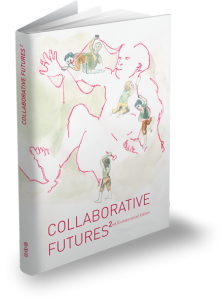
CF_coverThe Collaborative Futures book is back for another edition and is smarter, sharper, and more insightful than ever.

Last spring I was fortunate to become involved in an amazing experiment in composition and collaboration.  A friend and colleague of mine, Mushon Zer-Aviv locked himself up in a hotel room with 4 other collaborators and came out 5 days later with a the first edition of Collaborative Futures. Many conversations and an intensive editing sprint later (with a fresh team of collaborators), yields a much more comprehensive and finished work.

While the original team was in Berlin, I sent Mushon a copy of my essay on the history of version control systems – Versioning Dissonance. In this essay I discuss the significance of the distributed version control phenomenon, and speculate on the crossover of these collaborative modalities from software to other forms of production. An excerpt from my essay underlies the chapter on Multiplicity and Social Coding.  I didn’t make it out to Germany, nor did I communicate synchronously with the sprinters. 🙁 However, through my friendships and participation in the larger NYC free software/culture,  collective communications campus,  and Eyebeam communities, I was a participant in an ongoing conversation around these important themes.

This book is a really cool accomplishment on multiple levels. It’s creation myth is legendary, the content is compelling, and its a technical triumph. The first edition was admittedly a bit choppy and also neglected to address some critical perspectives that were introduced into the new edition. I am really happy with these substantive improvements, as well as the fabulous new cover art, web site, and distribution formats.

Special thanks to everyone involved in this project for inviting me along for the ride.

Now Playing: Nothing but the whole truth

sword-justice-not-blindI recently learned about a fascinating  trend in litigation that is quietly transforming courtroom testimony, and is spreading fast and far – video depositions.

I talked with a consultant who helps attorneys process video depositions. In the courtroom, attorneys are juxtaposing live testimony with segments from depositions.  Video clips of witnesses reinforcing (or contradicting) themselves are far more powerful than merely reading back the transcript. The courtroom has always been about performance, but these videos have taken this to a new level, as savvy lawyers manipulate appearances and emotions. Increasingly all depositions are being recorded, just as they are transcribed.

Apart from the ways that courtroom proceedings are being transformed, I am also intrigued by the software that is undoubtedly in development to support these operations. In addition to conventional A/V support, working effectively with hundreds of hours of video involves archiving, indexing, distributing, editing, and clipping.  At about a day or two of testimony per witness, and dozens of witnesses per trial, the numbers add up pretty quickly.

As cases accumulate, and multiple associates begin working with and analyzing video, law firms will quickly recognize the desirability of networked, collaborative, video annotation environments.  Some large firms (and their vendors) may have already begun developing solutions. However, the consultant that I spoke with was storing video locally on a laptop hardrive and tracking it with an Access database, so opportunities are knocking. Without a doubt many of the tools that will be highlighted at the upcoming Open Video Conferene (OpenCast, Kaltura, and CCNMTL’s Mediathread come to mind) have overlapping feature and requirements.

Once again the organizational digital divide looms, and I am deeply concerned that only the high end corporate law firms will be able to invest in the competencies and capacities to make this work.  Meanwhile, the impact law firms (along with journalists and social scientists), will be playing catch up, handicapped by this powerful new differential.

I wonder how quickly this practice will spread?

Oyez, Oyez, Oyez!

Next Page
/* reset the net - http://resetthenet.tumblr.com/post/84330794665/the-reset-the-net-splash-screen */