Philosophy

Another New Kind of Science?

Last weekend’s Cultural Studies conference reminded me of a viscous cycle that many humanities-oriented researchers are being subjected to. Disciplines such as educational research, ethnography, anthropology, cultural studies, sociology etc have effectively been colonized by the methodology of the social sciences and they are being forced to play a numbers game which they may not be suited for. Many projects striving for credibility are subjected to the tyranny of statistics - forced to transform their qualitative information (interviews, transcripts, first person accounts) into quantitative information through the process of coding. This reduction forces the data into buckets and creates a significant degree of signal loss, all in the name of a few percentages and pie-charts. Perhaps we have lost sight of the motivation for this reduction - the substantiation of a recognizable, narrative account of a phenomena, supporting an argument. Arguably, the purpose of the number crunching is to provide supporting evidence for a demonstrable narrative. Modern visualization techniques may be able to provide one without all the hassle. True, this is not always the only reason that qualitative is transformed into quantitative data, but advanced visualization techniques may provide a hybrid form that is more palatable to many of the researchers active in this area, and is still a credible methodology. It seems as if many people are being forced into coding and quantification, when they aren’t thrilled to be doing so. But the signal loss that coding is responsible for, all in the name of measuring, might be unnecessary if people think about using data visualization tools, that comprehensibly present the data, in all of its richness and complexity, as opposed to boiling it down to chi-squared confidence levels (and does this false precision actually make any difference? Does a result of 0.44 vs. 0.53 tell significantly different stories?) In a thought provoking post on the future of science, Kelly enumerates many of the ways new computing paradigms and interactive forms of communications might transform science. The device that I am proposing here might lead to some of the outcomes Kelly proposes. For a better idea of the kinds of visualization tools I am imagining, consider some of the visualization work on large email corpora coming out of the M.I.T. media lab, or the history flow tool for analyzing wiki collaborations, but even the humble tag cloud could be adapted for these purposes, as the power of words and visualizing the state of the union demonstrate. Crucially, tools analogous to Plone’s haystack Product (built on top of the free libots auto-classification/summarizer library) might help do for social science research what auto-sequencing techniques have done for biology (when I was a kid, gene sequences needed to be painstakingly discovered “manually”). The law firms that need to process thousands of documents in discovery and the commercial vendors developing the next generation of email clients are already hip to this problem - when will the sciences catch up? For any of this to happen the current academic structure needs to be challenged. The power of journals is already under attack, but professors who already have tenure can take the lead here and pave the road for their students to follow.

Permanent Records

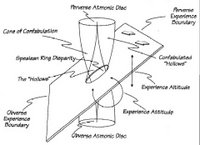
Sonnabend DiagramToday I presented last year’s bioport Part II paper to the 2nd annual Cultural Studies conference at Teachers College. Permanent Records: Personal, Cultural, and Social Implications of Pervasive Omniscient Surveillance I think the distilled version of this model if far more digestible and accessible than the papers. One of my co-panelists is doing some really interesting work with urban youth in the bronx, and gathering incredible interview materials about the perceptions of surveillance by these youth, and their forms of resistance. These stories might help convey the violence of a surveillance society. The conference format was a bit disappointing. I can barely believe academics still read their papers to each other at conferences - there are so many things that Open Source does right, including, knowing how to throw a great conference. Even the variety of presentation formats is an idea that needs to spread - BOFs, lighting talks, presentations and posters all create different spaces and dynamics for interactions between participants. The traditional model is so intimidating that it seems like many people are discouraged from participating. More importantly, the social justice issues and governance models that are being explored by F/OSS projects are really important for the Cultural/Critical studies folks to be considering. It is also shocking how disconnected they are from the freeculture movement, and its theoretical roots. Arguably, the freeculture movement is a shadow struggle, mirroring the struggles for sustainability, and against globalization and the logic of capitalism being conducted in the physical world. But, it may also represent the actual ground on which that struggle is being conducted.

There is no folder

Originally published on theploneblog.org Do not try to bend the folder – that’s impossible. Instead, only try to realize the truth. Then you will see that it is not the folder that bends–it is only yourself. Tagging seems to have spurred a growing amount of research on categories and classification. A recent paper by Clay Shirky, entitled Ontology is Overrated: Categories, Links, and Tags directly challenges the desktop metaphor which currently underlies much of Plone’s UI. To be sure, it is certainly possible to model the connections that Shirky describes using topics, smart folders, and a disciplined use of keywords, but the metaphor is critical for designing and intuitive system, all the way down to the icon. I have recently been working a bit with Drupal, and their handling of this problem is worth checking out.  The core taxonomy module, combined with its corresponding menuing systems (menu, sitemenu, taxonomy menu) provide a great deal of flexibility in this regard. Organization is going organic.

Happy Holidays!

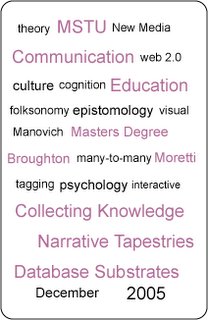
Collecting KnowledgeThe semester is almost over, and that means its time for me to compose some thoughts. As usual, this opens more questions than it answers, but I’m pretty happy about how it turned out. Collecting Knowledge: Narrative Tapestries and Database Substrates “An examination of Web 2.0 using Manovich’s Language of New Media, and an interpretation of folksonomies within the context of the narrative-database dichotomy. This inquiry looks at tagging as a mechanism for constructing narratives from databases, and relates narratives to knowledge construction and representation. Educational curricular activities involving tagging will also be considered.” Special thanks to Prof. John Broughton, John Frankfurt, Michael Preston, and Alexander Sherman for helping me develop these ideas.
"Michael, are you sure you want to do that?"

Pull over Kitt - you’ve just been lapped. On Monday November 14th I attended a presentation by Sebastian Thrun, an AI researcher at Stanford U. whose team recently won the Darpa Grand Challenge. The idea behind the Grand Challenge is to accomplish something that seems impossible, along the lines of crossing the Atlantic, the X-prize, etc. Darpa had previously funded cars that drive themselves, but after numerous failures decided to turn the task into a contest and see how far teams would get in a competitive setting. Last year none of the entrants managed to finish the course, but this year 5 finished, 4 within the alloted time. The difference between last year and this year was primarily improvements in software, not hardware. In fact, once the software has been developed, outfitting a car with the necessary equipment to drive itself (the perceptual apparatus - laser, radar, and video guidance, the gps, the inertial motion systems, the general purpose computing servers, and the fly-by-wire control systems), were estimated by Sebastian to cost the robots are already here (some of them killer)!

Fraternal Nearness

In his post Social agency and the intersection of communities and networks, Ulises Mejias expounds on the differences between communities and networks, and relates these concepts to the possibility of ontological nearness. The placement of communities within this continuum can be understood more clearly by the immediacy, intensity and intimacy of the interactions. This conceptual apparatus is helpful for me to being to explain a phenomena that I have been thinking about for a while now. Part of the question can be though about as: What motivates the open source developer? Why would someone who works full time, often writing code professionally, choose to volunteer their nights and weekends to the continued production of more code? I think this question is an important one for the educational community, since if we could identify this source of motivation, we might be able to “bottle it” and recreate it within the classroom. My experiences with the Plone community has given me some insight into this question, and I think that the phenomena of Open Source projects would benefit from an analysis using the ideas proposed in Mejias’ draft. While many people imagine that open source communities are purely virtual (the non-possibility of a virtual community notwithstanding) , it is important to recognize the ways in which these networks of individual developers become communities. Open Source projects typically use a variety of Social Software tools to communicate - email and mailing lists, web sites, forums, discussion boards, blogs, and irc, to name a few. They also often hold face-to-face conferences, and some projects even regularly arrange sprints (also). Anecdotally, I found it fascinating to observe a progression in intimacy, to the point where some people’s day jobs are just what they do between conferences and sprints. It is no secret that sprints and conferences help make these communities function, cementing interactions over mailing lists and irc. But an interesting comparison that I would like to propose, which I think can also be described according to the dimensions proposed by Schutz, is the similarity between an Open Source community and a college Fraternity. [Disclaimer: I was never in a college fraternity, so this analysis is partially speculative] Fraternities (and I suppose professional guilds and/or unions which they might be related to) are an example of an extended network/community which is disappearing from the modern urban reality. Some people find these kinds of connections in religious congregations, but otherwise many of us have lost the extended networks of people we know, but not intimately or closely. Like fraternities, Open Source projects typically have a steep gender imbalance, members often go by aliases or nicknames, develop internal languages, acronyms, and lore. The “project” or “organization” becomes an independent object of importance that members become loyal to, and devote their time and resources to supporting. Eric Raymond has written a bit on the motivations and structure of the hacker community. I have also heard alternate accounts of developer motivation, beyond status and recognition, that have to do with escape from “reality” and immersion in an environment that the developer completely controls. There are many potent sociological, ethnographic, and anthropological research questions that this touches on, many under active research (e.g. Effective work practices for Free and Open Source Software development, or wikipedia’s research pages). In summary, I think that Mejias’ framework is very useful, but would benefit greatly from more examples which exercise the ideas. Perhaps we can work these categories into our ssa wiki.

slipery handles

Today I leared that a friend of mine changes her IM handle every time she switches jobs. That’s nothing, she changes emails every time a relationship ends. I don’t know why or when she started doing this, but the more I think about it, the more sense it makes.

"Because its your music, and you paid for it"

This afternoon I attended a talk given by Bill Gates at Columbia University. The talk was a part of his university tour, probably prompted by the well documented braindrain happening at MS right now (Certain well known competitors seem to be following the strategy outlined in Good to Great - get the smartest people you can find “on the bus”, and then let them drive…). Here are my raw notes. I must say that this afternoon’s talk was a bizarre experience. Perhaps its all the theory stuff I have been reading lately, but I was in a very psychoanalytic, read between the lines, kind of mood, trying to pay as much attention to what he didn’t say, as to what he did. First, he has clearly taken some lessons from Steve Jobs. He presented casually and demoed live software. One big difference - while Jobs enjoys demoing creative authoring tools, Gates spends most of his time demoing tools of consumption. He continues to treat his gadgets as receivers, not transmitters, and this is all getting a bit tiring. Next, close to all the software contexts he described were business and work related. There was very little talk about socializing or play (save for the xbox, and socializing in that virtual space). It was eerie that when someone asked him what his greatest accomplishments were, he responded how much he loved work (and working at his foundation). All of his examples for the uses of ubiquitous computing were work/consumer related (auto tracking receipts for expense reports, shopping, collecting business cards when traveling, Location info - while in traffic (presumably while commuting)) – this is all summed up with his grand vision of the future smartphone as replacement for wallet. Isn’t there something else the phone could replace? Could our phones become surrogate brains, man’s best friend, or personal assistants? Can’t we conjure up a better metaphor than wallets for how software will change the world? Will it do anything beyond making us better and more efficient shoppers? The talk kept getting weirder - Gates played a video, which most of the audience thought was very funny. I will have to save my analysis for my Media and Cultural Theory class (or the comments), but it really threw me off. Gates never mentioned Google, Firefox, or Linux. Did acknowledge the wikipedia (by name), freebsd, sendmail, and the NSCA browser. He even made two truly surprising statements regarding IP - after demoing that the new XBox 360 will connect to an IPod, an audience member asked if it would be able to play fairplay protected ACC files. Gates responded that it won’t be able to, because Apple won’t let him (Ha!), to which he added “its your music and you paid for it.” He also stated that “studios have gone overboard in protection scheme”, and " will always have free and commercial software." Before the session, they passed around cards with potential questions (I am still not sure if the questioners were plants, reading these cards…). Here were my, never asked questions:

Is anyone watching grandma?

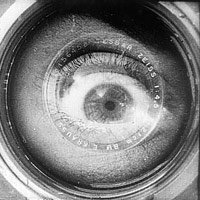
kino eyeOn Friday I had a chance to meet with a group of Artificial Intelligence researchers at Carnegie-Melon university. They demonstrated a working technology, Informedia, which I would have guessed was at least 3-5 years off. What was most incredible about this demonstration was the vivid observation of the trenches in which the information war is being waged. Like any power, technology can bend towards good or evil, and as this post points out, Social Software can be understood as the purposeful use of technology for the public good. The surveillance possibilities that machine based processing of video and film affords is mind-boggling and horrifying (for more on this angle, see my bioport papers or the Permanent Records presentation). At the same time, the kinds of research, machine based assistance, and even the ways in which this kind of technology would change journalism, could all be harnessed for the public good. Is transparency, openness, and free culture our best bet for steering and harnessing these powers productively?