Philosophy

Can you keep a dark secret?

caduceus.jpgThe Alchemist in me feels compelled to respond to the excellent documentary that aired on PBS the other week entitled Newton’s Dark Secret. The film profiled Sir Issac Newton’s fascination with the ancient art/science/craft of Alchemy. Many of the experts interviewed regarded Newton’s Alchemical experiments to be shameful, perhaps reflecting more on our modern epistemic prejudices than on Newton. Contemporary experts seem threatened by the prospect than anybody in historical times understood things about the world that we don’t. Beyond the shame of taking Alchemy seriously, they also considered Newton’s alchemy to be his greatest failure. Failure?!? During the period Newton was practicing alchemy he wrote the Principica Mathematica, and also catapulted his way into the power elite - he became knighted, was appointed the head of the Royal Society, and earned power, prestige and wealth beyond his wildest dreams. To this day one of the most respected chairs in physics still bears his name. From this perspective, his alchemical pursuits seem quite successful. Smashingly successful if you consider this blogs tagline “Aurum nostrum non est aurum vulgi” - Our gold is not ordinary gold. The Alchemists understood metaphor, and it was essential to their theory and practice. Why do most modern thinkers insist upon interpreting the craft so literally? My girlfriend shared a Bahá’í quote on a related subject.
OLPC Field Repair

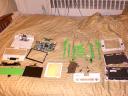
466296547_46b55653ce.jpgAt last month’s incredible Teach Think Play Conference I was fortunate enough to borrow an OLPC laptop from a good friend. As usual, the tangible green machine was a Pop Star (though in this educator crowd, most were not familiar with the project), garnering interest and attention wherever it travels. Sadly, the machine I had borrowed had some serious power issues, and I could not demo Sugar - the linux-based, free operating system developed specifically for the OLPC - to any of the attendees. Since my employer CCNMTL is a participant in the OLPC developer program (thusfar we have only received a raw motherboard, not a complete laptop), I decided to attempt a field repair of the OLPC in the vain hope I might be able to swap boards and get the unit running again. I discovered that the OLPC hardware (at least at this stage) is not quite as easy to disassemble as one would hope - you really need more of a clean room than a Third-World repair shop to work on this model. Still, a few iconic cues directing disassembly, like on a Thinkpad or Apple, would go a long way. Amazingly, there were no moving parts! In any case, I visually documented the disassembly process, but I don’t think I am going to be able to put humpty dumpty back together again any time soon. I guess I owe my friend $100 (well, now $150), since that is the list price of the OLPC.

Teaching, Thinking, and Playing: Day One

Today I attended day 1 of this year’s amazing Cultural Studies conference at Teachers College - Popular Culture in the Classroom: Teach, Think, Play. The morning kicked off with a Keynote by Taylor Mali, a spoken word philosopher-poet who perpetrates lyrical homicide against those who judge others according to their salary instead of the difference people are making in the world. I highly recommend taking a listen to some of his work, as he is working to inspire 1000 new teachers, and is only up to ~160. I presented a hybrid of my SXSW talk, Teaching in the New Vernacular, and Chris Blizzard’s OLPC introduction in a session called: Portable Culture Machines: One Multimedia Studio Per Child (the proposal had been published on OLPCNews). The talk was well attended, and the conference attendees were very excited to see/touch/feel/smell the XO device I borrowed from a friend. Ernest Washington gave a great session on teaching w/ hip hop, but for me the real takeaway was a perspective on education as the “cultivation of emotions” - this talk really connected alot of dots I have been working on lately, especially the “chemical swaddling” conversation I have been having with Philip Dawdy of Furious Seasons. The Media About Youth Consortium, a group print and film journalists (Alissa Quart, Jennifer Dworkin, Maia Szalavitz, Joie Jager-Hyman) spoke about their work and issues they are facing on the publishing front. Jan Jagodzinski gave a fabulous and fun (but substantive and deeply critical )reading of everything from Borat to South Park, and of designer capitalism through the eyes of a Kynic (not to be confused with a cynic). Art Spiegelman, the creative force behind Maus gave a wonderful history of the comic strip (and more generally, the genre of narrative storytelling with text and images) and his wife, Francoise Mouly, the Art editor of the New Yorker, gave back to back talks. Finally, Will Pearson the President of mental_floss (a magazine in the spirit of highlights which entertains while it teaches) closed out the day with a lively talk explaining their history, and why Einstein appears on every cover. And tomorrow’s schedule is jam packed too!

"Wait until pictures start getting indexed."

police_sketch.jpgWell, I called it: In in class I took with Eben Moglen I predicted in a class discussion that pictures on the internet would soon be indexed: Re: video cameras (Feb. 11, 2005) Many people in the class were skeptical… Well, here it is, less than two years later: Face Search Engine Raises Privacy Concerns Of course, there are standard objections to the two primary critiques of surviellance “paranioa”.

  1. If I am not breaking the law, why should I care?
  2. There is so much informatoin being gathered, who could possibly sort through it all?

The responses to these objections should be well rehersed.

Wonderful Things

testtaker_main.jpgMonday night I went to the ITP’s end-of-semester show. A friend of mine is in the program and I went to check out the scene. ITP, the Interactive Telecommunications Program, is part of the Tisch School of the Arts at NYU. ITP has been around since ‘79, and lies somewhere concetually between the MIT Media Lab and Mary Flanagan. When I visited the MIT Media Lab this summer I began to understand how it was really operating as a pooled R & D lab for corporate interests (with plenty of military funding). I got the vibe that ITP is coming from a different place with different priorities, but I don’t really know the full back story. Here are some of the highlights of the many many projects I saw the other night:

Free Laptops

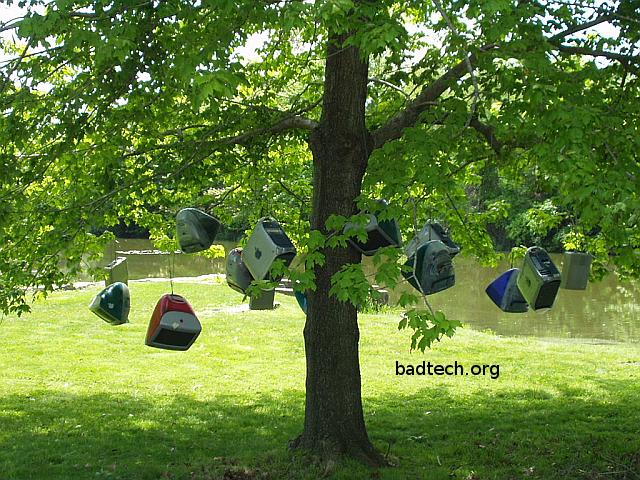
apple treeIn keeping with the Alchemist’s recent “free” disambuguation theme, here is my latest installment on the OLPC project:

Free Laptops: Creating, Producing and Sharing a Revolution

In this essay/story I leave wise ‘ol Plato behind, and tried for a straight up, journalistic take on the project. Except there is no such thing as objectivity in journalism, so in this piece is explicitly infused with subjectivity and ideology. Conversations with Ian Bicking helped convince me that believing in this project is a ultimately a matter of faith, in which case our optimism or cynicism go a long way towards shaping reality. And our perceptions are often shaped by media, so lets start advocating for this project instead of kicking it in the shins.This is one reason I am starting to think that olpcnews should seriously ease up on the project, stop taking cheap swipes and jibes, and start offering more constructive criticism, or even better, apply for some grants so they can fix the project as they see fit. Happy Holidays!

He is the Law

killer_robot.jpgWhile we continue to arm the robots at an alarming rate, the real transition of power and control is far more subtle and insidious. Humanity is ceding power to the machines, but not at gunpoint. Rather, we are relinquishing our will to the machines through the kinds of bureaucratic machinery Max Weber and Terry Gilliam would have a hard time imagining. I am talking about the reification of bureaucracy in the form of software - the rules that we all live by are being carved into stone, or more accurately, etched in silicon. Code == Law? Some industries have already made this transition. From the sympathetic bartenders unable to extend happy hour a moment past 7pm, to the tele-tellers who inform the customer that “the system” will not allow them to exercise any judgment or compassion, some systems are already being governed by the machines. But this is just the start. In the corporate world, IBM is banking on the tight relationship between software and processes. I recently attended a talk presented by their VP of Services, Stu Feldman, and he relayed an anecdote about certain contracts in the financial sector which are no longer governed by legal documents. The final word on maturation and vesting is expressed in a crufty old C program… Considering some of these deals are worth billions, the impact is suddenly more significant than an overpriced cocktail or an unwaied late fee. Judge_Dredd.jpg The starkest example of this trend to date, is the recent announcement by the chinese government that software issue judgments in criminal cases. While they justify this system on the grounds that it will help eliminate the effects of corruption and bribery, reality’s reassemblance to pulp science fiction is growing by the day.
Meet the Robots

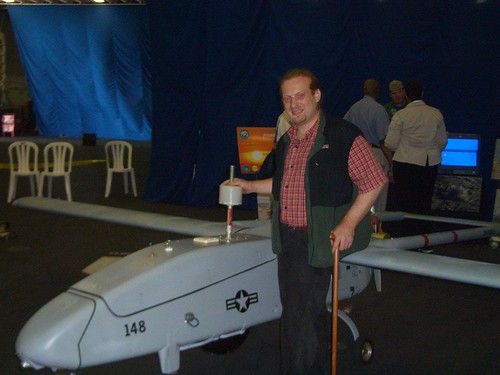
Over Memorial Day weekend I attended Fleet week, and made a few new friends. They happen to be robots, of the autonomous flying variety. These little gadges come in a wide range of sizes, from wasp not much bigger than two hands all the way up to the predator, which is now armed with hellfire missiles. For the time being, these robots are unarmed, but are all equipped with survaillance cameras. This explosion in optical feeds helps explain the urgency behind programs like Carnegie Mellon’s Informedia project (Is Anyone Watching Grandma?). These craft already realize Ender’s Game scenarios, with hs dropouts controling live ammunition in the Iraqi theater of combat from the safety of a bunker in New Mexico. But even without carrying missiles themselves, these robots have become part of the weapons system. A soldier explained to me how the targeting systems for the large guns on the decks of US ships are now wired to the data feeds coming from the remote drones. With the click of a lightpen, what the plane sees is targeted from the ship’s guns, damage assesed and trajectories corrected. Killer robots are a topic I have been thinking about for a while, but it was truly amazing to see these devices in person. In many respects this hardware is identical to the remote control airplanes from the ’50s. The only major new advancement is the software controling them. Here is the model that Bush is planning on deploying to patrol the Mexican border. How long before local law enforcement gets a few of these to play with? How many do they need before the start assigning them to track individual suspects?
Turtle Totems

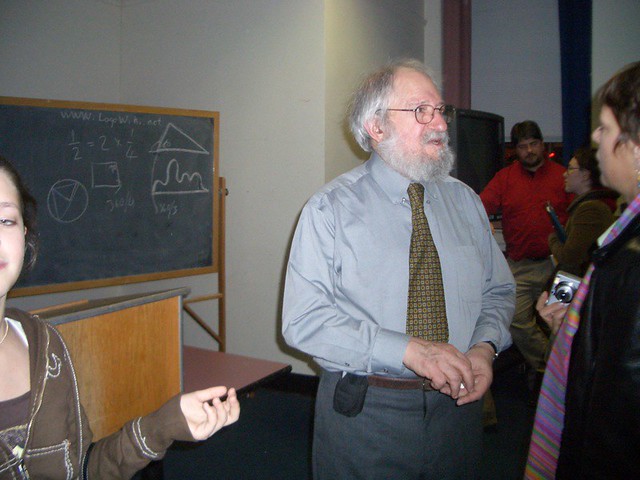
Seymor PapertSeymour Papert , the inventor of Logo, spoke at Teachers College on Monday April 10th. I was lucky enough to hear him talk in a standing-room-only event. My former employer, Idit Caperton studied with Papert, and MaMaMedia incorporated many of the principles he advocated. His ideas, once stated, are remarkably simple and obvious–usually a mark of the good ones. He thinks we are teaching mathematics ass-backwards, and that we ought to introduce it the way it came about in the history of humanity - engineering first. This approach will create and foster the demand for mathematics. Pyramids, navigation, astronomy, all drove the development of mathematics - and robotics and programming can provoke and instigate the need for mathematical abstraction in education. Sounds about right. Interestingly, his experiments have led to anecdotal accounts of a reversal of the gender discrepancy in science/math. He claims with an engineering first approach, girls actually quickly excel beyond the boys, venturing beyond speed and destruction to the mastery of a much wider variety of skills with the systems. He also demonstrated, in 10 minutes flat, how logo can be used to teach 2nd graders the notion of a mathematical theorem (in creating any closed shape, the turtle will rotate through a full 360 degrees - repeat N {fd 10 rt 360/N}) as well as how to introduce calculus (through the idea of the limit). He made the point that once a second grader is arguing – “that’s not a circle, its lots and lots of short lines”, you have already won… If logo has a failing, its that it does not provide the necessary scaffolding for teachers other than Papert to effectively teach with it. I have been exposed to logo in the past, but never really understood its appeal until Seymour started turtling. Interestingly, Logo is far from irrelevant. Mark Shuttleworth’s ClassroomCoders curriculum imagines a logo->squeak->python pipeline for educating the programmers of the future… Seymour is also heavily involved in the $100 laptop project, a project which many consider to be one of the most important educational initiatives currently underway.

soft metamedia?

April 7th I heard Lev Manovich talk at Pratt. I am a big fan of Manovich’s written work, and the Language of New Media was instrumental in my analysis of tagging. Friday night Manovich showed us ideas in progress, and bravely admitted that they were not completely formed. He talked about describing the evolution of media in evolutionary terms. As in, the next logical progression after getting all our media digitized (i.e., simulating physical processes w/in the digital environment) is the breeding and hybridization of the media. He is claiming that some of what we are now seeing in ‘moving graphics’ or ‘design cinema’ is actually a new form of media, distinct from what came before it. And he is interested in identifying the trunks and branches of this media evolution. Plaid Itsu was a film he used as an example of a completely new form. Whereas multimedia was the assembly of multiple forms of media adjacent to each other, metamedia is the combination of these forms into a new unified whole. He pointed out the live action photography, combined with traditional design aesthetics, combined with graphics, etc etc. Not sure I bought it, but it was an interesting assertion. The best question from the audience alluded to a longstanding disconnect between media and communication theorists. Manovich is looking exclusively at the end product of the media being created, and not examining the cultural and social conditions that lead to its creation. There may be mileage from this rarefied approach, as some patterns are discernible, but it does seem to be lacking the depth to explain the creative dynamics and underlying motivations. After the talk, I began to this relate his line of reasoning to Arthur Young’s theory of process: The Theory of Evolutionary Process as a Unifying Paradigm Theory of Process Poster (too bad this isn’t really visible online) Which I first became exposed to through the work of the Meru Foundation: letter matrix It seems to me that the evolutionary forces that Manovich is documenting conform to the trans-disciplinary evolutionary process that Young articulated. For what its worth, the hybridization of media that Manovich claims we failed to predict, was foretold back in this book on the MIT Media Lab, published in 1988.