Music

I <3 compliance!

I <3 compliance!

Onkyo CompliesLast month I bought an amazing gadget that is easily my most favorite of the decade. Before last month, I was barely aware this product category existed until I browsed the “Home Audio” section at PC Richards while looking for a replacement vacuum cleaner. I noticed that many of the receivers had ethernet jacks and also supported wi-fi, bluetooth, hdmi and USB. They boasted compatibility with internet audio streaming services, home media libraries, as well as any bluetooth-enabled media collection. Brought to all of us thanks to Free and Open Source Software. The Onkyo TX-NR626 looks almost identical to a stereo receiver you could have bought from Onkyo in the 80s and 90s. In fact, the chases is the same, save for a few extra buttons, and the form factors of the inputs/outputs in the back. A 95W per channel, supporting 7.2 channels, this sucker packs a meaner punch than my UWS apartment (or, more accurately, my neighbors) can stomach. But don’t let it’s outer shell fool you. But, the guts of this gadget have been updated for the 21st century, with flair.

Audio experiments and the rise of Scuttlebutt

Audio experiments and the rise of Scuttlebutt

by Jonah Bossewitch and Rob Garfield

ouroboros_Michael_Maier_Atalanta_Fugiens_Emblem_14While chipping away at my dissertation this summer I found myself faced with the daunting task of transcribing about a dozen hours of video. I desperately wanted to believe that, in 2014, transcription was a machine’s task, so I took a minor detour through the state of the (consumer) art in voice recognition.  One of my computers runs OSX which includes Dictation (since Mavericks), the same voice recognition software that powers Siri. Following these instructions I used the Soundflower kernel extensions to send the audio output from Audacity into Dictation’s input. Dictation did such an awful job understanding my video that I actually found it easier to transcribe the videos manually rather than edit Dictation’s vomit. I found some decent software called ExpressScribe to assist in the manual transcription.  ExpressScribe makes it easy to control the playback speed, and can be configured to play a segment, automatically pause, and then rewind the video to moments before it paused.  The pro version can be rigged up to foot petal controls, but I was able to do my transcription using the crippleware. This summer I visited my friend Rob’s country house, affectionately dubbed Snowbound and located on the transcendental Baptist Pond, NH. Rob was gracious enough to invite me up for a writing retreat, though we managed to fit in some canoeing, hiking, cooking and drinking. We also gave birth to one of the most creative constructive procrastinations of my dissertation*—Scuttlebutt. After all that time playing with transcription tools we began to wonder if OSX could understand itself.  For years, OSX has been able to turn text to speech, and even ships with dozens of voices, with names like Vicky and Alex.  What would happen if we fed OSX’s text-to-speech into it’s own Dictation software? Dealing-with-Workplace-Gossip6Originally we thought Scuttlebutt might analogize and highlight the way that we humans misunderstand, mishear and misremember, in particular, the lightning quick messages that we receive on a daily basis through personal interaction, social media and email—*often deeply changing the message, generalizing it, and recontextualizing it.  Although voice recognition software begs us to “train” it, we thought we might have better results interacting with its infant state. We needed a reliable benchmark and settled on the first chapter of Genesis. We were curious if the voice recognition software would improve, with successive iterations of feeding it it’s own output back to itself using text-to-voice. There was one way to find out.

too sexy for my phone

too sexy for my phone

bling_bejeweled_cell_phone_kandee_fashion_weekThe other week I thought I lost my phone and I visited a local Best Buy to find out what a temporary substitute would cost me.  I asked the salesperson for the dumbest phone they had, and was struck by its feature/price ratio. Thankfully, my phone turned up, but I was reminded of the power of Moore and his law. The phone I looked at was a BLU Tank, which you can find online for ~$25 (it retails for $32.99) . This phone is so dumb that it has an FM Radio, can capture images, audio, and video, has 2 sim card slots, and a replaceable battery. There is no built-in browser, but it does comes with facebook and twitter apps. It even comes in different colors! Not only would this phone make fabulous burner, but it really got me thinking. Imagine if you wrapped that phone in metal - aluminum, silver, gold?  You could probably sell it for twice the price. Easy. What about a wood case - maple, oak, teak?  Double again? But, if you really wanted to make some serious money you would have to put the right initials on there.  Maybe G for Gucci, or LV for Louise Vuitton? It really hit home that as tech becomes ubiquitous, it’s becoming fashion. Products like Google Glass are starting to make this more obvious, but companies like Crated are taking this a step further by designing unobtrusive, intelligent wearables as well as focusing on improvements to the manufacturing process. If only we could figure out how to tap the vanity of the 1% and redirect wealth back to the rest of us.

Pick a world... any world...

abandon_despairLast week I attended the second half of the US Social Forum - not exactly a conference, but more of a convergence or a process, where 20,000 people gathered in Detroit to build coalitions, alliances, and movements. The World Social Forum began as a response to the World Economic Forum - Why should the power elite be the only ones planning humanity’s future?!? The USSF web site and the People’s Media Center (made possible by some righteous radical techies, the Design Action Collective, riseup.net, and May First/People Link) should give you a flavor of what the event was all about. But, be aware that the streaming video and social media barely scratches the surface of the experience. The forum is organized around 2-hour long workshops, and over 100, 4-hour long People’s Movement Assembly’s.  The sessions were in depth and quite intensive. The format is designed to encourage small group interactions and for people to connect and get to know each other. The assemblies were geared around crafting resolutions and actions - I attended parts of the transformative justice and healing PMA, and it was really well facilitated. During the closing ceremony the assemblies synthesized their resolutions, scheduled actions, and asked for commitments of solidarity around their issues.  I don’t think that this forum represents the Left’s answer to the Tea Party, but I did gain a much better appreciation for the scope of issues comprising The Agenda(s). And, considering that anyone passionate about an issue was welcome to participate, the assemblies offered an authentic glimpse into everyone’s priorities. It felt like a determined effort to take things into account, and put them in order. Here are some of the resolutions that emerged from the Progressive Techie Congress Principles and the Transformative Justice and Healing assembly. Collective Liberation and Radical Mental Health The main draw for me to the conference were the Icarus Project workshops and the convergence of Icaristas, in person. We took over and transformed a house in a Detroit suburb, and mad dreaming and plotting ensued. The place was quickly transformed into a safe space for people to brilliantly  navigate the madness of the forums, and it was quite amazing to spend quality time, face to face, with friends and allies. I gravitated to the heath tracks, taking up issue of self-care, mutual aid, and wellness.  I also caught some great music, ate some amazing homemade food (and not bombs), visited some incredible collective living spaces, and was pretty inspired by everyone who cared and showed up. This Icarus workshop I attended (there was another that I missed, plus a screening of Crooked Beauty) was eagerly anticipated and well attended - the participants were open and receptive to the core messages, and there was a palpable desire to embrace these issues locally. The session leaders shared their personal stories and modeled peer-support as we broke into groups (photos, highlight reel to be posted shortly). People shared details of their individual and organizational neuro-diversity and how dysfunctional feedback loops undermine many organizing efforts. The relationship between personal and collective liberation emerged from the workshop and will travel far beyond Detroit’s (shrinking) city limits. Detroit is pretty beat up - we stayed two blocks away from a refinery that belched flames into the night sky - but there are some wonderful people and projects that were really cool to experience. It’s also the only city I have ever been to that has a monument to organized labor. If I can’t dance, I don’t want to be part of your revolution - Emma Goldman, Radical Feminist
Crowded Wisdom

This week I saw a presentation given by a member of the Yahoo!/Berkeley research team. At the talk, Dr. Naaman demoed this unassuming tool that his group has been working on: TagMaps (live demo, description) I am really glad I went to the talk, since the demo helped me understand how sophisticated this tool really is. I had a definite ah-ha moment learning about all the new flavors of semantic information soon to be mined from the massive amounts of memories we are collectively recording. During the talk I was reminded of this recent essay on Evolution and the Wisdom of the Crowds which explains how counter-intuitive these emergent properties are to our everyday experience. But, this seemingly teleological construction of semantic knowledge naturally emerges from a rich enough system, as the flickr research demonstrates. To clarify what you are looking at here, no humans tuned or trained the system to teach it which are the significant landmarks in these regions. The representation is computed using the aggregate processing of many, many tags. These tags are starting to provide enough information to disambiguate different senses of a word (based on the adjacent tags that are also present). Patterns are also discernible from the spatial-temporal information on these photos, and yearly events (e.g. BYOBW) have been detected and recognized by the system. Formerly unanswerable questions, like “What are the boundaries of the Lower East Side?”, now have a fuzzy answer of a sort, in the form of collective voting. While the UI work here is neat, it pales in comparison to this Jaw-dropping Photosynth demo presented at TED this year (though it does beat the pants of the current UI of pink dots on a map which forces you to paginate over all the matching pictures in batches of 20). The widget is even available as web service which you can feed your own data into. But, the real work here is going on behind the scenes. It’s being published and presented in CS contexts, just in case anyone thought this “social media” stuff was for just for kids. How flickr helps us make sense of the world: context and content in community-contributed media collections There is certainly lots to digest here. It’s one thing for an algorithm to decide on the most representative photographs of the Brooklyn Bridge essentially based on popularity (though its a shame that avat-garde art photos will be automatically marginalized through this technique), but its quite another to imagine other important areas of discourse being regressed to the mean - its an odd sort of leveling effect that is likely another manifestation of Jaron Laniers’ Digital Maoism. The presenter did note that social media designers do need to anticipate feedback effects, as when they launch a new tool and users adjust to the new conditions and modify their behavior accordingly (or begin to “game” the system to take advantage of it). We are a long way from 1960’s AI and its conviction that the world is best modeled and represented as a series of explicit propositions.

Creep-Ola

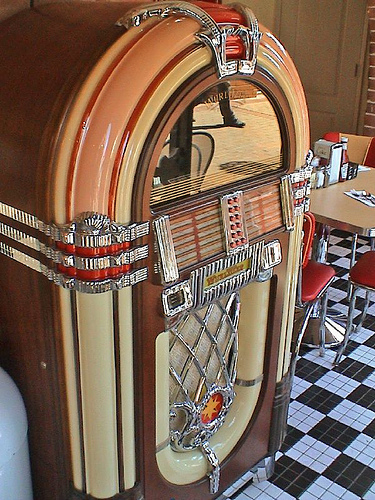
classic_jukebox.jpgLast Saturday night I was at a bar downtown for a friend’s birthday. I decided to pick out a few songs (no, I didn’t use the obnoxious “play now” feature). After selecting my songs, the Rock-Ola internet jukebox asked me if I wanted to take a quiz. It asked me for my gender and age bracket, and then asked me what issue I thought was the most important one in the 2008 presidential elections (I think the choices were the environment, ending the Iraq war, health care, social security, & What Election?). I was mildly surprised that this machine was collecting this kind of data, until I realized that they must be attempting to correlate musical taste with political leanings (they knew the songs I chose). This could come in quite handy when trying to directly target political advertising, or even redistricting. I couldn’t easily figure out who owns Rock-Ola, or where this information is going, but I hope to figure it out soon. The “right” playlist might one day qualify you for suspicious behavior?

Personal Media

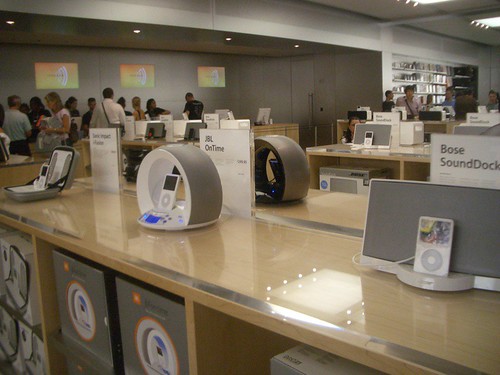
A recent visit to the new 5th avenue Apple store made me realize that the war for the living room console is effectivlely moot. For years manufacturers have been vying to create the hybrid computer/tv, destined for the position formely occupied by the VCR. What I realized was that this compititiion is a bit like the telcom companies fighting over landlines, while everyone else went out and got themselves a cell phone. Portable media players, combined with docking stations mean that I can have my music, movies, games, pictures, etc on my person, at all times. Inconvinient to carry your xbox, ps3, or mac mini in your car, to your office, or to your friends house. It’s all too easy to forget to factor in Moore and his law.

His Master's Voice

I recently read that Guglielmo Marconi envisioned the radio being used primarily for 2-way communications, and Alexandar Graham Bell imagined the telephone being used to broadcast concerts to large audiences. Whether or not this is true, it’s interesting to wonder if the inventors of technology are really the best at predicting its eventual usage. Today I attended a focus group organized by the Marconi Society and EPIC which focused on the next generation of scholarly tools, and the future of research and the journal. Most people in the room were completely overwhelmed by the amount of information they were supposed to track, and many thought that better filtering tools would help. People also talked about the real problem of knowledge quality and credibility, and some sort of map for navigating the various layers of information in the world. What I kept hearing in people’s remarks was that people really need spaces, not maps. Researchers need virtual watering holes to gather around. The quest for knowledge is not a search for data, it is arrived at through dialectic. Communities of like minded researches will naturally perform the task of filtering, highlighting, and vetting important information. It will take AI a long long time to accomplish the comparable task with advanced search and filtering portals…. Seems to me like the Marconi Society should consider funding the development of a specialized distribution of a well established CMS, perhaps modeled on drupal’s CivicSpace, or Shuttleworth’s SchoolTool. CivicSpace is basically a drupal bundled and configured with some modules that are geared towards operating an NGO. SchoolTool a Zope3 app designed for operating a small-mid size k12 school. The work might also benefit from considering the social software design patterns we worked on in Ulises’ course this past fall. I also met some really cool people, doing really interesting and socially important work with technology.

"Because its your music, and you paid for it"

This afternoon I attended a talk given by Bill Gates at Columbia University. The talk was a part of his university tour, probably prompted by the well documented braindrain happening at MS right now (Certain well known competitors seem to be following the strategy outlined in Good to Great - get the smartest people you can find “on the bus”, and then let them drive…). Here are my raw notes. I must say that this afternoon’s talk was a bizarre experience. Perhaps its all the theory stuff I have been reading lately, but I was in a very psychoanalytic, read between the lines, kind of mood, trying to pay as much attention to what he didn’t say, as to what he did. First, he has clearly taken some lessons from Steve Jobs. He presented casually and demoed live software. One big difference - while Jobs enjoys demoing creative authoring tools, Gates spends most of his time demoing tools of consumption. He continues to treat his gadgets as receivers, not transmitters, and this is all getting a bit tiring. Next, close to all the software contexts he described were business and work related. There was very little talk about socializing or play (save for the xbox, and socializing in that virtual space). It was eerie that when someone asked him what his greatest accomplishments were, he responded how much he loved work (and working at his foundation). All of his examples for the uses of ubiquitous computing were work/consumer related (auto tracking receipts for expense reports, shopping, collecting business cards when traveling, Location info - while in traffic (presumably while commuting)) – this is all summed up with his grand vision of the future smartphone as replacement for wallet. Isn’t there something else the phone could replace? Could our phones become surrogate brains, man’s best friend, or personal assistants? Can’t we conjure up a better metaphor than wallets for how software will change the world? Will it do anything beyond making us better and more efficient shoppers? The talk kept getting weirder - Gates played a video, which most of the audience thought was very funny. I will have to save my analysis for my Media and Cultural Theory class (or the comments), but it really threw me off. Gates never mentioned Google, Firefox, or Linux. Did acknowledge the wikipedia (by name), freebsd, sendmail, and the NSCA browser. He even made two truly surprising statements regarding IP - after demoing that the new XBox 360 will connect to an IPod, an audience member asked if it would be able to play fairplay protected ACC files. Gates responded that it won’t be able to, because Apple won’t let him (Ha!), to which he added “its your music and you paid for it.” He also stated that “studios have gone overboard in protection scheme”, and " will always have free and commercial software." Before the session, they passed around cards with potential questions (I am still not sure if the questioners were plants, reading these cards…). Here were my, never asked questions: