Mental-Health

Finally! We've Been Too Patient

Finally! We've Been Too Patient

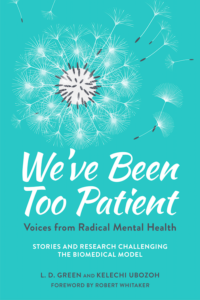
The long-anticipated anthology of mad poems, stories and research is finally out. The book is split between personal mental health narratives and research, a powerfully balanced approach for contending with these issues.

I contributed to two (going on three) chapters of this book - a lightly modified version of the first chapter of my dissertation appears, as well as excerpts from Mindful Occupation, which I helped produce, write and edit.

Pick up a copy at your local bookstore https://www.indiebound.org/book/9781623173616 !

Coding Mental

Coding Mental

Last weekend I traveled to the lovely city of New Haven for a mental health hackathon hosted by Hack Mental Health Care. I was very pleasantly surprised by the experience, which proved interesting, fun and invigorating (with a few healthy dashes of disappointment and horror). I was mostly expecting undergraduate participants with ideas for mood tracking apps, but the event drew over 200 people, and was quite diverse.  In addition to programmers, designers, product folks and business people showed up. Genders were closely balanced and minorities were represented. Crucially, over 30% of the participants had clinical or lived experience. The event also featured a therapy dog, yoga sessions and a guided mediation. Peer voices and ethics were featured in some of the talks, although due to time constraints, project design was complete and implementation was already underway. And, kudos on the Code of Conduct… next year I would also love to see consent-based photography and sponsored childcare. The organizers worked hard to prompt the participants in advance with these challenges:

The Rise of Surveillance Psychiatry and the Mad Underground

This past year I have been working on turning my dissertation into a trade book. I am making steady but slow progress; print remains an important but slooooow media. My concerns around preventative psychiatric diagnosis and treatment motivated and propelled my dissertation, and they form the backdrop of my ethnographic study of the mad movement. My book will engage with these threats more directly and position them alongside the demands of the Mad Underground. The ideas of groups such as the Institute for the Development of Human Arts and NYC Icarus offer us some hope of diffusing the menacing time-bomb of surveillance psychiatry before it explodes. In the past few weeks, a few stories broke and I feel compelled to write about them in the context of my research:

DSM-5 vs. NIMH: kill-shots and social constructs

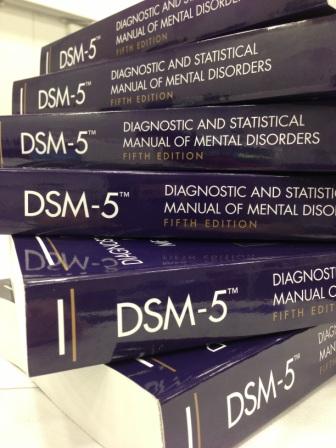
Last month the DSM-5 finally launched at the American Psychiatric Association conference. After 13 years and multiple delays, you can now pre-order your copy at Amazon (list price: $150), or just leave a helpful comment. The DSM-5 had been surrounded by controversy, and not just by the usual suspects. Allen Frances, the chairman of the DSM-IV task force, just published a scathing critique of the processes and outcomes of the DSM-5 efforts: Saving Normal: An Insider’s Revolt Against Out-of-Control Psychiatric Diagnosis, DSM-5, Big Pharma, and the Medicalization of Ordinary Life. Frances has been sounding the alarm about DSM-5 for over a year, raising concerns over the current committee’s secretive methods, conflicts of interest, expansive diagnostic inflation, and the reduction in reliability (the odds of two doctors agreeing on a diagnosis) that DSM-5.  Over 50 Mental Health organizations and almost 15k people signed a petition demanding reform of the DMS-5 drafts. Although this scale of controversy would be scandalous in many fields, the APA barely flinched. The DSM-5 task force moved some of the most troubling diagnoses into the appendix, renamed a few others, skipped a round of efficacy trials to meet their deadline, and otherwise proceeded with business as usual. I have to say my jaw dropped when I learned that the National Institute of Mental Health (NIMH), and it’s $1.5B/year of funding,  was “re-orienting its research away from DSM categories[!]”. The official NIMH announcement, Transforming Diagnosis, posted by their director Thomas Insel on April 29th, was picked up by a wide range of science media (NYTimes, Koplewicz @ The Huffington Post, Chris Lane @ Psychology Today, Psych Central) with headlines such as “NIMH Withdraws Support for DSM-5” and analysis that this was a “kill-shot” for DSM-5. What struck me as most shocking was that the NIMH basically came out and said that the the Mental Illnesses defined in the DSM are social constructs - “the DSM diagnoses are based on a consensus about clusters of clinical symptoms, not any objective laboratory measure.”  Ironically, the anti-psychiatrist’s arguments have prevailed, although for the wrong reasons. As I interpret this statement, NIMH isn’t denying the existence of mental illness, just our current ability to agree on its nature and manifestations. But, yes, the current definitions are social constructs and continue to defy attempts at validity. Ha! But, before anyone gets too excited, what the NIMH proposes may turn out to be scarier than the system in place. This research is representative of the direction that the NIMH is heading: Suicidal behavior is a disease. Here, disorders will be sliced and diced into their constituent elements, which conform more readily to the instruments and models that scientists (neurobiologists and geneticists) already have at their disposal. I’ve been convinced for a while that within the next 5-10 years the Pharma-Industrial complex was going to invest enough research money to find a definitive neuro-imaging/molecular/genetic/biochemical marker for mental illness (that is, once the marker cast a wide enough net).  However, I wasn’t expecting them to turn the tables and redefine mental illness according to what they could already test. Pretty sneaky. The saddest part of this whole debacle is that instead of seizing this moment of crisis as an occasion to bring together disparate stakeholders - from patients, to consumers, to survivors, to advocates, to caregivers across a range of backgrounds - and work together to develop a new language and paradigm for understanding human suffering and emotional crisis, the NIMH has doubled down on scientific authority. Soon they will be short-circuiting all debate by pointing at pretty false-color pictures and lab results. There will always be a value judgement when evaluating the boundaries of normal experience/behavior, and no scientific instrument will ever be able to tell us when someone’s experience/behavior is deviant, without human interpretation. As the disability right’s movement says: Nothing about us, without us. Somehow, for all of the NIMH’s noble intentions, I have a bad feeling that the treatment side of mental health care is poised to become more oppressive. We’ll likely continue to see the growth of anti-psychotics for everyone, and the pre-cog, pathologizing of risk through predictive and preventative care that will explosively expand the diagnostic reach. This conversation just took a sharp turn past the rhetoric of the last few decades. I hope the psychiatric resistance is following along closely, and updating their arguments accordingly.

Quetzalcoatl and Back Again

It’s nice to be on the spring side of the winter solstice. Farewell, Apocalypse. Nice try. What a year. In 2012 I occupied — Wall Street, Mental Health, the American Psychiatric Association, and my dissertation. I catalyzed the production and distribution of Mindful Occupation, and helped organize the Icarus Project’s NYC 10 year anniversary event and art show.  And, I was privileged to visit the great Mediterranean capitals — Cairo, Istanbul, Athens, Jerusalem, and Ramallah. All while holding down a full-time job. Some were not concerned that the world would end on 12/21, but instead, were horrified at the prospect that humanity will continue hurdling forward, business as usual. As many on our planet yearn for unity and the Most Great Peace, and there are hints we might be learning to direct, harness, and measure our collective intentions. But, as mystics have long understood, our collective choices will decide if we converge on a global state of war or peace. All of my travels this year were transformative and intense, but my October trip to the West Bank was really the culmination of my hero’s journeys. I travelled there for the final stage of the project we began 2 years ago, trying to help Palestinian educators develop their capacity to improve their teaching excellence (Towards the (educational) liberation of Palestine, Dispatches from Cairo: The Raw Data, If I forget you, O Palestine…). I travelled with my friend and colleague, Mark Phillipson.  Together we delivered a keynote speech at the Palestine Technical University — Kadoorie, in TulKarm, and taught workshops on cutting edge, video-based, teacher training and assessment techniques.  The PTUK team officially opened the Multimedia and Educational Resources Center (MERC), and were raring to go. The MERC center is an impressive accomplishment, but I also experienced great sadness and disappointment at the unsustainability of the development grant. Just as we were finally getting some traction, the funding was finished.  I understood that unsustainability is a common failure of projects like this, but the firsthand experience felt worse than any theoretical critique. My boss/advisor/mentor, Frank Moretti, was unable to make the trip this Fall, but recorded a video introduction to our keynote that set the stage for the rest of my trip. The introduction started out cordial and friendly, but 3/4 of the way through, Frank lobbed a handgranade was starker and sterner than any Mayan prophesy. He warns that unless educators incorporate the twin themes of environmental catastrophe and nuclear war into every stage of curriculum we are headed for a “collective calamity”: This warning framed the rest of my trip, and the rest of the year. I’m still unpacking the fallout.

scaling inefficiencies

By Stichting Onderzoek Multinationale OndernemingenLast week I attended an amazing reading and film series group that felt more like a graduate seminar than a meetup. Cáfe de Cleyre has been gathering for 3+ hours weekly, for the past 3 months, and exploring the theme of Direct Action in theory and practice. I attended their ninth gathering where the the group explored mental health as direct action. They screened Crooked Beauty and read excerpts of Mindful Occupation and other Icarus Project publications. The topic was organized independently of anyone directly involved with the Mindful Occupation project, and this was a refreshing reminder of the power of media. I learned that the CdC is run by two primary facilitators, who keep the operation running, and each week’s topic is facilitated by two more people who volunteer to run that week’s conversation. The night I joined, over 25 people attended, and I was very impressed with participant’s commitment and the level of discourse. The evening’s discussion was inspirational, but in this post I want to focus on the group’s format. On the surface, Cafe de Cleyre looks alot like a traditional reading group.  However, as I was reflecting on the organizing involved to bring this many people together—on an ad-hoc basis—I realized that digital communications play a large role in making assemblies like these possible. As I understand, group attendance varies significantly, week to week, as participants join for the discussions they are interested in. In years past, it was possible to organize a reading group around a particular theme, but the ad-hoc, on-demand spontaneity of this series would be much harder to maintain prior to social networking. For sure, it happened, but the internet has greatly facilitated this. I bring up this point in direct relation to the conversations swirling in educational technology around MOOCs (Massive Open Online Courses).  Columbia University is actively experimenting in this area now,  and there are great debates of what MOOCs are, and what, if any, value do they offer.  While access is not an end if of itself, I agree with Anya Kamenetz that, access to knowledge is generally a good thing. To be sure, granting more dominance to already powerful voices threatens diversity, but that is one of the reasons that the evaluation of MOOCs needs to be tempered by genre. Many of the conversations about MOOCs also stress the efficiencies of scaling.   As a programmer, ’efficiency’ is often my euphemism for ’lazy’ (in the best sense), but it is important to point out that scaling isn’t the only way we could decide to leverage technology for learning. I am reminded of another extreme example of this – May First/People link has recently launched a mentored training program called the People of Color Techie Training Program “for activists of color to become professional-level, politically progressive and movement involved technologists”.  May First is using communications technology to connect remotely with geographically dispersed learners, but in just about every sense, they are using technology to scale down - supporting 1-on-1 direct encounters, instead of the mass broadcast of lectures to 180k students. Not all progress is driven by maximizing efficiency, and some of the most interesting educational moments happen at the smallest scales.

Hide your kids

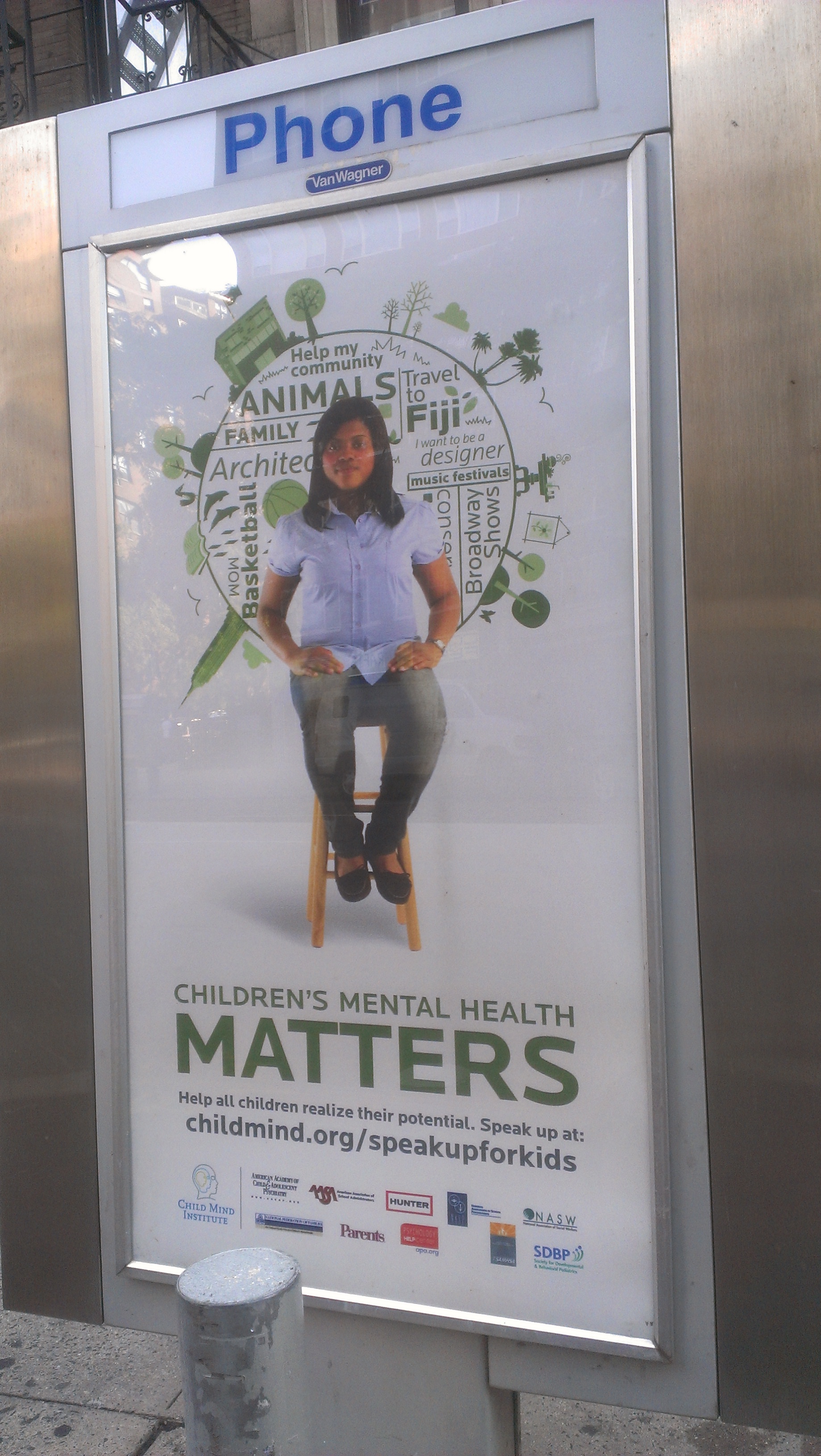
It’s back to school season, and if you’ve glanced up from your smartphone while walking the streets of New York City, you are sure to have noticed a new campaign that is sweeping the city’s billboards and phone booths.

Children’s Mental Health MATTERS

Where Science Meets Hope for Children’s Mental Health

  Who could possibly object to children’s health and well being? The Child Mind Institute, whose “Billboard is now at Penn Station!” is a recently founded non-profit “committed to finding more effective treatments for childhood psychiatric and learning disorders, building the science of healthy brain development, and empowering children and their families with help, hope, and answers.".  According to their website, they don’t accept funding directly from pharmaceutical companies. Anyone want to help me start cross-checking Pharma’s ties to their staff and board? In a gushing profile of the organization and its founder, Dr. Harold Koplewicz, the New York Times reported last summer that they are awash in millions of dollars of funding, have 14 clinicians on staff, and a former editor of the New York magazine is editing their website. Koplewicz is also the go-to doc for helping celebrities and the 1% “manage” their children. The story glosses over Koplewicz’s messy departure from NYU to start the Child Mind Institute. “[Koplewicz’s] main mission in life, he contended, is to remove any stigma from mental illness among children and teenagers, make it merely something to be managed and overcome as it was with dyslexia or attention deficit disorder before it.” In his critique of Marcia Angell’s two-part series in the New York Review of Books on the epidemic of mental illness Koplewicz stakes out his position clearly: “In the meantime, we have patients, in our case children and adolescents, who desperately need help. These children may be out of control, overwhelmed by anxiety, dangerously aggressive, disorganized in their communication, floundering in school. We need to help them. Medications, often along with behavioral therapy, can have a transformative effect.” These are the symptoms that Koplewicz wants concerned parents to be vigilant about patrolling: Child Mind Institute Symptom Checker. To me, Koplewicz reads like a raving megalomaniac, and his devotion and conviction are more frightening than the fictitious evil masterminds he claims are posited by Psychiatry’s critics. I get the sense that he genuinely believes his own spin. He worships at the alter of “objectivity”—“We would like to see objective research catch up with the clinical realities but can’t wait until that happens. Furthermore, falling back on pure non-pharmacological treatment is not the better alternative, since these treatments have rarely undergone objective evaluation."—and the Child Mind Institute is outfitted with “the latest in brain imaging technology”. Koplewicz wields a formidable rhetoric, but is almost a caricature of the scientific realists in the Science Wars. This post raises more questions than it answers. Who is funding the Child Mind Institute? Why now? How can organizations developing compassionate languages to describe mental diversity and difference, like The Icarus Project, respond to these campaigns? What roles do “objectivity” and “risk aversion” have in shaping the dynamics of this controversy? Should anything be stigmatized? UPDATE 4/22/2013: I  tweeted about this ages ago, but realized that the following tidbit never made it into this post. If you visit the wonderful Drug Industry Document Archive and search for ‘Koplewicz’, you will find that he was one of the co-authors on the now infamous Paxil 329 study that cost Glaxo Smith Klein $3 BILLION in settlements in 2012. The Paxil 329 study tried to cover up the finding that not only does Paxil not work in children, but that it makes them more suicidal than a sugar pill did. The Dept of Justice found the study to be misleading and fraudulent.  I am pretty sure that the study was ghost written, but I think that makes his credibility even worse. See also: Bossewitch, Jonah (2011). Pediatric Bipolar and the Media of Madness “Drugs and Media: New Perspectives On Communication Consumption and Consciousness”, eds. MacDougall, R. C., New York : Continuum: 2011 Special thanks to Dyan Neary for helping out on this post.

#OccupyAPA: Mad Power, Mad Pride, Mad Action

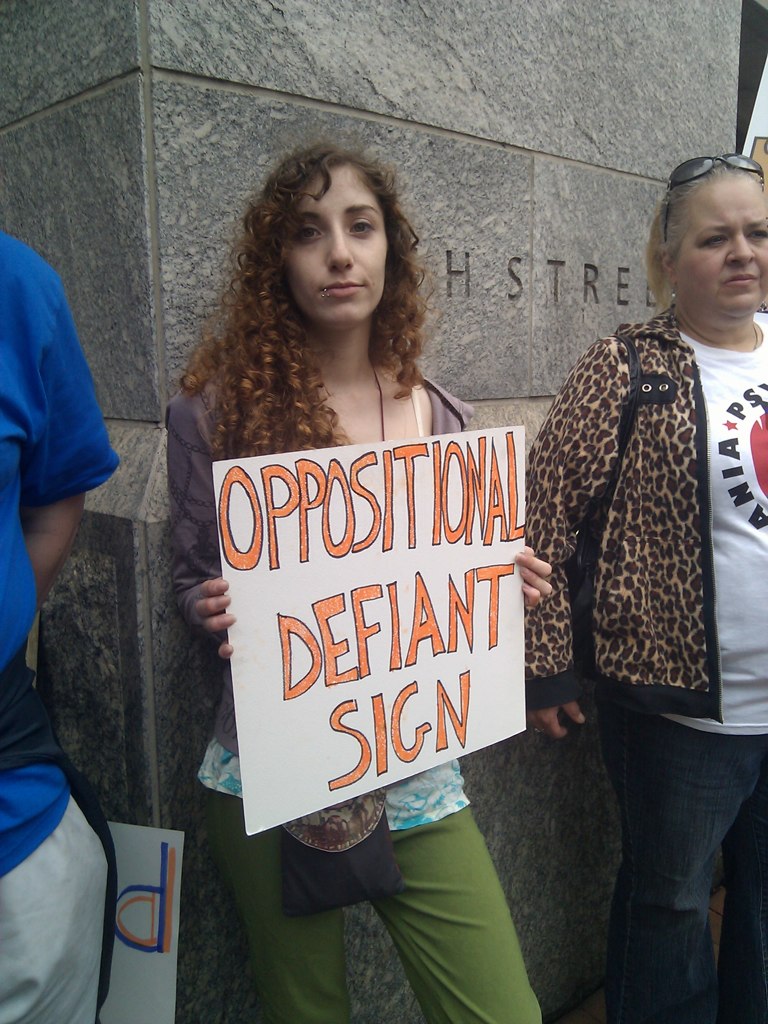
Last weekend I went down to Philly to Occupy the American Psychiatric Association’s yearly conference (#OccupyAPA). I joined the protests on Saturday, attended the APA on Sunday, and participated in the Radical Caucus, hosted by a group of psychiatrists attending the conference on Sunday night. The weekend was overflowing with information and emotion, and I when I finishing unpacking it all I might just have a dissertation (or, at least a fat chapter). This year’s APA was especially controversial since the DSM5 is scheduled to be published in 2013. Over a decade in production, and already delayed more than once, the DSM5 is, in a word, disastrous. Many psychiatrists, including the lead author of DMS-IV, have spoken out vehemently against both the processes and outcomes of DSM5. [CALL TO ACTION: The final round of public comments on DSM5 is now open, until June 15th, 2012.] The controversies around DSM-5 coupled with the energy of Occupy Wall Street, brought activists and the media out in force. The Philadelphia Inquirer ran a front page story on the protests (Former patients protest psychiatric convention), New Scientist covered the protests alongside their DSM coverage (Label jars not people), The Grey Lady covered and opined the DSM disaster (though not the protests), the BBC was filming, NPR was recording, and at least 2 documentary film crews (Cause of Death: Unknown), and a multitude of citizen journalists captured and reported on the actions. Saturday morning kicked off at Quaker Friend’s Center, with a powerful lineup of psychiatric survivors firing up the protesters with speeches, songs, and changes. Hundreds of protestors marched through the streets of Philly to the main convention center, many wearing psychopharmacomania t-shirts, and holding creatively maladjusted signs. The protest culminated in a label rip, staged outside of the main convention center (The Alchemist makes an appearance at 2:25, warning that psychiatry is a threat to itself and to others).: The Icarus Project represented, and we were thrilled to distribute physical copies of the eagerly anticipated Mindful Occupation to protestors, psychiatrists, and the media. The protests were a rush, but for me, the surprise thrill was gaining admission to the APA conference itself on Sunday. I attended a few talks and a poster session, irrefutably detailing and confirming my research and predictions. Then I hit paydirt. The vendor exhibition hall. HOLY FUCK. Highlights included: Future Blockbuster? Anti-psychotic action in 3D: A live psychiatrist, hired by AstraZeneka, delivering their powerpoint presentation (she only squirmed a little when I asked her if this was the drug that killed 3-year old Rebecca Reilly): and devices that only psychiatry can dream up uses for:             The Radical Caucus deserves a follow-up post of of its own. For starters, Brad Lewis’ brilliant breakdown seamlessly applies the hard-fought lessons of academic theory to the trenches of emotionally-loaded, real-life conflict. I have much more to say about this meeting, but first I need to track down who swallowed the comment that I posted in response to Brad’s post ;-). For now, I’ll leave you with a teaser for next year’s APA: “Pursuing Wellness Across the Lifespan” - I guess that covers kids, the elderly, vets, prisoners, pregnant women, and whoever else is ensnared by DSM-5’s diagnostic nets (including the appendix).

Promissory Notes

My friend Dr. Rasmus Nielson sends me the best leads. Or, the worst ones, considering they are irresistible calls to action.  He sent me this one days before it was due, and I scrambled to pull-off this abstract over the weekend. Below is the call for papers, and my response. Now all I need to do is deliver on the promissory note I just wrote sometime in the next 3 months. Thanks Rasmus. ;-)    

Mindful Occupation: Part II

In a previous post, I described my initial involvement with #occupymentalhealth and birth of our forthcoming zine Mindful Occupation: Rising Up Without Burning Out. I alluded to the heated debates that emerged around our work on this  zine and my direct participation in the local NYC ‘Support’ working group. It was through these deliberative processes and exchanges that I rediscovered the promise Occupy’s discursive ‘public space’. As a researcher of the radical mental health movement, I recognized a unique opportunity in Liberty Park to explore the rhetoric around mental health, in context. I was hopeful that the activists involved in supporting the health and safety of the #OWS community would be critical of mainstream corporate medical models, and would be very receptive to alternative perspectives and language. The discussions that ensued were provocative and transformative, and  the experiences have helped me crystallize future directions in my research. As the occupiers settled into Liberty Park the task of self-governance grew in scale, with complexity that rivaled running a small town. Dozens of working groups sprung up to meet the challenge of non-hierarchical, self-governance – many committed to modeling the kind of society they dreamt of living in, rather than replicating existing broken forms. The working groups took responsibility for the protester’s basic human needs - food, shelter, sanitation, safety, spirituality - as well as organizing, maintaining, and sustaining the occupation, over the short/medium/long term. A number of working groups took up the challenge of maintaining the heath and well-being of the protesters, and in New York City these groups  organized themselves into the Safety Cluster. The Safety Cluster included people committed to mediation, non-violent communication, security and deescalation, as well as people committed to anti-oppression and reducing sexual harassment (the Safer Spaces working group). Additionally, there was a working group calling itself ‘Support’ that had been operating as a subgroup of the Medic working group. The Support group was comprised primarily of mental health professionals - social workers, chaplains, psychiatrists, and a few non-traditional emotional support practitioners. Together, the safety cluster developed protocols for handling interpersonal conflicts in the park, and organized nightly “community watch” shifts, where members of the community organized to support protesters, and identify and defuse conflict. While some of my fellow collaborators on the Mindful Occupation zine felt more comfortable working with the Safer Spaces working group, I realized that the best education  happens outside of our comfort zones. Tension and conflict are inherent properties of activism, as activists attempt to question and dislodge accepted norms. Initially, I thought that this particular group of mental health professionals would be very receptive to questioning psychiatry’s mainstream medical models. These individuals were volunteering their time and energy at #OWS.  As it turned out, although I found many sympathizers and allies among the Support group, I was stunned by the systemic efforts to silence and marginalize voices from outside the mainstream. While many of the Support volunteers were fully engaged in critiquing social and economic injustice in the world at large, few seemed prepared to apply a self-reflective critique of their entrenched beliefs and professional norms. Through countless interminable meetings and mailings, I witnessed efforts to exclude the voices of those without formal expertise and training. Voices outside of the mainstream had difficulty getting their issues on the meeting agenda and were actively excluded from some events and conversations. I remained committed to working with the Support group, although I did not always feel welcome. Within the Support group, proposals were raised for the “community watch” volunteers to wear identifying badges which included their profession (e.g. social worker, chaplain, psychiatrist) and license number, and for an active recruitment of more psychiatrists to patrol Liberty park. Some of the medics insisted on “clearing” all of their patients medically, before turning them over to social and emotional support. Sounds reasonable until you begin to question what’s medical, and more importantly, what’s not? A head trauma might be medical, but what about a chemical imbalance? If all conditions are ‘medical’, then all authority around health and well being has been effectively ceded to a narrow range of medical specialists. In subtler ways, i believe that some of the work in this group contributed to an atmosphere of fear and control in the park. Support’s role-plays often focused on the most violent scenarios, invoking the stereotype of the knife-wielding psychotic, and priming those on community watch to bring this anxiety with them throughout their encounters in the park. While the violence and sexual harassment in the park were unfortunately very real, some of the efforts to prevent these behaviors may have exacerbated them. I witnessed that the providers of mental health services, with rare exceptions, found it incredibly difficult to listen to the recipients of their services. To ask and solicit opinions and stories, and incorporate their experience and judgment into the congress of their decision making. I developed fresh insights into radical mental health through these encounters, that opened my eyes to much of what I had grown to take for granted. I learned that radical mental health has less to do with any particular dogmatic position – around hospitalization, medication, coercion, or diagnoses – and everything to do with authority and knowledge production. I learned that it is hard to find a proposition more radical than the disability rights mantra - Nothing about us without us! #OccupyAuthority