Memory

Yottabytes, wormcams and whistleblowers

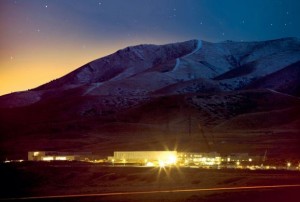
If you haven’t yet heard about the  details of the NSA’s spying program, catch yourself up with the timeline so this post doesn’t sound entirely bonkers. For years I’ve been pondering the scope and implications of what Aram Sinnreich and I call The End of Forgetting, and even prior to Edward Snowden’s revelations, I have recently noticed a few dramatic activations of massive distributed memory banks. In recent months, there have been a few instances where we have literally peered back in time, reconstructing the past based on comprehensive (relevant) records. In the sciences, the collection of records prior to having a specific question is sometimes called “triple-blind”. And, as we know, the dragnet-style collection of records has extended far beyond the lab. If software does one thing well its the collection/storage/retrieval of records; And, software is everywhere. This story about the reconstruction of February’s meteor path based on dashboard-cam footage reassembled inside Google Earth was pretty stunning: Also, was it me, or did the reconstruction of the crowd scenes leading up to the Boston bombings feel a bit like the the distorted phone messages from the past that the Scientists reconstructed in 12 Monkeys??? Mainstream physicists have postulated a viable form of 2-way time travel based on wormholes. In this scenario, one end of a wormhole is accelerated into the future, allowing those in the future to travel back to the point where the wormhole was opened, but crucially, no farther back in the past. The point when this wormhole is created is known as Year Zero. In the past, I have discussed physically travelling through time (Pyramid Schemes), including how critical detailed records of your destination is to plotting flippin’ pinpoint coordinates. But in this post I’m content to explore the metaphor of the Wormcam, a science-fiction device I first saw used in Arthur C. Clarke’s Light of Other Days.  The wormcam is a wormhole that only allows light to travel through it. In this book, wormholes are first able to bridge any two points in space, and soon thereafter, any two points in time. Most people learn to correctly assume that they have at least one wormcam fixed on them all the time. I’m not really big on sharp discontinuities in history, and I’m not particularly fixated on determining when precisely Year Zero fell/will fall. But, its increasingly clear to me that The End of Forgetting signifies the singularity, more-so than AI, Mo-Bio, and Nano-Tech combined. There won’t be a single moment when prior and after people won’t understand each other, but the period we are living through right now has those characteristics. And PRISM is just the start. If you haven’t heard of the British series Black Mirror, stop reading this post right now and go watch  S01E03 The Entire History of You.  Really, that episode alone should lay to rest the question of why someone who doesn’t break the law should care about the End of Forgetting. Of course, the precipice we are standing on does not only provide us with a view of the past. While the past doesn’t determine the future, power is determined to wield the past as a means of stacking the odds. The media is currently preoccupied with data mining, and forensic analysis.  But, the real money is about about turning the wormcams to the future, using predictive behavioral modeling. The NSA  only needs to be 100% correct to stop terrorists, but corporations only need to be a few percentage points better to sell more burgers or prevent your friends from changing mobile carriers, and politicians often only need a few more points to win an election or gerrymander a district. A friend of mine at TC published a paper about predicting who will drop out of high school dropouts by third-grade, based primarily on their grades and absentee records. And, that’s before we turn to  pre-crime or pathologizing risk. In Snowden’s own words, “they can use this system to go back in time and scrutinize every decision you’ve ever made, every friend you’ve ever discussed something with.” (7:33) Just remember, if all that exists is the present, then the past must be as malleable as the future. That is, unless we digitally ossify them :-)

RIP Aaron. You are not alone

The corner of the internet that I hang around in has been mourning all weekend with tributes, eulogies, and heartfelt sharing about the untimely death of Aaron Swartz. I don’t remember meeting Aaron personally, but I have heard him speak, am friends with many of his friends, and was very aware of his work and activism. I am furious and sad to hear that he took his own life. I have lost a few friends and relatives to suicide, and years ago wrestled with some of these demons myself. Honestly, I am not sure how I feel about politicizing this moment. There are strong arguments on both sides. Being persecuted by the state is horribly stressful and isolating, and I also feel strongly about many of issues that Aaron advocated for. But, I am concerned about responses that reduce and simplify Aaron’s complex decision. This post about suicide reporting on the internet raises the concern that sensational reporting causes an increase in suicides in the wake of the coverage. What I want to contribute to this conversation is an important message to any geeks, hackers, or activists that are struggling with isolation, alienation, depression, or even suicidal thoughts. You are not alone. And, sometimes it takes alot of courage to decide to stay alive. For the past 10 years, radical mental health groups like The Icarus Project have been developing support materials for activists that provide alternative ways of thinking and talking about mental health. Take a peek at their forums, publications, podcasts, documentaries, and more. They have really helped so many people rewrite their own narratives, and connect with others struggling with similar emotions. In the past year or two especially, I have seen more and more geeks/hackers who are attempting to organize around these issues, eliminate stigma, and provide peer-support outside of the mainstream psychiatric paradigm. Geeks, hackers, and activists are especially suspicious of authority, and habitually question systems of power.  They are justifiably mistrustful of psychiatry, but need a place to turn to for support. I don’t know the state of all of these projects, but they seem like a good place to pick up the conversation for how can we take better care of each other and provide kind of compassionate support we all need so horrible tragedies like Aaron’s, Ilya’s and countless others can be averted in the future.
Mobility Shifts: teaching & learning w/ video

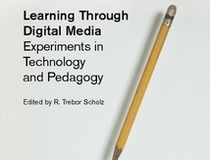
Michael Preston and I have co-authored a chapter— Teaching and Learning with Video Annotations —for the recently released anthology, Learning Through Digital Media: Experiments in Technology and Pedagogy. This chapter recapitulates the history of multimedia annotation projects at CCNMTL, focusing especially on the pedagogies and learning outcomes that have motivated much of my work at CCNMTL work over the years. We discuss curricular activities which have stimulated the development of our VITAL and MediaThread multimedia analysis environments. Learning Through Digital Media was edited by New School Professor Trebor Scholz in preparation for the upcoming Mobility Shifts: An International Future of Learning Summit (Call for Workshops: submissions due by July 1). The peer-reviewed book contains a series of practical applications of digital media to formal and informal learning situations, with a focus on teaching techniques across a range of services and tools. The “ambition of this collection is to discover how to use digital media for learning on campus and off. It offers a rich selection of methodologies, social practices, and hands-on assignments by leading educators who acknowledge the opportunities created by the confluence of mobile technologies, the World Wide Web, film, video games, TV, comics, and software while also acknowledging recurring challenges.” Trebor throws a great conference. Mobility Shifts is part of a bi-annual conference series on Digital Politics.  The conference topic ‘09 was digital labor, and in ‘13 it will be about digital activism. Trebor is truly a performance artist when it comes to organizing conferences. He works really hard to get people talking to each other before the conference starts, so that when people arrive they are already in the middle of a conversation.  For the Internet as Playground and Factory he produced a series of short videos introducing participants to each other (mine is here).  This year he published a peer-reviewed anthology, available in a variety of formats, including hardcopy, PDF, ebook, and web-based. Learning Through Digital Media was published in March 2011 by the Institute of Distributed Creativity under a creative-commons license (CC-BY).

Collaborative Futures, 2nd Ed.

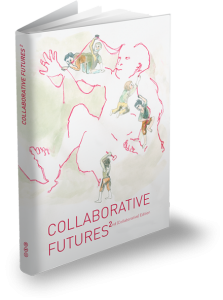
CF_coverThe Collaborative Futures book is back for another edition and is smarter, sharper, and more insightful than ever. Last spring I was fortunate to become involved in an amazing experiment in composition and collaboration.  A friend and colleague of mine, Mushon Zer-Aviv locked himself up in a hotel room with 4 other collaborators and came out 5 days later with a the first edition of Collaborative Futures. Many conversations and an intensive editing sprint later (with a fresh team of collaborators), yields a much more comprehensive and finished work. While the original team was in Berlin, I sent Mushon a copy of my essay on the history of version control systems - Versioning Dissonance. In this essay I discuss the significance of the distributed version control phenomenon, and speculate on the crossover of these collaborative modalities from software to other forms of production. An excerpt from my essay underlies the chapter on Multiplicity and Social Coding.  I didn’t make it out to Germany, nor did I communicate synchronously with the sprinters. :-( However, through my friendships and participation in the larger NYC free software/culture,  collective communications campus,  and Eyebeam communities, I was a participant in an ongoing conversation around these important themes. This book is a really cool accomplishment on multiple levels. It’s creation myth is legendary, the content is compelling, and its a technical triumph. The first edition was admittedly a bit choppy and also neglected to address some critical perspectives that were introduced into the new edition. I am really happy with these substantive improvements, as well as the fabulous new cover art, web site, and distribution formats. Special thanks to everyone involved in this project for inviting me along for the ride.

Two more flakes

6 credits and another season later, I have two more essays to show for the time indentured to my phd program. One of these years I might even save up enough flakes for a snow bank. I had fun with this one, which I wrote for a class on the History of the Theory of Architecture - the assignment was to analyze a piece of architectural theory, so naturally I chose an information architect… Possibility Spaces: Architecture and the Builders of Information Societies This other paper was for my seminar with Michael Schudson on Transparency and Democracy. It packages up some thinking I have been doing for a while on the politics of memory, surveillance, and transparency, and opens up some serious ground for future research. The End of Forgetting: Transparent Identities and Permanent Records Next stop is a week in Vermont - off the grid (honestly, its almost off the map), but am already looking forward to next Spring’s semester, kicking off with this conference on The Changing Dynamics of Public Controversies.

Domestically Spooked

This Fall I am taking a great class on Transparency & Democracy (syllabus) taught by Prof. Michael Schudson. We are talking about the history of the Freedom of Information Act (FOIA), and trying to puzzle out what sorts of cultural forces accounted for an indisputable rise in transparency and openness in American society. We are taking a fascinating journey through the history of social movements in the 60s and 70s and reading about the Free Speech movement, SDS, the feminist movement, the gay liberation movement, and tabloid talk shows. This summer I had also heard a great presentation by Phil Lapsley at the Last HOPE conference on The Hackers View of FOIA. I learned a great deal of practical information about how to properly file a FOIA request, a few fun FOIA hacks (hint: an agency’s FOIA logs are FOIA’able), and about www.getmyfbifile.com (the NSA has their own easy to use FOIA form).  The main value of Get My FBI file are the office addresses it contains. Although requesting your intelligence files may put an end to any of your delusions that you were important enough to have a file about you, I decided to take the plunge. In my case, I imagined I might not have the security clearance to see my own file - I’m one of those “disposable spooks” whose very existence will always be fervently denied. As it turned out, my ego didn’t even get brushed, never mind bruised. The NSA has now officially responded that they can “neither confirm nor deny” any intelligence records. In fact, I think I received a boilerplate response letter, which sure makes it sound like the NSA is engaged in widespread domestic spying. So, judge for yourselves and get involved and support the EFF! The spirit of FOIA wants information to be free - Does the NSA answer to anyone for any of its activities anymore?

A panel of prophets?

psychic Last Thursday I participated in a panel at an event entitled “The Future of Digital Media: Predictions for 2008.” The event was recorded and will soon be posted, but in the meantime here is a page about the event with more details and some pictures. The even was hosted by Ember Media, held at The Armory and featured their CEO Clayton Banks keynoting some predictions for the coming year. The predictions didn’t contain too many shockers (though I have blogged 1.5 years ago here about where I think the set-top box is headed - hint: straight into your pocket, and Clayton’s legislative prediction about a minimum, symmetrical bandwidth goal is something I find hard to imagine in a country where we can’t get network neutrality, municipal wi-fi, or even rural connectivity right). After the keynote, Clayton asked myself and my fellow panellists - Kay Madati, VP of Community Connect, and Alan Stern, Editor CenterNetworks - a series of smart questions. It’s been a little while since I’ve hung out with this many entrepreneurs and it was refreshing. I definitely appreciated the opportunities to discuss privacy, the politics of bandwidth, and economics of sharing and test the theoretical chops I have been sharpening in grad school. Reflecting on the evening, I was a bit frustrated at what seemed like a get-rich-quick entitlement that some of the questions implied. At one point I wanted to shout - 9 out of 10 restaurants in NYC fail - why do you think your digital media company deserves anything different? Micropayments?!? I remember hearing that elusive siren song back in ‘99 at MaMaMedia… and smarter folks than I agree that free is a stable strategy… in fact, when copies are free, you need to sell things which can not be copied. Try concentrating on creating real value in the world, and trust me, the wealth will follow. But, I suppose not all of us have incorporated alchemical wisdom into our daily lives. Thanks to everyone who was involved in organizing this event - it was a great success!

Nostalgia Train

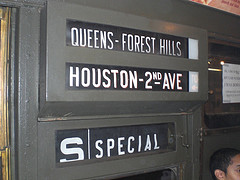
nostalgia_train.jpgYesterday I took a ride on the the S train - not the shuttle, the special. The MTA conducted a vintage run of some 1930s trains this month, including many of the original advertisements and maps. Amazingly, these trains were not replaced until the late 70s… I must have ridden on some of these as a child. I definitely remember the lights flickering on and off and the wicker seats. More pictures here.
Crowded Wisdom

This week I saw a presentation given by a member of the Yahoo!/Berkeley research team. At the talk, Dr. Naaman demoed this unassuming tool that his group has been working on: TagMaps (live demo, description) I am really glad I went to the talk, since the demo helped me understand how sophisticated this tool really is. I had a definite ah-ha moment learning about all the new flavors of semantic information soon to be mined from the massive amounts of memories we are collectively recording. During the talk I was reminded of this recent essay on Evolution and the Wisdom of the Crowds which explains how counter-intuitive these emergent properties are to our everyday experience. But, this seemingly teleological construction of semantic knowledge naturally emerges from a rich enough system, as the flickr research demonstrates. To clarify what you are looking at here, no humans tuned or trained the system to teach it which are the significant landmarks in these regions. The representation is computed using the aggregate processing of many, many tags. These tags are starting to provide enough information to disambiguate different senses of a word (based on the adjacent tags that are also present). Patterns are also discernible from the spatial-temporal information on these photos, and yearly events (e.g. BYOBW) have been detected and recognized by the system. Formerly unanswerable questions, like “What are the boundaries of the Lower East Side?”, now have a fuzzy answer of a sort, in the form of collective voting. While the UI work here is neat, it pales in comparison to this Jaw-dropping Photosynth demo presented at TED this year (though it does beat the pants of the current UI of pink dots on a map which forces you to paginate over all the matching pictures in batches of 20). The widget is even available as web service which you can feed your own data into. But, the real work here is going on behind the scenes. It’s being published and presented in CS contexts, just in case anyone thought this “social media” stuff was for just for kids. How flickr helps us make sense of the world: context and content in community-contributed media collections There is certainly lots to digest here. It’s one thing for an algorithm to decide on the most representative photographs of the Brooklyn Bridge essentially based on popularity (though its a shame that avat-garde art photos will be automatically marginalized through this technique), but its quite another to imagine other important areas of discourse being regressed to the mean - its an odd sort of leveling effect that is likely another manifestation of Jaron Laniers’ Digital Maoism. The presenter did note that social media designers do need to anticipate feedback effects, as when they launch a new tool and users adjust to the new conditions and modify their behavior accordingly (or begin to “game” the system to take advantage of it). We are a long way from 1960’s AI and its conviction that the world is best modeled and represented as a series of explicit propositions.

Second Life Political Rallies?

psychicGiven the Alchemist’s recent trackrecord of predictions, I am going to pass along another prediction that we came up with at lunch the other day. The ‘08 presidential campaign will witness political rallies, and probably counter-protests, inside of second life (for activists who don’t have a first life?) We also wondered if the recent moves to restrict people’s right to assemble publicly in New York City (see Assemble for Rights) might carry over into cyberspace. No more than 50 avatars per server? I’m not sure if even Gonzales would have the gumption to distort our constitutional right to assembly, but like with his recent frightening attack on habeas corpus, the constitution only states that “Congress shall make no law.. abridging the freedom of speech, or of the press; or the right of the people peaceably to assemble,” - so executive orders or judicial rulings might be fair game?