
Free-Culture

O.V. High

Man w/ a Movie Camera Tattoo I have to thank my friend and colleague Clayfox for comparing (positively) the vibe at this weekend’s fabulous Open Video Conference to High School. The optimism, diversity, and composition of the crowd was really inspiring. In some ways, this conference might as well have been called the “Independent Media” conference, but of course, if it was, the right people wouldn’t have attended. Somehow they managed to attract people involved with every layer of the stack needed to create independent media.  Subcultures representing hardware, html5, metadata, content, law, production, funders and more were all represented. To make independent new media, you either need to understand all of these details, or know someone who does.  I don’t think I have ever been in a room with this particular blend of expertise and interests before. The networking was great, and my office was closely involved in making the education stuff at this conference happen (I have a great job). At the conference we announced the liberation of a great piece of software - VITAL is free! Run, VITAL, Run. The highlight of the talks had to be Amy Goodman’s inspiring speech. I had seen her introduce Chomsky last week, and was left a little bummed out by his talk since it was blow after blow of what’s broken in the world, with very little vision, and no call to action. You don’t hear too many female preachers, but Goodman has really mastered an hypnotic cadence - speeding up to fit in alot of ideas, but slowing down for emphasis.  Her soundbytes are eminently tweetable (twitter essentially  replaced irc at this conference, and there was an incredibly active backchannel around the #openvideo tag/frequency/channel). Benkler also opened with fresh material - he has clearly been thinking about journalism in the wake of this year’s collapses (and maybe even our CDPC conference?). It is amusing to think that between Benkler and Moglen (and his metaphorical corollary to Faraday’s law), it might be the sociologically-inclined lawyers who arrive at a theory of creativity (instead of the cognitive scientists).  And Zittrain covered for the missing Clay Shirky, and pulled of a funny and intelligent talk. Many other highlights which I hope to curate once the video is all posted and I have a chance to decompress. I know I should have gone to more talks that I didn’t belong at, but I kept getting pulled in to great conversations… Kudos to the organizers for pulling off a small miracle. I’ve been to many conferences that cost hundreds of dollars to attend, and don’t even offer lunch.  They managed to pull off a beautiful space, food, and even video djs and an open bar. I wonder to what degree freeculture’s networked proximity to techies and lawyers simplifies some of the logistical nightmares that often plague organizers. It just sems like they are able to organize with relative ease, as the communications media and social capital are intuitive and readily available. Good thing for everyone they are using their super-powers for the greater good ;-) In terms of the longer term, they were consciously trying to create something bigger than a one time event. I was impressed at the purposeful scaffolding of the infrastructure meant to sustain this conversation now that conference is over.  Many gatherings only figure out at the event that they want to keep talking afterwards.  THe OVC crew did a great job of setting up, and using a wiki, and some sensibly divided mailing lists to seed a healthy after-party.
Intentional Energy

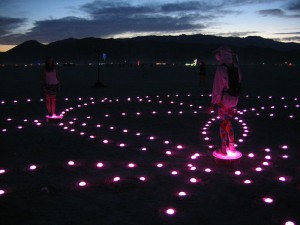
Seed of Life ActivatorThis past weekend I took part in an exciting panel on internet labor at the Left Forum, but the highlight of the weekend was serendipitous. I attended a salon hosted by Reality Sandwich:

Electrical energy is political energy is personal energy is metaphysical energy: A discussion on technological tools and political policy for opportunities of human freedom and evolution.

While I am usually open to edgy ideas, and am quite comfortable entertaining (and sometimes visiting) alternate realities, I certainly wasn’t expecting the treat I encountered. Ryan Wartana orchestrated an amazing experience, successfully interweaving the metaphors of energy and power through the lenses of the physical, personal, political, and metaphysical. Ryan has PhD in chemical engineering and has been researching and working with nanotechnology and batteries for over a decade.  Professionally, he is the CTO for the alternative energy startup iCel Systems and is quite committed to alternative renewable energy solutions. He was on the East Coast participating in conference in DC on Advanced Battery Manufacturing, and swung through NYC to connect with other segments of his network. To give you a sense of the atmosphere, Ryan spoke against the backdrop of a revolving slideshow of sacred geometry (which I have studied also), whose forms and principles have inspired many of his artistic/scientific inquiries and designs. He has worked with researchers growing self-repeating and self-replicating nanostructures, and it soon became clear how inhabiting this domain influenced his thinking. Some large problems can be effectively broken into tiny parts, but it can be difficult to imagine how to practice this w/out radically adjusting our perspective. I left the lecture with a much clearer vision of what an intelligent energy grid, or an “internet of energy” is all about.  Basically, the current energy grid is unidirectional, and on-demand.  It is a centralized distribution system, much like last century’s mass broadcast media. If we distribute a dollop of storage and intelligence to the network, many amazing possibilities emerge. The analogy with integrated circuits was quite provocative - our current grid is like a circuit board w/out any capacitors on it. iCel and companies like them are trying to become the Cisco of the Energy platform, and create integrated energy systems. So, individuals could draw power when its inexpensive (at night) and produce power and return it to the grid, or even to their peers - bittorrent style. The power of distributed networks to improve redundancy and resilience, and reclaim lost bandwidth and capacity is well known in information technology and network theory. Google has even been distributing their physical power storage in their servers. But the possibilities Ryan illuminated intuitively clicked for me - and I trusted his vision, even though he is in the battery business ;-) These distributed energy systems are vital, and starting to happen. I wondered about connections with the electric car venture - Beter Place. Their system is immensely promising, but riddled with uncertainty. Will their hardware interoperate with other power providers, or will people be locked in? Will their customers be better off relying on a centralized transportation provider, instead of remaining independent and relatively autonomous?  What there be provisions to mitigate the surveillance threats their network poses?  When you mash good batteries up with Better Place (with a bit of peer-to-peer pressure), many of these problems melt away. We also talked alot about the importance of energy awareness, giving way to energy responsibility, leading to energy intentionality.  These ideas actually had alot to do with my presentation at the Left Forum, which are hinted at in my take on Free Energy. The talk left me invigorated and hopeful. NYU’s ITP has had some great projects on energy awareness, and there is even a prof at Columbia who wants to rig up a dorm with energy monitoring.  And, some of our work at CCNMTL with the Earth Institute and the Millenium Villages might benefit from these insights and connections as well. I attended the Reality Sandwich event hoping that a dose of creative consciousness expansion would offset the heaviness of struggle at the Left Forum. What a refreshing contrast to feeling trapped inside an inescapable system. We can imagine our way free.

Mobile Student Labor

students-on-edge-of-lowAt the beginning of the semester I shopped a class offered in the Columbia CS Dept on mobile computing.  Sadly, I didn’t have time to take the class this semester, but I suppose I can follow along Standford’s version free of charge. Prof. Nieh was personable, animated, and bright, but the first day of class made me realize the impact CCNMTL has had on me. I doubt I would have made these observations/connections as an undergrad. First, I was a bit sad that the curriculum did not include even a spoonful of social/cultural context.  The only books on the reading list were SDKs. A little Rhiengold, Shirky, or Zittrain, judiciously applied, could go a long way. Second, Nieh announced that the entire semester would be organized around projects. That’s a great way to learn, but he also imagined a competition, with the possibility of a venture capitalist evaluating the projects at the end of the semester. Now, although I am presenting at the Left Forum this weekend, I have nothing against turning a profit (after all, I’m an Alchemist).  But, would it really be too heavy handed to require that students at the university organize their production around the Public Good (and maybe become mobily active)?  What about the needs of the university?  Or even, an Open Source project? 60-80 Columbia CS students (w/ some Masters students) - that’s alot of creative labor power.  And, there is a dire need for applications like this, around the world, and across campus (SIPA, The Earth Institute, Teachers College, the J-School, the libraries are all groups on campus that are investigating mobile apps). Even if students are required to create something for the public good, at least giving them that option might expose them to a possibility they hadn’t considered. To Prof. Nieh’s credit, he invited me to submit an application idea to the class forum, though I am not sure if any of the students actually followed up on these suggestions. As I wrote in my email, while VC’s won’t likely chase the students down to invest in these kinds of apps, they might be surprised by the overlapping technical requirements across sectors. And foundations are definitely very interested in innovations in this area right now too. I am under no delusion that most undergrads could actually complete a useful application in a semester, but a few might. And the opportunity to make a hyper-local useful application (find a book in the library stacks, anyone?) seems promising.  And its getting so easy.

Herding Anarchists

Anarchy in the UKThere is a fascinating culture emerging around distributed version control systems (DVCS), facilitated by software, but responding to (and suggesting) shifts in collaboration styles. It is very easy to imagine these practices percolating through other areas of information production. I am still a bit new to distributed versioning, but a primary difference between distributed versioning and traditional centralized versioning is how easy/hard it is for an outsider to contribute ideas/expressions/work back to the project. Part of what makes this all work smoothly are very good tools to help merge disparate branches of work - it sounds chaotic and unmanageable, but so did concurrent version control when it first became popular (that is, allowing multiple people to check out the same file at the same time, instead of locking it for others while one person was working on it). This post, Sharing Code, for What its Worth, does a great job explaining some of the advantages of distributed version control systems. Sometimes you just want to share/publish your work, not start a social movement. Sometimes you want to contribute back to a project w/out going through masonic hazing rituals. DVCS facilitates these interactions, far more easily than traditional centralized/hierarchical version control systems. Wikipedia runs on a centralized version control system, but the Linux Kernel is developed on DVCS (as Linus Trovalds explains/insists himself here). We are just starting to use github at work, and I have watched it increase the joy of sharing - reducing the disciplined overhead of perfecting software for an imagined speculative use and coordinating networks of trusted contributors. The practice really emphasizes the efficient laziness of agile programming, and helps you concentrate on what you need now, not what you think you might need later. In some ways, this style of collaboration is more free-loving than an anonymously editable wiki, since all versions of the code can simultaneously exist - almost in a state of superposition. However, there is a hidden accumulation of technical debt that accrues the longer you put of combining different branches of work. And, sometimes you may actually want to start a community or social movement around your software, which is still possible, but is now decoupled and needs to be managed carefully. I think we can start to see hints of this approach breaking free from the software development world in this recent piece of intention-ware described in Crowdsourcing the Filter.  (I met some of the Ushahidi team earlier this year -  -and was impressed by how competent and grounded they seemed - tempering both the hype and nostalgia). As Benkler has argued, ranking and filtering is itself just another information good, and amenable to peer production, but the best ways of organizing and coordinating - distributing and then reassebling - this production, still need to be worked out.

The Tweets of War

The current tragedy unfolding in the Middle East right now deserves a more powerful and direct response than I am prepared to deliver. The media coverage is very difficult to sift through and judge, as the reporting has been marinated in propaganda campaigns more sophisticated than anything I have personally experienced. Many people I talk to seem to be unwittingly “on message”, faithfully echoing the sound bites they have been fed on a steady basis. I am connected to people with very deep convictions about this issue. I know this is a divisive wedge issue, but I am not sure how many social networks contain the extremes it feels like mine does. I have not found it productive to weigh in on the questions of morality and entitlement, but I have come across a few pieces that I think do a good job discussing the long term strategic stakes, from a more detached and rational perspective. I feel like I can more successfully engage staunch supporters of Israel by challenging the long term wisdom of these attacks, not their justification. Proportionality And Terror Even Israeli newspapers and human rights groups are far more nuanced, vocal and divided than the homogenized dichotomy I am subjected to in the US. At times like these, I also return to read the wise Kabbalistic reflections of the Meru Foundation’s Stan Tenen and his series Making Peace with Geometry (and the recent How Mother Nature Keeps the Peace). Meanwhile, this is all occurring in an environment awash in participatory media, and I am trying to track the online tactics emerging around this showdown. This is a decent run-down on the cyber-debate the gaza conflict has precipitated. However, beyond the viral video games (newsgaming as the new political cartoon? Raid Gaza!), facebook status updates (qussam count, support gaza), interactive visual propoganda, and virtual protests (which I predicted last year), there is something different happening that is really worth noting. Computer users are installing software on their computers to donate their computing power to attacking the opposing side’s infrastructure. Conceptually, this is a bit like donating your computer cycles to search for aliens with Seti@Home, except for destructive purposes. Technically, you are installing a trojan on your own computer, so that it can be taken over on demand to join a botnet army of other zombie computers and launch a Denial of Service attack.  (And, there really is no way to verify the actions or intensions of these combatants. For all we know, the russian mafia might be working both sides of the conflict to capture credit card numbers.) Denial of Service attacks are pretty serious. If the infrastructure you are attacking runs mission critical services, like hospitals, airports, traffic lights, or whatever, suddenly you might actually be participating directly in the destruction, not just debating about it. It’s scary and important to recognize the dark side of collaboration - the side that leads to lynchings and mob justice.  I have to wonder whether the constant visceral immersion in this carnage has anything to do with its spillover beyond the Mediterranean - NYC police officers have even been injured in this conflict. Imagine. Update (11/28/09): I have learned that the World Flag image I used in this post was created by the world flag project “to raise awareness and funding for non-profits and individuals working in the areas of education, world health, human rights, and the environment.”  I had chosen this flag since during these internet campaigns it is common for people to declare their allegiance to one side or another with a national flag, but I was unaware there was an organized project behind this fabulous image.

Hot off the Collaborative Digital Press

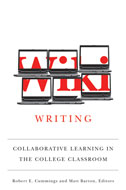
At long last! Wiki Writing: Collaborative Learning in the College Classroom has finally been published. An anthology of peer-reviewed essays on teaching and learning with wikis, the first two chapters in the book are written by myself, my coworkers, and my friends.  Mark Phillipson contributed “Wikis in the Classroom: A Taxonomy,” and Myself, John Frankfurt, and Alex Gail Shermansong teamed up with Professor Robin Kelley, our faculty partner on the Social Justice Wiki, to write “Wiki Justice, Social Ergonomics, and Ethical Collaborations.” Over 3 years since the Call For Papers, and a long and arduous review process, the hard copy of this book is now available for purchase from the University of Michigan Press and at Amazon, and will soon be available to explore free of charge at the Digital Culture Books website. It think they may have grown the trees before killing them for the paper. The half-life of the subject matter certainly warranted a more rapid turnaround, but I guess that’s the sound of dying media letting out its last wheeze. I am also disappointed that the hard copy managed to publish the wrong, older version of my diagram. So, for my first erratum, here is the figure that should have been printed: Social Software Value Space. Gripe, gripe, gripe. Actually, I am thrilled this came together, and think the book looks great and will stand the test of time. I’m also happy the digital version of the book will be available for free, though I am not certain the book made it out under a Creative Commons license. A huge thanks to our editors (Robert E. Cummings and Matt Barton, whom I have yet to meet in person) for persevering and making this happen.

The year of the hybrid?

Economies, not cars. Last night I saw Larry Lessig present “Remix: Making Art and Commerce Thrive in the Hybrid Economy” as a part of Evan Korth’s amazing Computers and Society speaker series.  The talk was an improved iteration on the talk I saw him present at Wikimania ‘06, but it was much tighter - concentrated, but not too dense. He included a few new examples and anecdotes, collapsed earlier presentations into compact sub-segments, and has incorporated Benkler’s hybrid economies (articulated in The Wealth of Networks) into the Read-Only->Read/Write->Hybrid progression. It really is a pleasure listening to a world-class orator (he has argued cases in front of the supreme court) deliver an argument, and I was trying to pay attention to his rhetorical style, and the ways he has honed the structure of his argument over time. First, a small bone - For a while, Lessig has been making a bold and provocative assertion that text has become the Latin of our time, and audio and video are the vulgar. Arguments over the correctness of tense aside, I sure wish he would start using the word ‘vernacular’ instead of ‘vulgar’.  ‘Vulgar’ makes the argument sound, well, a bit elitist to me, and when I repeat this claim, I remix it to ‘vernacular’. More important than quibbling over this choice of words I was a little thrown off by the direction that Lessig wants to take IP reform. Last night he spent a bit of time outlining a scheme that hinges on the analytic distinction between professionals and amateurs. I think he may have been trying to appeal to an intuitive sense of fairness, or perhaps pragmatics, over how professional creators work might be protected by IP while amateurs should be free to create w/out regulation or restriction. I thought it was downright odd that in one breath he was persuading us that we live in a hybrid world, and in the next trying to maintain the line between amateurs and professionals.  The line between professionals and amateurs is clearly blurring, as the difficulties in applying shield laws to journalists attests. Nowadays, who exactly is The Press, whose freedoms may never be abridged according to the First Amendment? I am really unclear about the definition of a creative professional in a hybrid economy. Would we need to introduce licenses to certify creative professionals? Even in the example of the baby video with Prince music playing in the background, would the situation change if the mother was making money off of google ad-words aside the video? To me, if you take Benkler’s argument to heart, in a networked world many everyday interactions will be commodified, and favors will turn into transactions. We’ll all become some hybrid of amateur and professional. This doesn’t sound all good to me, as I am not sure I want to live in a world where everything has an exchange value… This paper by Nigel Thrift, Re-inventing invention: new tendencies in capitalist commodification, paints a grimmer picture than Benkler does about the sophisticated ways that knowledge workers are being exploited in the hybrid world we are hurtling towards.

Free Energy Redux

No, this post isn’t about the LHC creating black holes, time machines, or perpetual motion - its an update on my ~2 year old post on Free Energy - where I reflected on what the environmental movement might learn from the free software movement… Looks like environmental labelling, one of the ideas I discussed, is actually starting to happen in the UK: What is your dinner doing to the climate? Synchronously, this week I am reading an excellent treatment of the rise of transparency as a form of (meta)-regulation for my seminar on Transparency and Democracy Democracy by Disclosure: The Rise of Technopopulism Now I finally have the theoretical apparatus to completely obfuscate my ideas ;-) BTW - Happy Software Freedom Day!

The Zen of Life^2

cgon370l.jpgI suppose it was only a matter of time before I experienced something within Second Life that caught my interest. Though I work on and study social software, I haven’t been particularly giddy about metaverses (multiplayer, persistent, 3D immersive environments) for a variety of reasons - perhaps tracing back to the fact that I haven’t really enjoyed playing too many computer games. As a free software developer I have participated in quite a few post-geographic projects where communication is managed quite effictively in 2D. While I recognize the value of ‘presence’ and synchronous communications, I doubted that an avatar added much additional value to a communicative experience. This semester I am personally participating in a digital studio, where we have held some meetings inside Adobe’s Connect, but have found the experience cumbersome, adding little value over irc (or, at least, VOIP + text, like in skype). I usually dread video conferenced meetings, though its sometimes worthwhile to share a browser. At work, we helped set up a Global Classroom for the Earth Institute, which has been receiving rave reviews, but is mostly just a shared video experience (with a few live events). Prior to this week, I have visited second life on a handful of occasions as a guest, but mostly just been reading about it, watching videos, and hovering over other people’s shoulders while they play. All this changed this week, after a chance encounter with a professor, Piet Hut, whose work I encountered years ago as an undergrad. His dialogue with Bas Van Fraassen on The Elements of Reality really helped me crystallize my thinking on a range of philosophical questions, and the perspective explored in this conversation may serve as an effective bridge between ancient and modern metaphysics. Prof. Hut is an astrophysicist at Princeton’s Institute for Advanced Study (which now, more than ever, reminds me of the village) , and he takes phenomenology and mysticism pretty seriously. His interdisciplinary research is really all over the map and I dig his philosophies of science. His writing is usually clear and free of jargon. I have not been keeping up with his work, but when I saw his name on the schedule at the CSSR Neuroscience and Free Will conference, I decided to crash his talk (and I figured there would be coffee and snacks). In his talk he mentioned some of his latest work inside of virtual worlds, including new ways of conceptualizing (scientific) simulations and research. I was quite receptive to this topic, since I have been thinking a whole lot about how Technology is transforming Epistemology, which I have started writing about here, and hope to expand upon at the end of this semester (um… that’s in a few weeks!). His latest project though is another trip entirely - (or, perhaps identical, from the inside-out ;-)). The project, Play As Being is described and tracked on that blog, and is a bit tough to explain in words - you sorta have to try it to understand/believe it. So, I kinda had an enlightening experience inside of SL. I learned about the potentialities of virtual worlds as phenomenological laboratories. While I was there last night I was attentive to my minds restlessness (how weird is it that after 45 minutes I was compelled to stand my avatar up and stretch my “legs”?) and learned a few new RL practices. I brought the lessons back to meatspace today, and was much more mindful of my body and breathing. I’m not on the full 1% time-tax rhythm, but I am working on picking out mnemonic bells so I can introduce a bit more discipline into the flow of my experience. In retrospect, I shouldn’t have been that surprised at the cognitive value of a 3D experience. I mean, I’ve read about The Loci Method in books like The Art of Memory. But the idea of using the environment as a Zen training studio really blew me away. I imagine you really need the right group for the experience to work, but I am quite impressed by this particular purposeful use of this instrument. It took a really good teacher(s), but I have a much better appreciation for effectively using SL as a space to practice mindfulness and contemplate Being. Has anyone else heard of things like this happening w/in SL?

Fabricating Freedom

Originally posted on theploneblog.org Free Software Developers at Work and Play I haven’t posted much here lately, but I have been writing. I recently finished my first semester as a doctoral student in Columbia’s school of journalism and one of the papers I completed draws directly on my experiences in the Plone Community.  A few years ago I remember being struck at how different open source development was from what I (and presumably others) imagined it to be. I kept pitching human interest stories to journalists, ones that might emphasize the playfulness, the sprinting, and the organizational experimentation, but got very few nibbles. So, I finally wrote some of this up myself before it all fades from memory: Fabricating Freedom: Free Software Developers at Work and Play The paper was for a wonderful class this semester at the New School taught by Paolo Carpignano (The Political Economy of Media - here is the syllabus). The class was all about the shifting relations between fabrication and communication, or more colloquially, work and play. We opened with Marx and Hannah Arendt and closed with Yochai Benkler and danah boyd. The piece I wrote is personal and anecdotal, but reflects on all that our community has taught me about free software, free culture, organizing, consensus building and the day to day politics of software development. enjoy.