 Last week I reflected on the Everyblock.com acquisition. Since then, Knight’s journalism program director has blogged about their perspective on the sale, and some great conversations have continued. I have also had a wonderful opportunity to discuss the purchase with Christopher Mackie, a program officer at the Mellon Foundation. Chris is the Associate Program Officer in the Research in Information Technology program and is closely involved in Mellon-funded software initiatives.
Here are some excerpts from our conversation:
JB: Thanks so much for taking the time to share some of your thoughts on the recent purchase of Everyblock. As you know, Everyblock is a foundation sponsored, open-source journalism startup that was recently acquired by msnbc.com. Even though the Knight Foundation mandated that all the software they funded was released under an open (GPLv3) license, the future openness of this application is now uncertain. As an important funder of many valuable open source software projects I am wondering if you could share your reactions to this news? How do you feel about the outcome? Did the deal take you by surprise?
CM: Hi Jonah – good to talk with you! Before we start, let me be clear about a couple of things. First, I don’t speak for the Mellon Foundation on this, so all I can share are my own views. Second, I’m by no means the most knowledgeable person around when it comes to intellectual property issues. In fact, I can find several people who know more than I do without even leaving the building at Mellon. What I do have is a particular perspective on IP issues that has been developed in large part from my work with our information technology program. I hope that my perspective is useful, but I wouldn’t want anyone confusing it with either an official Mellon perspective or some sort of consensus view among experts. As far as I can tell, consensus only exists among IP experts on issues that no one cares about.
That said, as I follow the conversation, what appears to be happening with Everyblock is that a number of people are seeing for the first time some issues that have been seen before in other parts of the software space. In the process of thinking through the implications of those developments, they’re reinventing old arguments, most of which are insufficiently nuanced to be valid. Eventually, they’ll work it out, but right now, many people are still looking for too-simplistic answers.
JB: This moment is such a great learning opportunity to teach grantmakers and journalists some really important lessons about Intellectual Property, and the complexities of Open Source software, community, and culture - is there anything specific you think we can learn from this transaction?
CM: Rather than try to parse the many issues individually, let me just suggest a couple of basic principles that I use when I’m trying to advise projects on licensing issues:
First, “the context is more important than the license.” The debate over BSD/GPL tends to take place at a very abstract, ideological level. This is the wrong level: when it comes to licensing, I believe that you really need to get down and grub in the dirt. Licensing decisions are almost always made better when they’re made in a carefully contextualized fashion.
The single most important contextual dimension I know concerns the “organizational complexity” of the product. That’s my own, made-up term to describe the need to integrate your project with other organizational systems, human and software. Organizationally complex software requires significant adaptation or customization in most installations – which implies the need for significant vendor involvement in many installations. A good example of an organizationally complex system is something like a financial system, which tends to have to connect to all sorts of other software and to interact with all sorts of human workflows. Good examples of organizationally simple software are things like a Web browser or a word processor, which ought to work out-of-the-box without any customization or integration.
If you have an organizationally complex product, BSD licenses tend to work better than GPL. Why? BSD licenses don’t scare off the vendors who have to poke around the insides of the product in order to support it, and who worry that their private IP may be compromised by an accidental contact with a GPL’d product’s innards. I’ve seen the arguments about whether this is actually a valid concern, by the way, and I’m not particularly invested in learning the right answer, if there even is one. As long as vendors believe or fear it to be true – and many do – then it might as well be true. Without vendors, it’s hard for an organizationally complex project to thrive, so BSD tends to win out in those sorts of projects.
A second dimension concerns the degree of “market power” held by the users. Market power depends on the ability of users to recognize themselves as having shared interests and then to act on those shared interests. A user community that has market power can issue a credible threat to punish a misbehaving vendor; one lacking market power, cannot. This often isn’t a simple determination; for instance, consider Mozilla. At the core of the Mozilla community, as with most open source communities, is an intense, dedicated group that sees itself as having shared interests and clearly has the will to punish someone who attempts to misuse the Mozilla IP. But do they have the ability? After all, they’re only a tiny fraction of all Mozilla users. The rest are a widely distributed, diffuse group that would never imagine themselves as having much in the way of common purpose, beyond the desire to have a free Web browser. Which constituency matters more in calculating market power? It almost certainly depends on the context.
Some people object to the phrase “market power,” preferring terms like “strength of community” or “trust.” I’m not too worried about what one calls it, but I will say this: once you get past the rhetoric, it mostly boils down to the community’s ability to deliver a credible threat to punish a malfeasant vendor. If the user community ceases to value the project enough to want to defend it against vendor malfeasance, or ceases to be able to act together effectively to deliver that defense, then, however much they value the project individually, it is unlikely to stay open no matter the license.
There are other dimensions to think about, too; for instance, a project having multiple vendors is safer than one with only a single vendor, or none, because non-colluding vendors tend to act in ways that keep each other well-behaved. But those are the biggest two, in my experience so far.
Earlier, you brought up the Sakai and OpenCast projects, both of which have been funded by us (and by other foundations, such as the William and Flora Hewlett Foundation, as well). I believe that these two characteristics are why Sakai and OpenCast, as well as other community source projects, are able to use BSD-style licenses (they actually use the Educational Community License, or ECL, which is almost-but-not-quite the Apache license). Community source software projects produce organizationally complex products deployed by a coherent community of institutions willing and able to exercise market power if needed. For instance, the community of higher education institutions seems to have no trouble understanding their common interest in keeping Sakai’s IP open, even if they’re not Sakai users themselves–and as a group, they seem to have the will and ability to punish vendors that attempt to misbehave. Most vendors sell more than one product into these institutions, so they stand to lose more than they can gain from bad behavior on any single project like Sakai. The result: there is virtually no evidence of significant vendor malfeasance in any of the community source projects, despite the use of a license that in theory allows any vendor to close the code at any time. The closest you can find is the Blackboard patent dispute—which is a challenge to the ownership of the IP, not its licensing, and in which Blackboard has been careful to steer clear of any direct threat to the Sakai community. But would every vendor’s good behavior continue if the community stopped caring about Sakai? I seriously doubt it.
On the other hand, if you have a product which is organizationally simple, as well as having a relatively powerless user community, then get thee to the GPL, because the temptations to steal and close the code just become too great for some vendors to resist. We’ve seen some examples of that, recently, too. Still, don’t believe that the GPL will protect you if your community cannot or will not. If the community is weak enough, nothing can really protect you.
Second, “IP ownership trumps IP licensing.” Some of the commentators on Everyblock that I have read so far are circling around this point, but none has yet followed the logic all the way. All the debate over licensing tends to obscure the reality that final power lies in ownership, not licensing. For a surprising number of situations, licensing is little more than a red herring.
If I own the code, I can issue you a GPL, someone else a BSD, and yet another license to a third party–take a look at the Mozilla licensing scheme sometime, for an example. If I’m also responsible for updating the code, I can change the license to all of you at any time simply by issuing a new version. Sure, you can still use the old version under the old license, but if I really want to make it tough for you to keep using the old version, there are ways. Finally, as you’re seeing with Everyblock, when someone owns the code privately, there’s nothing that prevents someone else from buying the code – often by buying the firm itself – and changing the licensing terms.
I have no insight into MSNBC’s plans for Everyblock. Maybe they’ll close the code; maybe not. Maybe they’ll keep something open but close the commercial services they build on top of it – I don’t know. As your commentators have noted, no one seems to know – and that’s part of the problem with privately owned but open-licensed code. You just never know.
That’s one reason why I tend to be wary about the “commercial OSS” model, no matter what license it uses. In many commercial OSS projects that I’ve seen, even the GPL is effectively just a cover for what is to all intents and purposes a closed code-base, because the owner/vendor is the only entity on earth that has any realistic likelihood of supporting or extending or developing the code further. Ask someone in the MySQL community how protected they feel by their license – or ask the people using Zimbra how they expected to fare if Microsoft bought Yahoo. It’s not about whether the current owner is good, bad, or ugly; it’s about the fact that you can never know whether it will be the same owner tomorrow. That’s a lot of uncertainty on which to base a mission-critical technology choice.
JB: So, given the diverse range of contexts you describe, what specific strategies have you deployed to mitigate these risks?
CM: Good question – and it’s important to emphasize the word “mitigate,” because there are no guarantees and there’s no such thing as absolute effectiveness. One thing we do in our program is to use IP agreements (a contract with the owner of the code to be developed) that require any transfer of ownership to be to an entity which must also agree to the terms of our IP agreement. In a sense, we make the ownership viral, whether or not the license is viral. That’s not a perfect solution, but it appears to be working for us so far.
It also helps that we make our grants to non-profit organizations, which can’t be bought the same way you can buy a private or publicly held firm. When for-profits are involved in our grants, which sometimes happens when grantees decide to contract with for-profit developers, my program (Mellon’s Program in Research in Information Technology) has always required that the non-profit be the IP owner. We are not alone in this; for instance, when several major technology corporations—all for-profits—decided to share and protect some of their own intellectual property in an open environment, they didn’t trust it to a for-profit, but instead created the Eclipse Foundation, a non-profit that owns the Eclipse Project IP. Ditto the Mozilla Foundation.
Still, it bears repeating that just putting your IP into a non-profit mindlessly doesn’t eliminate the risk, because it matters how the non-profit is structured and governed: nothing says a non-profit can’t be malfeasant, too, if in somewhat different ways.
JB: Do you think that the Knight Foundation was swindled? Did they get outfoxed by msnbc.com, or do you think they are happy with this outcome?
CM: I have no knowledge about what the Knight Foundation intended – has anybody bothered to ask them? [ed note: this conversation took place before Knight made a public statement] I think it would be foolish simply to assume that the grant makers have been outfoxed by this development: it may have been exactly what they wanted, or just a risk they decided beforehand that it was worthwhile to run. Keep in mind, too, that MSNBC hasn’t said or done anything about closing the code so far. Even if the Knight Foundation did want perpetual openness and the strategy wasn’t perfect, there’s still a chance that they’ll get what they wanted.
All that’s really happened here is that the sense of security held by at least some members of the Everyblock community has been shaken by the purchase news. But it was always a false sense of security; at this moment, as far as I can tell, nothing objective about the openness of the project has actually changed.
JB: Do you have any closing thoughts about this deal, or what you think grantmakers and open source advocates can learn from it?
CM: If Everyblock serves to help some members of the openness community to get past their ideological blinders and recognize that IP ownership and licensing decisions are subtle challenges with relatively few simple, definitive answers, it will have done some good. After all, even the best source code is relatively ephemeral, but we can hope that such wisdom will last forever.
JB: Thanks so much for your time and wisdom. I know alot of people who were quite surprised by this turn of events, and it feels like we all need a crash course in IP law /and/ sociology to navigate the intricacies of this political economy. Even veteran lawyers and free software evangelists are often confused by many of these complexities. I really hope that this case and your analysis will better inform future work of this type. Good luck keeping it open (and real)!
CM: Thanks very much. I hope what I had to say is useful.
Last week I reflected on the Everyblock.com acquisition. Since then, Knight’s journalism program director has blogged about their perspective on the sale, and some great conversations have continued. I have also had a wonderful opportunity to discuss the purchase with Christopher Mackie, a program officer at the Mellon Foundation. Chris is the Associate Program Officer in the Research in Information Technology program and is closely involved in Mellon-funded software initiatives.
Here are some excerpts from our conversation:
JB: Thanks so much for taking the time to share some of your thoughts on the recent purchase of Everyblock. As you know, Everyblock is a foundation sponsored, open-source journalism startup that was recently acquired by msnbc.com. Even though the Knight Foundation mandated that all the software they funded was released under an open (GPLv3) license, the future openness of this application is now uncertain. As an important funder of many valuable open source software projects I am wondering if you could share your reactions to this news? How do you feel about the outcome? Did the deal take you by surprise?
CM: Hi Jonah – good to talk with you! Before we start, let me be clear about a couple of things. First, I don’t speak for the Mellon Foundation on this, so all I can share are my own views. Second, I’m by no means the most knowledgeable person around when it comes to intellectual property issues. In fact, I can find several people who know more than I do without even leaving the building at Mellon. What I do have is a particular perspective on IP issues that has been developed in large part from my work with our information technology program. I hope that my perspective is useful, but I wouldn’t want anyone confusing it with either an official Mellon perspective or some sort of consensus view among experts. As far as I can tell, consensus only exists among IP experts on issues that no one cares about.
That said, as I follow the conversation, what appears to be happening with Everyblock is that a number of people are seeing for the first time some issues that have been seen before in other parts of the software space. In the process of thinking through the implications of those developments, they’re reinventing old arguments, most of which are insufficiently nuanced to be valid. Eventually, they’ll work it out, but right now, many people are still looking for too-simplistic answers.
JB: This moment is such a great learning opportunity to teach grantmakers and journalists some really important lessons about Intellectual Property, and the complexities of Open Source software, community, and culture - is there anything specific you think we can learn from this transaction?
CM: Rather than try to parse the many issues individually, let me just suggest a couple of basic principles that I use when I’m trying to advise projects on licensing issues:
First, “the context is more important than the license.” The debate over BSD/GPL tends to take place at a very abstract, ideological level. This is the wrong level: when it comes to licensing, I believe that you really need to get down and grub in the dirt. Licensing decisions are almost always made better when they’re made in a carefully contextualized fashion.
The single most important contextual dimension I know concerns the “organizational complexity” of the product. That’s my own, made-up term to describe the need to integrate your project with other organizational systems, human and software. Organizationally complex software requires significant adaptation or customization in most installations – which implies the need for significant vendor involvement in many installations. A good example of an organizationally complex system is something like a financial system, which tends to have to connect to all sorts of other software and to interact with all sorts of human workflows. Good examples of organizationally simple software are things like a Web browser or a word processor, which ought to work out-of-the-box without any customization or integration.
If you have an organizationally complex product, BSD licenses tend to work better than GPL. Why? BSD licenses don’t scare off the vendors who have to poke around the insides of the product in order to support it, and who worry that their private IP may be compromised by an accidental contact with a GPL’d product’s innards. I’ve seen the arguments about whether this is actually a valid concern, by the way, and I’m not particularly invested in learning the right answer, if there even is one. As long as vendors believe or fear it to be true – and many do – then it might as well be true. Without vendors, it’s hard for an organizationally complex project to thrive, so BSD tends to win out in those sorts of projects.
A second dimension concerns the degree of “market power” held by the users. Market power depends on the ability of users to recognize themselves as having shared interests and then to act on those shared interests. A user community that has market power can issue a credible threat to punish a misbehaving vendor; one lacking market power, cannot. This often isn’t a simple determination; for instance, consider Mozilla. At the core of the Mozilla community, as with most open source communities, is an intense, dedicated group that sees itself as having shared interests and clearly has the will to punish someone who attempts to misuse the Mozilla IP. But do they have the ability? After all, they’re only a tiny fraction of all Mozilla users. The rest are a widely distributed, diffuse group that would never imagine themselves as having much in the way of common purpose, beyond the desire to have a free Web browser. Which constituency matters more in calculating market power? It almost certainly depends on the context.
Some people object to the phrase “market power,” preferring terms like “strength of community” or “trust.” I’m not too worried about what one calls it, but I will say this: once you get past the rhetoric, it mostly boils down to the community’s ability to deliver a credible threat to punish a malfeasant vendor. If the user community ceases to value the project enough to want to defend it against vendor malfeasance, or ceases to be able to act together effectively to deliver that defense, then, however much they value the project individually, it is unlikely to stay open no matter the license.
There are other dimensions to think about, too; for instance, a project having multiple vendors is safer than one with only a single vendor, or none, because non-colluding vendors tend to act in ways that keep each other well-behaved. But those are the biggest two, in my experience so far.
Earlier, you brought up the Sakai and OpenCast projects, both of which have been funded by us (and by other foundations, such as the William and Flora Hewlett Foundation, as well). I believe that these two characteristics are why Sakai and OpenCast, as well as other community source projects, are able to use BSD-style licenses (they actually use the Educational Community License, or ECL, which is almost-but-not-quite the Apache license). Community source software projects produce organizationally complex products deployed by a coherent community of institutions willing and able to exercise market power if needed. For instance, the community of higher education institutions seems to have no trouble understanding their common interest in keeping Sakai’s IP open, even if they’re not Sakai users themselves–and as a group, they seem to have the will and ability to punish vendors that attempt to misbehave. Most vendors sell more than one product into these institutions, so they stand to lose more than they can gain from bad behavior on any single project like Sakai. The result: there is virtually no evidence of significant vendor malfeasance in any of the community source projects, despite the use of a license that in theory allows any vendor to close the code at any time. The closest you can find is the Blackboard patent dispute—which is a challenge to the ownership of the IP, not its licensing, and in which Blackboard has been careful to steer clear of any direct threat to the Sakai community. But would every vendor’s good behavior continue if the community stopped caring about Sakai? I seriously doubt it.
On the other hand, if you have a product which is organizationally simple, as well as having a relatively powerless user community, then get thee to the GPL, because the temptations to steal and close the code just become too great for some vendors to resist. We’ve seen some examples of that, recently, too. Still, don’t believe that the GPL will protect you if your community cannot or will not. If the community is weak enough, nothing can really protect you.
Second, “IP ownership trumps IP licensing.” Some of the commentators on Everyblock that I have read so far are circling around this point, but none has yet followed the logic all the way. All the debate over licensing tends to obscure the reality that final power lies in ownership, not licensing. For a surprising number of situations, licensing is little more than a red herring.
If I own the code, I can issue you a GPL, someone else a BSD, and yet another license to a third party–take a look at the Mozilla licensing scheme sometime, for an example. If I’m also responsible for updating the code, I can change the license to all of you at any time simply by issuing a new version. Sure, you can still use the old version under the old license, but if I really want to make it tough for you to keep using the old version, there are ways. Finally, as you’re seeing with Everyblock, when someone owns the code privately, there’s nothing that prevents someone else from buying the code – often by buying the firm itself – and changing the licensing terms.
I have no insight into MSNBC’s plans for Everyblock. Maybe they’ll close the code; maybe not. Maybe they’ll keep something open but close the commercial services they build on top of it – I don’t know. As your commentators have noted, no one seems to know – and that’s part of the problem with privately owned but open-licensed code. You just never know.
That’s one reason why I tend to be wary about the “commercial OSS” model, no matter what license it uses. In many commercial OSS projects that I’ve seen, even the GPL is effectively just a cover for what is to all intents and purposes a closed code-base, because the owner/vendor is the only entity on earth that has any realistic likelihood of supporting or extending or developing the code further. Ask someone in the MySQL community how protected they feel by their license – or ask the people using Zimbra how they expected to fare if Microsoft bought Yahoo. It’s not about whether the current owner is good, bad, or ugly; it’s about the fact that you can never know whether it will be the same owner tomorrow. That’s a lot of uncertainty on which to base a mission-critical technology choice.
JB: So, given the diverse range of contexts you describe, what specific strategies have you deployed to mitigate these risks?
CM: Good question – and it’s important to emphasize the word “mitigate,” because there are no guarantees and there’s no such thing as absolute effectiveness. One thing we do in our program is to use IP agreements (a contract with the owner of the code to be developed) that require any transfer of ownership to be to an entity which must also agree to the terms of our IP agreement. In a sense, we make the ownership viral, whether or not the license is viral. That’s not a perfect solution, but it appears to be working for us so far.
It also helps that we make our grants to non-profit organizations, which can’t be bought the same way you can buy a private or publicly held firm. When for-profits are involved in our grants, which sometimes happens when grantees decide to contract with for-profit developers, my program (Mellon’s Program in Research in Information Technology) has always required that the non-profit be the IP owner. We are not alone in this; for instance, when several major technology corporations—all for-profits—decided to share and protect some of their own intellectual property in an open environment, they didn’t trust it to a for-profit, but instead created the Eclipse Foundation, a non-profit that owns the Eclipse Project IP. Ditto the Mozilla Foundation.
Still, it bears repeating that just putting your IP into a non-profit mindlessly doesn’t eliminate the risk, because it matters how the non-profit is structured and governed: nothing says a non-profit can’t be malfeasant, too, if in somewhat different ways.
JB: Do you think that the Knight Foundation was swindled? Did they get outfoxed by msnbc.com, or do you think they are happy with this outcome?
CM: I have no knowledge about what the Knight Foundation intended – has anybody bothered to ask them? [ed note: this conversation took place before Knight made a public statement] I think it would be foolish simply to assume that the grant makers have been outfoxed by this development: it may have been exactly what they wanted, or just a risk they decided beforehand that it was worthwhile to run. Keep in mind, too, that MSNBC hasn’t said or done anything about closing the code so far. Even if the Knight Foundation did want perpetual openness and the strategy wasn’t perfect, there’s still a chance that they’ll get what they wanted.
All that’s really happened here is that the sense of security held by at least some members of the Everyblock community has been shaken by the purchase news. But it was always a false sense of security; at this moment, as far as I can tell, nothing objective about the openness of the project has actually changed.
JB: Do you have any closing thoughts about this deal, or what you think grantmakers and open source advocates can learn from it?
CM: If Everyblock serves to help some members of the openness community to get past their ideological blinders and recognize that IP ownership and licensing decisions are subtle challenges with relatively few simple, definitive answers, it will have done some good. After all, even the best source code is relatively ephemeral, but we can hope that such wisdom will last forever.
JB: Thanks so much for your time and wisdom. I know alot of people who were quite surprised by this turn of events, and it feels like we all need a crash course in IP law /and/ sociology to navigate the intricacies of this political economy. Even veteran lawyers and free software evangelists are often confused by many of these complexities. I really hope that this case and your analysis will better inform future work of this type. Good luck keeping it open (and real)!
CM: Thanks very much. I hope what I had to say is useful.

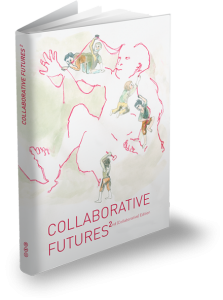 The Collaborative Futures book is back for another edition and is smarter, sharper, and more insightful than ever.
Last spring I was fortunate to become involved in an amazing experiment in composition and collaboration. A friend and colleague of mine, Mushon Zer-Aviv locked himself up in a hotel room with 4 other collaborators and came out 5 days later with a the first edition of Collaborative Futures. Many conversations and an intensive editing sprint later (with a fresh team of collaborators), yields a much more comprehensive and finished work.
While the original team was in Berlin, I sent Mushon a copy of my essay on the history of version control systems - Versioning Dissonance. In this essay I discuss the significance of the distributed version control phenomenon, and speculate on the crossover of these collaborative modalities from software to other forms of production. An excerpt from my essay underlies the chapter on Multiplicity and Social Coding. I didn’t make it out to Germany, nor did I communicate synchronously with the sprinters. :-( However, through my friendships and participation in the larger NYC free software/culture, collective communications campus, and Eyebeam communities, I was a participant in an ongoing conversation around these important themes.
This book is a really cool accomplishment on multiple levels. It’s creation myth is legendary, the content is compelling, and its a technical triumph. The first edition was admittedly a bit choppy and also neglected to address some critical perspectives that were introduced into the new edition. I am really happy with these substantive improvements, as well as the fabulous new cover art, web site, and distribution formats.
Special thanks to everyone involved in this project for inviting me along for the ride.
The Collaborative Futures book is back for another edition and is smarter, sharper, and more insightful than ever.
Last spring I was fortunate to become involved in an amazing experiment in composition and collaboration. A friend and colleague of mine, Mushon Zer-Aviv locked himself up in a hotel room with 4 other collaborators and came out 5 days later with a the first edition of Collaborative Futures. Many conversations and an intensive editing sprint later (with a fresh team of collaborators), yields a much more comprehensive and finished work.
While the original team was in Berlin, I sent Mushon a copy of my essay on the history of version control systems - Versioning Dissonance. In this essay I discuss the significance of the distributed version control phenomenon, and speculate on the crossover of these collaborative modalities from software to other forms of production. An excerpt from my essay underlies the chapter on Multiplicity and Social Coding. I didn’t make it out to Germany, nor did I communicate synchronously with the sprinters. :-( However, through my friendships and participation in the larger NYC free software/culture, collective communications campus, and Eyebeam communities, I was a participant in an ongoing conversation around these important themes.
This book is a really cool accomplishment on multiple levels. It’s creation myth is legendary, the content is compelling, and its a technical triumph. The first edition was admittedly a bit choppy and also neglected to address some critical perspectives that were introduced into the new edition. I am really happy with these substantive improvements, as well as the fabulous new cover art, web site, and distribution formats.
Special thanks to everyone involved in this project for inviting me along for the ride. I recently learned about a fascinating trend in litigation that is quietly transforming courtroom testimony, and is spreading fast and far - video depositions.
I talked with a consultant who helps attorneys process video depositions. In the courtroom, attorneys are juxtaposing live testimony with segments from depositions. Video clips of witnesses reinforcing (or contradicting) themselves are far more powerful than merely reading back the transcript. The courtroom has always been about performance, but these videos have taken this to a new level, as savvy lawyers manipulate appearances and emotions. Increasingly all depositions are being recorded, just as they are transcribed.
Apart from the ways that courtroom proceedings are being transformed, I am also intrigued by the software that is undoubtedly in development to support these operations. In addition to conventional A/V support, working effectively with hundreds of hours of video involves archiving, indexing, distributing, editing, and clipping. At about a day or two of testimony per witness, and dozens of witnesses per trial, the numbers add up pretty quickly.
As cases accumulate, and multiple associates begin working with and analyzing video, law firms will quickly recognize the desirability of networked, collaborative, video annotation environments. Some large firms (and their vendors) may have already begun developing solutions. However, the consultant that I spoke with was storing video locally on a laptop hardrive and tracking it with an Access database, so opportunities are knocking. Without a doubt many of the tools that will be highlighted at the upcoming
I recently learned about a fascinating trend in litigation that is quietly transforming courtroom testimony, and is spreading fast and far - video depositions.
I talked with a consultant who helps attorneys process video depositions. In the courtroom, attorneys are juxtaposing live testimony with segments from depositions. Video clips of witnesses reinforcing (or contradicting) themselves are far more powerful than merely reading back the transcript. The courtroom has always been about performance, but these videos have taken this to a new level, as savvy lawyers manipulate appearances and emotions. Increasingly all depositions are being recorded, just as they are transcribed.
Apart from the ways that courtroom proceedings are being transformed, I am also intrigued by the software that is undoubtedly in development to support these operations. In addition to conventional A/V support, working effectively with hundreds of hours of video involves archiving, indexing, distributing, editing, and clipping. At about a day or two of testimony per witness, and dozens of witnesses per trial, the numbers add up pretty quickly.
As cases accumulate, and multiple associates begin working with and analyzing video, law firms will quickly recognize the desirability of networked, collaborative, video annotation environments. Some large firms (and their vendors) may have already begun developing solutions. However, the consultant that I spoke with was storing video locally on a laptop hardrive and tracking it with an Access database, so opportunities are knocking. Without a doubt many of the tools that will be highlighted at the upcoming  Last week I attended the second half of the
  Today I attended a