
Pedagogical Sofware
Literally. See my post on The Plone Blog: Plone University
Literally. See my post on The Plone Blog: Plone University
 Originally published on theploneblog.org
Open source software as pedagogical scaffolding, and F/OSS ecologies as a dialogical knowledge communities.
This is a fun post recognizing the role of open source software and breaking routines in learning new programming patterns and paradigms.
7 Reasons I switched back to PHP after 2 years on Rails
Originally published on theploneblog.org
Open source software as pedagogical scaffolding, and F/OSS ecologies as a dialogical knowledge communities.
This is a fun post recognizing the role of open source software and breaking routines in learning new programming patterns and paradigms.
7 Reasons I switched back to PHP after 2 years on Rails
Rails was an amazing teacher. I loved it’s “do exactly as I say” paint-by-numbers framework that taught me some great guidelines. I love Ruby for making me really understand OOP. God, Ruby is so beautiful. I love you, Ruby. But the main reason that any programmer learning any new language thinks the new language is SO much better than the old one is because he’s a better programmer now!
 My visits to the Informedia lab have consistently generated futuristic ideas (and corresponding posts), and my trip this spring was no exception.
This time I was thinking alot about what kinds of schemas will be employed after their prototype moves beyond watching grandma? When this kind of a system is inevitably rigged up to a school or a prison, or fed raw streams from live surveillance cameras?
My money is on the Diagnostic Statistical Manual of Mental Disorders, an instrument that is arguably becoming the de-facto catalog for the full range of human behavior and experience.
In some respects, this progression parallels the notion that nobody dies of old age anymore - they die of heart failure, cancer, or other diseases. And, as the title of this post cheerily states, we are all dying, we are all sick, and we are all crazy.
As crazy as it sounds, the DSM is poised to become the lens through which we interpret all of human behavior. Given its breadth of coverage, I challenge anyone to find me a normal, healthy individual. It’s ambition reminds me of William James’ Varieties of Religious Experience, except in our generation, the full range of human experience has been radically pathologized.
BTW - the folks who brought us Sexual Orientation Disorder are hard at work on V 5.0 of this catalog - and there is a call out for diagnosis suggestions.
My visits to the Informedia lab have consistently generated futuristic ideas (and corresponding posts), and my trip this spring was no exception.
This time I was thinking alot about what kinds of schemas will be employed after their prototype moves beyond watching grandma? When this kind of a system is inevitably rigged up to a school or a prison, or fed raw streams from live surveillance cameras?
My money is on the Diagnostic Statistical Manual of Mental Disorders, an instrument that is arguably becoming the de-facto catalog for the full range of human behavior and experience.
In some respects, this progression parallels the notion that nobody dies of old age anymore - they die of heart failure, cancer, or other diseases. And, as the title of this post cheerily states, we are all dying, we are all sick, and we are all crazy.
As crazy as it sounds, the DSM is poised to become the lens through which we interpret all of human behavior. Given its breadth of coverage, I challenge anyone to find me a normal, healthy individual. It’s ambition reminds me of William James’ Varieties of Religious Experience, except in our generation, the full range of human experience has been radically pathologized.
BTW - the folks who brought us Sexual Orientation Disorder are hard at work on V 5.0 of this catalog - and there is a call out for diagnosis suggestions.
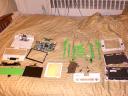 At last month’s incredible Teach Think Play Conference I was fortunate enough to borrow an OLPC laptop from a good friend. As usual, the tangible green machine was a Pop Star (though in this educator crowd, most were not familiar with the project), garnering interest and attention wherever it travels.
Sadly, the machine I had borrowed had some serious power issues, and I could not demo Sugar - the linux-based, free operating system developed specifically for the OLPC - to any of the attendees.
Since my employer CCNMTL is a participant in the OLPC developer program (thusfar we have only received a raw motherboard, not a complete laptop), I decided to attempt a field repair of the OLPC in the vain hope I might be able to swap boards and get the unit running again.
I discovered that the OLPC hardware (at least at this stage) is not quite as easy to disassemble as one would hope - you really need more of a clean room than a Third-World repair shop to work on this model. Still, a few iconic cues directing disassembly, like on a Thinkpad or Apple, would go a long way. Amazingly, there were no moving parts!
In any case, I visually documented the disassembly process, but I don’t think I am going to be able to put humpty dumpty back together again any time soon. I guess I owe my friend $100 (well, now $150), since that is the list price of the OLPC.
At last month’s incredible Teach Think Play Conference I was fortunate enough to borrow an OLPC laptop from a good friend. As usual, the tangible green machine was a Pop Star (though in this educator crowd, most were not familiar with the project), garnering interest and attention wherever it travels.
Sadly, the machine I had borrowed had some serious power issues, and I could not demo Sugar - the linux-based, free operating system developed specifically for the OLPC - to any of the attendees.
Since my employer CCNMTL is a participant in the OLPC developer program (thusfar we have only received a raw motherboard, not a complete laptop), I decided to attempt a field repair of the OLPC in the vain hope I might be able to swap boards and get the unit running again.
I discovered that the OLPC hardware (at least at this stage) is not quite as easy to disassemble as one would hope - you really need more of a clean room than a Third-World repair shop to work on this model. Still, a few iconic cues directing disassembly, like on a Thinkpad or Apple, would go a long way. Amazingly, there were no moving parts!
In any case, I visually documented the disassembly process, but I don’t think I am going to be able to put humpty dumpty back together again any time soon. I guess I owe my friend $100 (well, now $150), since that is the list price of the OLPC.
Today I attended day 1 of this year’s amazing Cultural Studies conference at Teachers College - Popular Culture in the Classroom: Teach, Think, Play. The morning kicked off with a Keynote by Taylor Mali, a spoken word philosopher-poet who perpetrates lyrical homicide against those who judge others according to their salary instead of the difference people are making in the world. I highly recommend taking a listen to some of his work, as he is working to inspire 1000 new teachers, and is only up to ~160. I presented a hybrid of my SXSW talk, Teaching in the New Vernacular, and Chris Blizzard’s OLPC introduction in a session called: Portable Culture Machines: One Multimedia Studio Per Child (the proposal had been published on OLPCNews). The talk was well attended, and the conference attendees were very excited to see/touch/feel/smell the XO device I borrowed from a friend. Ernest Washington gave a great session on teaching w/ hip hop, but for me the real takeaway was a perspective on education as the “cultivation of emotions” - this talk really connected alot of dots I have been working on lately, especially the “chemical swaddling” conversation I have been having with Philip Dawdy of Furious Seasons. The Media About Youth Consortium, a group print and film journalists (Alissa Quart, Jennifer Dworkin, Maia Szalavitz, Joie Jager-Hyman) spoke about their work and issues they are facing on the publishing front. Jan Jagodzinski gave a fabulous and fun (but substantive and deeply critical )reading of everything from Borat to South Park, and of designer capitalism through the eyes of a Kynic (not to be confused with a cynic). Art Spiegelman, the creative force behind Maus gave a wonderful history of the comic strip (and more generally, the genre of narrative storytelling with text and images) and his wife, Francoise Mouly, the Art editor of the New Yorker, gave back to back talks. Finally, Will Pearson the President of mental_floss (a magazine in the spirit of highlights which entertains while it teaches) closed out the day with a lively talk explaining their history, and why Einstein appears on every cover. And tomorrow’s schedule is jam packed too!
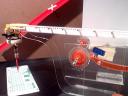 Monday night I went to the ITP’s end-of-semester show. A friend of mine is in the program and I went to check out the scene. ITP, the Interactive Telecommunications Program, is part of the Tisch School of the Arts at NYU. ITP has been around since ‘79, and lies somewhere concetually between the MIT Media Lab and Mary Flanagan. When I visited the MIT Media Lab this summer I began to understand how it was really operating as a pooled R & D lab for corporate interests (with plenty of military funding). I got the vibe that ITP is coming from a different place with different priorities, but I don’t really know the full back story.
Here are some of the highlights of the many many projects I saw the other night:
Monday night I went to the ITP’s end-of-semester show. A friend of mine is in the program and I went to check out the scene. ITP, the Interactive Telecommunications Program, is part of the Tisch School of the Arts at NYU. ITP has been around since ‘79, and lies somewhere concetually between the MIT Media Lab and Mary Flanagan. When I visited the MIT Media Lab this summer I began to understand how it was really operating as a pooled R & D lab for corporate interests (with plenty of military funding). I got the vibe that ITP is coming from a different place with different priorities, but I don’t really know the full back story.
Here are some of the highlights of the many many projects I saw the other night:
 Originally published on theploneblog.org
The $100 laptop project has chosen Python as the primary development language for The Laptop.
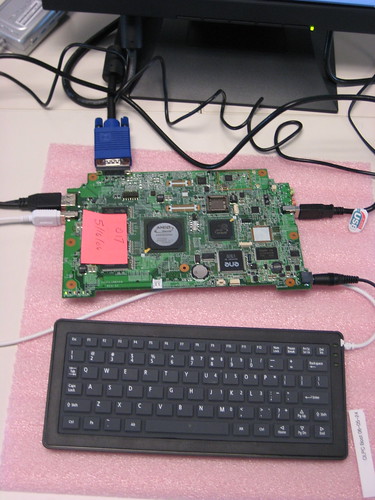
I was lucky enough to get my hands on an olpc developer board, and have spent a little time learning about the platform and project.
While there are a few issues I have with the project, it is really an thrilling moment in educational technology and after holding the hardware in my own hands I actually believe this vision might truly manifest.
The main reason I am writing about this in the Plone blog is I have learned that the olpc’s application development language of choice is Python!
Originally published on theploneblog.org
The $100 laptop project has chosen Python as the primary development language for The Laptop.
I was lucky enough to get my hands on an olpc developer board, and have spent a little time learning about the platform and project.
While there are a few issues I have with the project, it is really an thrilling moment in educational technology and after holding the hardware in my own hands I actually believe this vision might truly manifest.
The main reason I am writing about this in the Plone blog is I have learned that the olpc’s application development language of choice is Python!
 Originally published on theploneblog.org
Preliminary report on the Big Apple Sprint
July fourth has come and gone, but the fireworks set off at last week’s sprint are still visible.
The sprinters arrived at Columbia University bright and early, Wednesday morning. (note to all future sprint organizers: tell the caterers to skip the decaf and double the regular order). About ~13-15 sprinters were present, but we also coordinated remote sprints with Austria (+5 hours ahead) and Utah (-2 hours behind) meaning we were basically sprinting around the clock.
We all used the freely available, plone-based, OpenPlans service to manage our collaboration and everyone found the software to be extremely reliable and easy to use.
The sprint began with introductions and detailed demos of the tools and
products people had been working on and were most proud of. Sprints are
difficult to plan in advance since the skills and interests of the
attendees are not decided until the final roster shows up. A diverse
range of interests were represented, but common themes rapidly emerged
Originally published on theploneblog.org
Preliminary report on the Big Apple Sprint
July fourth has come and gone, but the fireworks set off at last week’s sprint are still visible.
The sprinters arrived at Columbia University bright and early, Wednesday morning. (note to all future sprint organizers: tell the caterers to skip the decaf and double the regular order). About ~13-15 sprinters were present, but we also coordinated remote sprints with Austria (+5 hours ahead) and Utah (-2 hours behind) meaning we were basically sprinting around the clock.
We all used the freely available, plone-based, OpenPlans service to manage our collaboration and everyone found the software to be extremely reliable and easy to use.
The sprint began with introductions and detailed demos of the tools and
products people had been working on and were most proud of. Sprints are
difficult to plan in advance since the skills and interests of the
attendees are not decided until the final roster shows up. A diverse
range of interests were represented, but common themes rapidly emerged
Originally published on theploneblog.org
A forray into drupal 4.7’s taxonomy system and what Plone can learn from it.
I have been moonlighting on a Drupal project and paying close attention to their taxonomy system. Drupal’s taxonomy/category/tagging system was completely revamped for their 4.6->4.7 release - a release close to a full year in the making, analogous to the Plone 2.0->2.1 “minor” point release.
The site I have been working on, theicarusproject.net
has a very rich collection of content, and one of the primary motivations for the migration is to get a better handle on the classification system - noboday can find anything on the current site. They were committed to Drupal long before I arrived, so I dug in with the hope of learning something from the contrast.
PHP bashing aside, there are alot of interesting things happening in Drupal land. I hope to follow up this post with a few more cross-pollinating nuggets, but for now I will focus on their taxonomy system.
Taxonomies in Drupal are considered the heart of the system, and the essential modules ship with the core and cannot be disabled. Most URLs in Drupal are effectively queries, much like our smart folders (actually, for anything aside from anti-chronological display order you need to install the Views module) but the display results are all instances of content with matching vocabulary terms. The absence of folders and containment initially confuses many administrators, and renders breadcrumbs largely useless, but does allow for the creation of sophisticated information architectures.
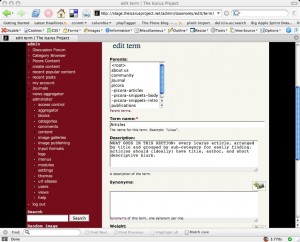
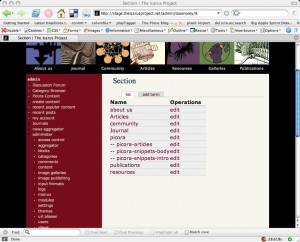
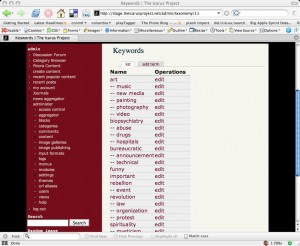
Taxonomies are managed top-down, not bottom-up, and have a separate administrative interface for their creation and management. Once the taxonomy vocabularies are created, specific terms can be added to these vocabularies without having to create content associated with those terms (in contrast to a bottom-up category system, like the mediawiki).
Category Management - Vocabulary Listings:
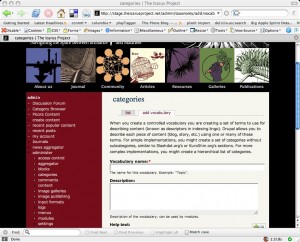
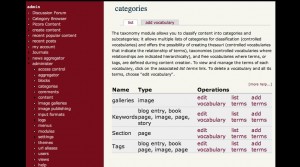 Druapl supports multiple vocabularies, which can each be associated with one or more content types. Vocabularies can be flat, one level deep, or N-levels deep (hierarchical). They can be fixed or free form (meaning content authors can make up new categories upon content creation). The core tagging system does not support the creation of tags per-user, per-object - only per-object.
Category Management - Add a Vocab:
Druapl supports multiple vocabularies, which can each be associated with one or more content types. Vocabularies can be flat, one level deep, or N-levels deep (hierarchical). They can be fixed or free form (meaning content authors can make up new categories upon content creation). The core tagging system does not support the creation of tags per-user, per-object - only per-object.
Category Management - Add a Vocab:
 Category Management - Add/Edit a Term:
 The Drupal taxonomy system is very powerful, but its power is very open ended and does not necessarily lead users towards a uniform experience. The confusion around categories and taxonomies is best exemplified by the category module meant to consolidate and simplify taxonomy and navigation, but there is no consensus on its incorporation into the core.
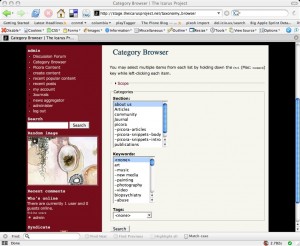
A large number of modules are built around taxonomies. Core Drupal supports roles, but no groups (organic groups is a popular access delegatoin solution, but it is incompatible with other access restriction modules - so you have to choose one), and does not have a notion of containment (ie folders). So, for example, one way to restrict editing access is by enabling the taxonomy access module. Another useful module is the taxonomy browser which allows for advanced search against unions/intersections of vocab terms.
Category Browser:
The Drupal taxonomy system is very powerful, but its power is very open ended and does not necessarily lead users towards a uniform experience. The confusion around categories and taxonomies is best exemplified by the category module meant to consolidate and simplify taxonomy and navigation, but there is no consensus on its incorporation into the core.
A large number of modules are built around taxonomies. Core Drupal supports roles, but no groups (organic groups is a popular access delegatoin solution, but it is incompatible with other access restriction modules - so you have to choose one), and does not have a notion of containment (ie folders). So, for example, one way to restrict editing access is by enabling the taxonomy access module. Another useful module is the taxonomy browser which allows for advanced search against unions/intersections of vocab terms.
Category Browser:
 Once vocabularies are created, and terms added, content can be associated with these terms:
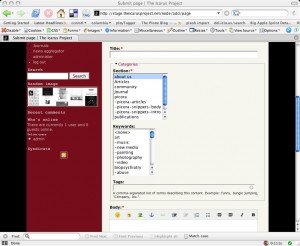 Working on this site really drove home the value in separating the navigation axis (section) from the thematic axis (keywords), and separating these dimensions was easy to accomplish with the taxonomy/category tools built into drupal. In particular, once the scheme was developed, managing vocabulary lists (even hierarchical ones) is intuitive, albeit slightly clunky. I further chose to introduce a free-form tagging dimension for member contributed posts which may or may not fit into the fixed taxonomy. This is similar to myspace and facebook allowing for free-form hobbies and interests, and banking on a large enough user base that there will be overlap and potentially interesting intersections.
 The system still does not allow for the intuitive modeling of a many-to-many relationship, which I continue to think is the litmus test which will mark of a truly powerful taxonomy UI. There is still quite a bit of programmer know how involved in setting up this system so that it operates the way that content administrators expect, and arguably there are too many degrees of freedom introduced by such a general purpose modeling capability (if you think about it, a tagging system can essentially allow web administrators to model relationships which used to require programming custom applications against an rdbms).
Nonetheless, Drupal’s taxonomy/category/vocabulary system definitely captures a few use cases more elegantly than Plone’s current core does. But perhaps the real lesson is the importance of not mixing navigation space and content space, which can be kept separate in Plone, but is all too easy to conflate (in Drupal too!).
Note: most things I describe in this case study could have been accomplished within core Plone - I think the most interesting things here are the administrative UI for multiple vocabulary management, the different types of vocabularies, and how central they are in the construction of a Drupal site.
The system still does not allow for the intuitive modeling of a many-to-many relationship, which I continue to think is the litmus test which will mark of a truly powerful taxonomy UI. There is still quite a bit of programmer know how involved in setting up this system so that it operates the way that content administrators expect, and arguably there are too many degrees of freedom introduced by such a general purpose modeling capability (if you think about it, a tagging system can essentially allow web administrators to model relationships which used to require programming custom applications against an rdbms).
Nonetheless, Drupal’s taxonomy/category/vocabulary system definitely captures a few use cases more elegantly than Plone’s current core does. But perhaps the real lesson is the importance of not mixing navigation space and content space, which can be kept separate in Plone, but is all too easy to conflate (in Drupal too!).
Note: most things I describe in this case study could have been accomplished within core Plone - I think the most interesting things here are the administrative UI for multiple vocabulary management, the different types of vocabularies, and how central they are in the construction of a Drupal site.
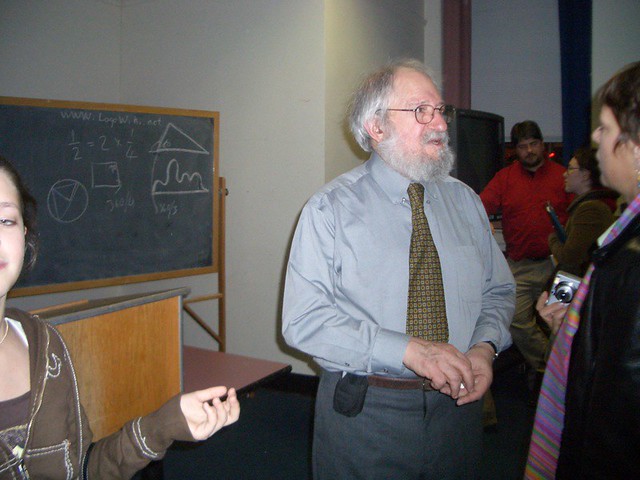 Seymour Papert , the inventor of Logo, spoke at Teachers College on Monday April 10th. I was lucky enough to hear him talk in a standing-room-only event. My former employer, Idit Caperton
studied with Papert, and MaMaMedia incorporated many of the principles he advocated.
His ideas, once stated, are remarkably simple and obvious–usually a mark of the good ones. He thinks we are teaching mathematics ass-backwards, and that we ought to introduce it the way it came about in the history of humanity - engineering first. This approach will create and foster the demand for mathematics. Pyramids, navigation, astronomy, all drove the development of mathematics - and robotics and programming can provoke and instigate the need for mathematical abstraction in education. Sounds about right.
Interestingly, his experiments have led to anecdotal accounts of a reversal of the gender discrepancy in science/math. He claims with an engineering first approach, girls actually quickly excel beyond the boys, venturing beyond speed and destruction to the mastery of a much wider variety of skills with the systems.
He also demonstrated, in 10 minutes flat, how logo can be used to teach 2nd graders the notion of a mathematical theorem (in creating any closed shape, the turtle will rotate through a full 360 degrees - repeat N {fd 10 rt 360/N}) as well as how to introduce calculus (through the idea of the limit). He made the point that once a second grader is arguing – “that’s not a circle, its lots and lots of short lines”, you have already won…
If logo has a failing, its that it does not provide the necessary scaffolding for teachers other than Papert to effectively teach with it. I have been exposed to logo in the past, but never really understood its appeal until Seymour started turtling.
Interestingly, Logo is far from irrelevant. Mark Shuttleworth’s ClassroomCoders curriculum imagines a logo->squeak->python pipeline for educating the programmers of the future…
Seymour is also heavily involved in the $100 laptop project, a project which many consider to be one of the most important educational initiatives currently underway.
Seymour Papert , the inventor of Logo, spoke at Teachers College on Monday April 10th. I was lucky enough to hear him talk in a standing-room-only event. My former employer, Idit Caperton
studied with Papert, and MaMaMedia incorporated many of the principles he advocated.
His ideas, once stated, are remarkably simple and obvious–usually a mark of the good ones. He thinks we are teaching mathematics ass-backwards, and that we ought to introduce it the way it came about in the history of humanity - engineering first. This approach will create and foster the demand for mathematics. Pyramids, navigation, astronomy, all drove the development of mathematics - and robotics and programming can provoke and instigate the need for mathematical abstraction in education. Sounds about right.
Interestingly, his experiments have led to anecdotal accounts of a reversal of the gender discrepancy in science/math. He claims with an engineering first approach, girls actually quickly excel beyond the boys, venturing beyond speed and destruction to the mastery of a much wider variety of skills with the systems.
He also demonstrated, in 10 minutes flat, how logo can be used to teach 2nd graders the notion of a mathematical theorem (in creating any closed shape, the turtle will rotate through a full 360 degrees - repeat N {fd 10 rt 360/N}) as well as how to introduce calculus (through the idea of the limit). He made the point that once a second grader is arguing – “that’s not a circle, its lots and lots of short lines”, you have already won…
If logo has a failing, its that it does not provide the necessary scaffolding for teachers other than Papert to effectively teach with it. I have been exposed to logo in the past, but never really understood its appeal until Seymour started turtling.
Interestingly, Logo is far from irrelevant. Mark Shuttleworth’s ClassroomCoders curriculum imagines a logo->squeak->python pipeline for educating the programmers of the future…
Seymour is also heavily involved in the $100 laptop project, a project which many consider to be one of the most important educational initiatives currently underway.