Education

The case of the missing Barnes paintings

The case of the missing Barnes paintings

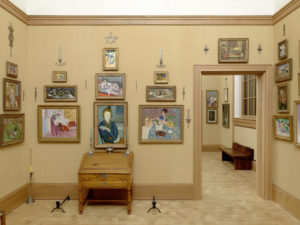
Dr. Albert Barnes was a chemist who made a fortune at the turn of the 20th century developing a treatment for infant blindness. He became interested in art and befriended the painter William Glackens. The two began collecting modern paintings in Paris in 1911, and Barnes eventually developed a private collection of paintings that today is valued at $50-60 Billion. Amazingly, he collected the works of the masters before they were masters, almost the equivalent of buying the Mona Lisa off Da Vinci in a dark Venice alley for twenty bucks. While he never got his hands on Mona, he amassed a world class collection of Renoirs, Picassos, Matisses, Modiglianis, Van Googhs, and more. Barnes was a quirky character. He hated the establishment, and couldn’t stand museums, high society or the 1%. He had this crazy idea that art was best appreciated by living with it, as opposed to viewing it in crowds for three second doses. He kept his collection of paintings in his home in the Philadelphia suburbs, and opened a school where people could learn about art while surrounded by it. He hung his paintings thematically, and each wall was a unique montage, what came to be known as an ensemble. He was constantly rearranging these works, and he rooms were often developed as a part of a curriculum – there were rooms featuring colorwork, brushwork, nudes – and, since he owned them, I imagine he occasional pulled down a Van Gough from the wall and let his students feel it to teach them about brushwork. He had an idiosyncratic sense of humor, and would often position large wooden chairs beneath paintings of big-bottomed subjects. Barnes was quite cantankerous, and he was picky about who he admitted to see the collection. He once rejected someone from seeing the collection and signed the letter as his dog. He was also close friends with John Dewey, and invited Bertrand Russel to teach at his foundation. A few biographies have been penned about him, and The Devil and Dr. Barnes recounts many of the battles he engaged in during his life. He was married for decades, but (spoiler alert) he died childless in 1951. During his lifetime he created the Barnes Foundation, and his will left crystal clear instructions that his collection was bequeathed to the foundation and should never leave his home. The documentary film The Art of the Steal tells the story of the greatest heist of the 20th century. According to the filmmakers, the City of Philadelphia and private foundations conspired to effectively eminent domain the collection. It took them a few decades, but they were eventually able to make the case that the environmental conditions of the Barnes home were jeopardizing the paintings. The proposed creating a brand new building in the middle of downtown Philly modeled after the wing of the Barnes estate that held his collections. They promised to preserve the unique curatorial layout of his rooms, recreating them within the new building. In 2012 the Barnes collection was moved to it’s new home in downtown Philly. The website describes the collection as:

Hippocratic hypocrisy

Hippocratic hypocrisy

caduceus-eyeWhen I graduated from Teachers College in ‘07, I donned the goofy ceremonial robes and walked with my classmates at the university-wide commencement.  I distinctly remember my astonishment when I heard the medical graduates recite the Hippocratic oath, right there, for all of us to witness. I remember thinking to myself that other professionals should be required to recite oaths too, as lawyers, teachers, journalists, and others all have the power to do great harm, but I suppose that medicine still occupies a unique place, as the power to heal is synonymous with the power to kill. I have arrived at a point in my dissertation research where I am now convinced that the psychiatric-pharmaceutical complex is in violation of the Hippocratic oath. I realize that this is a heavy accusation to make, but I now believe that the field has gone beyond simple, or even gross negligence, and has crossed the line into willful harm.

Makers, Burners and Pedagogy Transformers

Last Thursday, I managed to further integrate my personal/professional/hobbiest identitites, and me and two of my esteemed colleagues (Therese and Jon) presented Burning Man and Hacker/Maker Spaces at the weekly CCNMTL staff meeting.

The rosetta stone for our talk was Fred Turner’s seminal paper Burning Man at Google: a cultural infrastructure for new media production (published by New Media and Society, the same journal that published my and Aram’s paper on The End of Forgetting (preprint)), which Turner also presented at Google, where his talk was recorded. We tried to connect Burning Man to a central question in education – the question of transference.  Do skills learned under simulated conditions transfer over to real world settings? We started out with the grand question, “What Educates?”, and tried to narrow that down to the question of how we can view commons-based peer-production in an educational context?  What can Burning Man, and crucially, the Maker Spaces that make Burning Man possible, teach educators about teaching and learning?

Dear Frank,

I remember the first time we met. It was my third and final interview for my current job at CCNMTL back in Spring ‘04. I was initially anxious, but you immediately made be feel welcome and comfortable. [Over the years I came to appreciate your gift for authentically connecting with just about anyone, often within 30 seconds of meeting them. You dispatched with superficial niceties and blazed trails directly to people’s souls. You bridged intellect and emotion, without a hint of pomp or circumstance, projecting sensitivity and respect to everyone you encountered. Age, class, race, gender - not so much that these dimensions were irrelevant, but you always managed to connect with the individual. You actually listened. And learned.] During that interview I remember walking into your office, encircled floor to ceiling with books. You asked me about my undergraduate senior thesis, a topic I hadn’t revisited in almost a decade, and then proceeded to pull Julian Jaynes off the shelf. You showed me your photo with Allen Ginsberg, and then asked me if I recognized the person in another grainy b/w photo. When I correctly identified Wittgenstein I was pretty confident I had landed the job. But, more importantly, I had found a new mentor. We didn’t interact very often my first summer at CCNMTL. I worked in Butler library, under Maurice’s supervision, and you were keeping summer hours, at your office in Lewisohn. When Fall rolled around I was eager to enroll in classes, and begin my graduate journeys, but I was nervous about signing up for a course with my boss. You never made me feel like a subordinate, but I was scarred from my relationship with management at previous jobs, and wasn’t sure what it would be like for us to enter into a student-teacher relationship. I hadn’t quite figured out that that was the only kind of relationship that you knew how to cultivate, although our roles were constantly revolving and inverting, as you shared your wisdom, and facilitated growth in every exchange. You brought out the best in everyone around you, rarely content to talk about people or events - always rushing or passing your way into the realm of the Forms. As I reflected when Robbie retired, I chose to enroll in your legendary Readings seminar after one of your students (I think it was Joost van Dreunen) made the case that your syllabus was your text on social/cultural/critical/communications/media theory. That year was invigorating. I remember rediscovering the joys of school, as I learned to reclaim spaces of intellectual exploration and play, and translate them into action. On the surface, our seminars resembled office meetings, but the luxury of non-directed (not to be confused with non-purposeful) conversation, which was a privilege I needed to readjust to. Together we figured out ways to weave together disparate threads of my life - work, hobbies, play, passions - somehow, I learned to integrate these (often inconsistent) vectors into a unified construct. A self, I suppose. But, it was my self, not one you imposed on me. It never felt like you pushed your agendas or ideologies on me - rather, you always wanted to help me discover what I really want to think about and work on. And I know that I’m not the only one that believes this - this was your way. I often wish you had written more, although your autobiographical text is a multi-volume, multi-dimentional, multimedia masterpiece. Sometimes I wonder how seriously you took Socrates’ critique of writing, along with his commitment to be a midwife for ideas. Did you lose count of the number of dissertations you helped deliver? One under-studied paper that you published, “Who controls the canon? A classicist in conversation with cultural conservatives,” (Moretti (1993), Teachers College Record, 95, pp. 113-126) captures many of the paradoxes you embodied and worked through. A radical classicist, a skeptical optimist, a scientific artist, a philosophical craftsman, an institutional revolutionary. Somehow, you integrated these roles with a career trajectory that not even the most advanced detectors in the Large Hadron Collider could trace. I watched you start countless conversations with a Greek or Latin etymology, charming the academics, administrators, and funders alike in a display of the continuing power of the Western cannon. You constantly reminded us of the classical education that many of our favorite thinkers received, and insisted we read them against that backdrop. But, more importantly, a reminder of how radical these thinkers all were in their own time, and how likely they themselves would be protesting the ossification of the cannon, if they were around today. These lessons will live on through one of the last projects you initiated, Decolonizing the Cannon, which a number of us are committed to follow through with. After 25+ years of reading Homer every fall, it will take us a lifetime to reconstruct the lesson plans you left behind. In the 9 years that I’ve known you we’ve been to hell and back. We’ve studied together, traveled together, worked together, gotten sick and healed together, but all the while kept our senses of humor. I’ve read many beautiful eulogies about you, but in this letter I want to emphasize your enduring sense of humor. You were a funny man. LMAO funny. Slapstick funny. Dada surrealist funny. Hashish funny. Plenty of the humor was dark, and perhaps, as your student Ruthie suggested to me recently, your humor helped shield you from the brutal injustices that you perceived and experienced all around us. But you were also sometimes a klutz, in an absentminded-professor sense, and a disorganized mess. A creative mess, but a mess. But, I have to say, that even when you were operating on scripted autopilot, you were way better than most people at their best. There wasn’t much you enjoyed more than being called out for your lapses in attention, and my glimpses of your inner monologue were often hysterical. I think that your analysis of power led you to conclude the the world was simply absurd. We all witnessed you acting on this with gravitas and determination, but in the minutia of our micro-interactions, there was always a wide smile and a belly laugh. I don’t think any of us will ever forget the sound of your laugh. (Or, your bark. Man, did you love to throw down and argue. But, that’s another post.) After I started taking classes with you, it didn’t take me long to realize that that the secret to understanding what you were talking about was knowing what you were reading that week. You would basically have one conversation all week long, no matter who you were talking to. I imagine it was bewildering to many of my coworkers when you brought up false-needs, or commodification at our weekly staff meetings, but if people paid close attention, they could almost observe the wheels spinning all week long, as you lived the theorists you were teaching through the practice of our projects. I often explained to people the incestuous nature of my work/school commitments by comparing my situation to a graduate student in the natural sciences. They might spend 40-60 hours a week in a lab, and working for you was about as close as I could imagine to working in a communications lab. I often wondered how many of my cohorts managed to keep up on developments in new media (and many of them certainly did) without the ambient immersion in a practice that exercised and embodied the theories we were reading. When summer vacation rolled around, you never quit.  I remember how you used to talk about the stretch of time between Sept-May as one long sprint (as long as I’ve known you, you’ve taught at least 2-2 + advising phd students + multiple committees at TC and the J-School, on top of your administrative responsibilities as executive director at CCNMTL and a senior officer in the libraries) , but you didn’t exactly slow down in the summer either. Or, perhaps I should say that you did slow down, but you never stopped teaching and learning.  For at least 3 or 4 summers I participated in “slow reading groups” with you and a few of your dedicated students. We didn’t get any credit for these sessions, and you didn’t get paid. We would sit in your office, and go around the table reading a book out loud, pausing whenever we needed clarification.  And, we often needed clarification. You were convinced that no one was reading anything closely anymore, and that the hundreds of pages that were assigned in courses each week were flying by without students or teachers taking the time to slow down and absorb them.  The second summer we tried this we read Latour’s Politics of Nature, a text we all internalized and will never forget. You had such a funny relationship with technology. You loved gadgets, but were constantly thwarted and befuddled by them. I wonder how many laptops and phones you lost or broke in the years we have known each other. You never stopped learning, but were suspicious of every new tool that showed up, and the more hype around the tool, the more you growled defensively at it. But often, after months of critiquing and berating something, you would come around and start appreciating it. While some of my coworkers/cohorts seem to have chips on their shoulders about the ineffectual futility of technological interventions, you had an optimistic will that allowed you to wield technology like you wielded the classics. Opportunistically, and instrumentally, in the service of social justice. That was your gig. Relentlessly. Sometimes I wonder if you felt like you had painted yourself into a corner with all of your critiques – like when you whispered quietly to me that you wanted to learn how to use Second Life, without blowing your critical cover. Last week I ran into an ex-girlfriend that I hadn’t seen in over 10 years. It was nice to reconnect, and in the course of our conversation I realized that we hadn’t spoken since I had started working and studying at Columbia. I was an entirely different person back then, one I barely recognized. Perhaps people return to graduate school in order to change, but true transformations require a relinquishing of your old identity and ego, without a clear idea of what might emerge on the other end. The Judaic tradition has a teaching that anyone who teaches you the alphabet is considered a parent. You literally taught me the alphabet, as we revisited the alphabet as a revolutionary communications technology (via Eric Havelock), and you taught me many other alphabets and languages that gave me access to entire new worlds.  You also invited me into your home, and made me feel like I was part of your family. Most of all, you modeled and embodied an honesty, integrity, and sheer force of will that I am blessed to have intersected. Safe travels, Frank, and enjoy your vacation. Love, /J
Digital Communications in Theory and Practice

My doctoral program has an innovative alternative to traditional comprehensive exams.  Instead of reading 80+ books and spending a few days filling blue-books with essays, we can choose to 1. Publish a paper to a peer-reviewed academic journal, 2. Present a paper at an academic conference, and 3. Develop a syllabus. I just defended my comps and am now officially ABD (wahoo!).  I hope to trade in those letters for a different 3, but in the meantime, here is the work I submitted to complete my MPhil:

scaling inefficiencies

By Stichting Onderzoek Multinationale OndernemingenLast week I attended an amazing reading and film series group that felt more like a graduate seminar than a meetup. Cáfe de Cleyre has been gathering for 3+ hours weekly, for the past 3 months, and exploring the theme of Direct Action in theory and practice. I attended their ninth gathering where the the group explored mental health as direct action. They screened Crooked Beauty and read excerpts of Mindful Occupation and other Icarus Project publications. The topic was organized independently of anyone directly involved with the Mindful Occupation project, and this was a refreshing reminder of the power of media. I learned that the CdC is run by two primary facilitators, who keep the operation running, and each week’s topic is facilitated by two more people who volunteer to run that week’s conversation. The night I joined, over 25 people attended, and I was very impressed with participant’s commitment and the level of discourse. The evening’s discussion was inspirational, but in this post I want to focus on the group’s format. On the surface, Cafe de Cleyre looks alot like a traditional reading group.  However, as I was reflecting on the organizing involved to bring this many people together—on an ad-hoc basis—I realized that digital communications play a large role in making assemblies like these possible. As I understand, group attendance varies significantly, week to week, as participants join for the discussions they are interested in. In years past, it was possible to organize a reading group around a particular theme, but the ad-hoc, on-demand spontaneity of this series would be much harder to maintain prior to social networking. For sure, it happened, but the internet has greatly facilitated this. I bring up this point in direct relation to the conversations swirling in educational technology around MOOCs (Massive Open Online Courses).  Columbia University is actively experimenting in this area now,  and there are great debates of what MOOCs are, and what, if any, value do they offer.  While access is not an end if of itself, I agree with Anya Kamenetz that, access to knowledge is generally a good thing. To be sure, granting more dominance to already powerful voices threatens diversity, but that is one of the reasons that the evaluation of MOOCs needs to be tempered by genre. Many of the conversations about MOOCs also stress the efficiencies of scaling.   As a programmer, ’efficiency’ is often my euphemism for ’lazy’ (in the best sense), but it is important to point out that scaling isn’t the only way we could decide to leverage technology for learning. I am reminded of another extreme example of this – May First/People link has recently launched a mentored training program called the People of Color Techie Training Program “for activists of color to become professional-level, politically progressive and movement involved technologists”.  May First is using communications technology to connect remotely with geographically dispersed learners, but in just about every sense, they are using technology to scale down - supporting 1-on-1 direct encounters, instead of the mass broadcast of lectures to 180k students. Not all progress is driven by maximizing efficiency, and some of the most interesting educational moments happen at the smallest scales.

Hide your kids

It’s back to school season, and if you’ve glanced up from your smartphone while walking the streets of New York City, you are sure to have noticed a new campaign that is sweeping the city’s billboards and phone booths.

Children’s Mental Health MATTERS

Where Science Meets Hope for Children’s Mental Health

  Who could possibly object to children’s health and well being? The Child Mind Institute, whose “Billboard is now at Penn Station!” is a recently founded non-profit “committed to finding more effective treatments for childhood psychiatric and learning disorders, building the science of healthy brain development, and empowering children and their families with help, hope, and answers.".  According to their website, they don’t accept funding directly from pharmaceutical companies. Anyone want to help me start cross-checking Pharma’s ties to their staff and board? In a gushing profile of the organization and its founder, Dr. Harold Koplewicz, the New York Times reported last summer that they are awash in millions of dollars of funding, have 14 clinicians on staff, and a former editor of the New York magazine is editing their website. Koplewicz is also the go-to doc for helping celebrities and the 1% “manage” their children. The story glosses over Koplewicz’s messy departure from NYU to start the Child Mind Institute. “[Koplewicz’s] main mission in life, he contended, is to remove any stigma from mental illness among children and teenagers, make it merely something to be managed and overcome as it was with dyslexia or attention deficit disorder before it.” In his critique of Marcia Angell’s two-part series in the New York Review of Books on the epidemic of mental illness Koplewicz stakes out his position clearly: “In the meantime, we have patients, in our case children and adolescents, who desperately need help. These children may be out of control, overwhelmed by anxiety, dangerously aggressive, disorganized in their communication, floundering in school. We need to help them. Medications, often along with behavioral therapy, can have a transformative effect.” These are the symptoms that Koplewicz wants concerned parents to be vigilant about patrolling: Child Mind Institute Symptom Checker. To me, Koplewicz reads like a raving megalomaniac, and his devotion and conviction are more frightening than the fictitious evil masterminds he claims are posited by Psychiatry’s critics. I get the sense that he genuinely believes his own spin. He worships at the alter of “objectivity”—“We would like to see objective research catch up with the clinical realities but can’t wait until that happens. Furthermore, falling back on pure non-pharmacological treatment is not the better alternative, since these treatments have rarely undergone objective evaluation."—and the Child Mind Institute is outfitted with “the latest in brain imaging technology”. Koplewicz wields a formidable rhetoric, but is almost a caricature of the scientific realists in the Science Wars. This post raises more questions than it answers. Who is funding the Child Mind Institute? Why now? How can organizations developing compassionate languages to describe mental diversity and difference, like The Icarus Project, respond to these campaigns? What roles do “objectivity” and “risk aversion” have in shaping the dynamics of this controversy? Should anything be stigmatized? UPDATE 4/22/2013: I  tweeted about this ages ago, but realized that the following tidbit never made it into this post. If you visit the wonderful Drug Industry Document Archive and search for ‘Koplewicz’, you will find that he was one of the co-authors on the now infamous Paxil 329 study that cost Glaxo Smith Klein $3 BILLION in settlements in 2012. The Paxil 329 study tried to cover up the finding that not only does Paxil not work in children, but that it makes them more suicidal than a sugar pill did. The Dept of Justice found the study to be misleading and fraudulent.  I am pretty sure that the study was ghost written, but I think that makes his credibility even worse. See also: Bossewitch, Jonah (2011). Pediatric Bipolar and the Media of Madness “Drugs and Media: New Perspectives On Communication Consumption and Consciousness”, eds. MacDougall, R. C., New York : Continuum: 2011 Special thanks to Dyan Neary for helping out on this post.

Forthcoming: The End of Forgetting

In Spring ‘05 I took a class with Eben Moglen on the privacy, anonymity, and surveillance beat. The experience changed my life and with tons of support from my teachers and cohorts, I have been working on these ideas ever since. A few years ago I joined forces with Prof. Aram Sinnreich, after a great conversation at a free culture salon. Together we reframed and refined the work, and co-presented it at Media in Transition 6 in Spring ‘09. We rinsed, lathered, and repeated our revisions, and just learned that our paper, The end of forgetting: Strategic agency beyond the Panopticon will be published in an upcoming issue of New Media & Society. Damn. Scholarly communication is slow, but occasionally fulfilling. Aram will also be presenting our work at this year’s International Communications Association conference.  Sadly, I can’t make it, but if you are near Phoenix this weekend, stop by Camelback A at noon on Sunday!

Towards the (educational) liberation of Palestine

“Education is the unfinished business of the revolution.” – Malak Zaalouk, Director of the Middle East Institute of Higher Education On my recent trip to Cairo I spent a week at the American University of Cairo participating in a week-long professional development conference for Palestinian educators. The conference included educators from five different Palestinian universities—many of whom were meeting for the first time in Cairo, despite working and living in the same city. The experience brought me back to last summer’s visit to Palestine, which I wrote about here. Interacting with my Palestinian colleagues in a (relatively) free country was stimulating and engaging, but I was haunted by thoughts of the oppressive conditions back home they would soon return to. The conference was organized around establishing centers for academic excellence with a focus on the role of new media in supporting teaching and learning. My Columbia cohorts and I presented a keynote on Media Analysis and Social Pedagogy (Frank’s intro, Part 1, Part 2), and throughout the week we discussed the interplay between technical and pedagogical innovation. The elephant in the room was the desperate condition of basic telecommunications infrastructure in Palestine**—it’s difficult building a curriculum around blogs or wikis when Palestinian connectivity in the West Bank is notoriously unreliableeven when it works, it’s slower than dial-up. The real tragedy is this digital divide is artificially manufactured and brutally enforced. Last summer I had a better connection over complementary wifi on an Israeli Egged bus than at the Palestinian University PTUK. When I visited Palestine I experienced the reality of the occupation first hand. I have written about how so many aspects of lifefuel, electricity, food, water, mobility, connectivity—**are regulated and controlled. As I learned last summer, the Israeli government forbids Palestinian telecom from developing 3G networks, prevents the Palestinian Authority from laying fiber between cities or connecting directly to the Mediterranean backbone, and businesses have a very difficult time importing routers. At the same time, the Palestinian activists who are trying to develop free municipal wifi in Ramallah are being thwarted, but not by the Israeli government. They are facing staunch opposition from Palestinian Telecom corporations. I have come to realize that the forces of the Occupation are on a collision course with Capitalism. There is simply too much damn money to be made on data plans and broadband. I also believe the Israeli government has read The Net Delusion, and are arrogant enough to think that they can control the situation by surveilling it. The IDF is agressively targeting media networks. Ultimately, I think they will allow this infrastructure to be built, making it all-but-inevitable that better ICT infrastructure is coming to Palestine. The questions are: What will the Palestinians do with it when it arrives? Can government surviellance contain the power redistribution that networked organizing tantalizingly promises? One of the key themes of our keynote at AUC was the importance of developing meaningful superstructures on top of technical infrastructure. At the conference we explored ways in which educational technology could be combined with teaching strategies to support peer-to-peer learning,  the flattening of traditional classroom hierarchies, the displacement of conventional teacher-student power relations, and authentic learning activities. Of course, educational technology alone won’t bring these outcomes. In many situations educational technology serves to perpetuate and reinforce the status quo. These cultures of practice could spread further and faster if the Palestinians learn from our blunders, and create Freedom in their Cloud.  As this infrastructure is imagined and built , there is an opportunity to leap-frog over our mistakes and develop an distributed network architecture, instead of the centralized architecture we have fallen for. Imagine a Palestinian mesh-based cloud, running peer-to-peer social networking services. Such a vision is not a pipe dream, in the age of the Freedom Box, Mondonet, and Diaspora. Short of fulfilling this dream entirely, it would be tremendous for Palestinian educators to develop their own, local, free/libre, educational software services instead of relying exclusively on free-of-charge centralized corporate solutions—like Google, Facebook, and Twitter—that render their students into products. Over the week of the conference, as I learned more about the situation at my colleague’s universities, I realized that few of the eleven universities in the West Bank would have the necessary resources to adequately support a new-media teaching and learning center. A well functioning center needs to staff systems administrators, programmers, designers, and video specialists to support the needs of the educational technologists, and in turn, the faculty and students. However, while no single university could support a center like this, I began to wonder how the Palestinian universities might coordinate and pool their resources. Establishing an single independent institution (likely a technical NGO) that services all of the Universities in Palestine, and perhaps even all of the schools in Palestine, might be the next obvious step in the educational capacity-building project that I have been involved with. I have encountered a similar model elsewhere. Groundwire (formerly One NorthWest) is a US non-profit that  was launched with the intention of exclusively servicing environmental organizations in the Pacific North-West. A similar kind of organization could be established in Palestine to service the educational sector with educational technology solutions. An institution like this could function of a hub, mediating interactions between different Palestinian Universities, sharing successes and failures, while continually building local institutional knowledge. Unlike the One Laptop Per Child project, this effort would be conceived from the start with training, support, and local engagement. It’s all about developing cultures of practice, and sustainable models for the deployment of infrastructure and superstructure. Will the immanent Palestinian networks lead to greater freedom?  Maybe. Perhaps with enough will, determination, and work. The iron is hot.

Jonah and the Cetacea

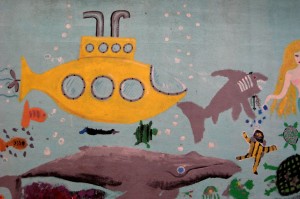
I recently returned from an amazing trip to Cairo, with a 36-hour stopover in Istanbul on the way home. While there, I learned something wonderful about the meaning of my name that continues to make me smile. While I am not a strict Nominative Determinist, I do take Plato’s Cratylus dialogue more seriously than most. I love learning new names, and often ask people what their names mean. Perhaps this fascination stems from the fact that my ambivalent parents gave me 5 (!) names, not including my surname, and my godfather gave me one more after I injured my back.  I have spent a great deal of time contemplating names and attempting to integrate mine into a coherent identity. Growing up I was always the only ‘Jonah’ I knew. In the 90’s the name gained popularity, but I still reflexively turn everytime I hear it (I can only imagine that Johns and Michaels learn to tune these out). The Old Testament’s Book of Jonah is a fabulous story. I’ve studied it closely and continue to find gems of wisdom and mystical insights. I have always appreciated that Jonah was: 1) One of the few (only?) prophets in the Old Testament sent to help the gentiles. 2) One of the only prophets in the Old Testament that anyone ever listened to!  In the closing coda, a mysterious “gourd” casts a shadow over Jonah’s mind (what kind of plant was this magical qiyqayown?), leading him to a transcendental experience in the desert where he learned to appreciate the universal nature of humanity. Great stuff - succinct, but it packs a punch. For a while I have known that Jonah the prophet was called Yunus (????) in the Qur’an. Jonah’s story in the Qur’an is quite similar to the Old Testament, though much shorter  (in the Qur’an Jonah is close friends with Jinns ;-)).  In Hebrew Jonah (??????) means ‘dove’.  Noah sent out 3 Jonahs to see if the flood waters had receded. But, to the best of my knowledge, Yunus does not mean anything special in Arabic. In Istanbul I learned that in Turkish, Yunus means dolphin. What a trip. In the past, in order to read the story of Jonah literally, I used to have to postulate UFOs or Yellow Submarines. I wasn’t quite as skeptical as this critic, but the story never added up on the plane of mundane reality. What if Jonah was saved by a dolphin(s)? Instead of being swallowed by a ‘Big Fish’, he could have been engulfed by a pod of dolphins. Sailors being saved by dolphins was a common motif in the ancient world. For example, Telemachus, son of Ulysses, was saved by dolphins, and to this day, we continue to confirm reports of humans saved by dolphins. Doves and Dolphins. What a name.