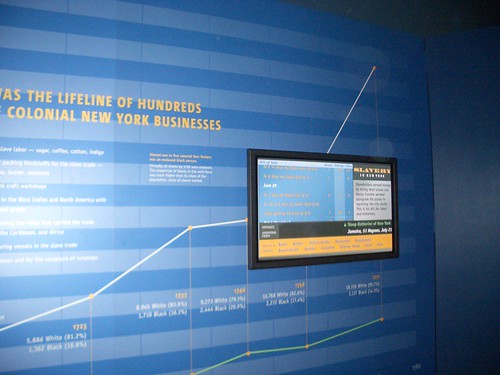
 This weekend I attended the masterfully produced Slavery in New York exhibit at the New York Historical Society. The exhibit was deeply moving, and vividly and viscerally captured a portrait of African American history I was not fully aware of previously. I left the exhibit with a new understanding of how the 400 year long institution of slavery was a tragedy fully on par with the Nazi Holacaust.
I will save a discussion of the show’s content for another time, but for now I want to focus on the amazing use of educational technology woven throughout the exhibit. From start to finish, the show effectively incorporated video, interactive kiosks, and innovative displays which pushed the boundaries of some of the best work I have seen in this field.
The use of screens is a topic that is on my mind from my studies of Lev Manovich this semester, and this exhibit incorporated many cutting edge treatments of the screen.
To start with, at the beginning of the exhibit, the visitor is confronted with video commentary of the reactions of past visitors, and at the end of the exhibit a self-service video booth allowed visitors to record their own commentary. I have never seen a self-service video booth like this incorporated into an museum exhibition, and it was very powerful and impressive.
Beyond that, their ability to transport the visitor to the reality of the past was greatly enhanced by their translation of historical abstractions to modern day interfaces. In particular, I am thinking of the classified ads advertising slaves for sale and offering rewards for runaways, the presentation of the slave ship logs, and most strikingly, the presentation of the slave economy in a bloomberg-style terminal. The cold economics of slavery were driven home by the scrolling marquee listing the numbers of Negros arriving on incoming ships, and the fluctuating going rates of various skills.
The incorporation of video throughout the exhibit, from overhearing the conversation of slaves gathered around a well (in a brilliant interface), to the dialogue between the portraits of ornately framed talking heads, to the interactive choose-your-own-adventure kiosks was incredibly well done, and offered accessibility and deep learning even to the fragmented attentions of the postmodern era.
I highly recommend visiting this exhibition, as the web site barely begins to do it justice.
This weekend I attended the masterfully produced Slavery in New York exhibit at the New York Historical Society. The exhibit was deeply moving, and vividly and viscerally captured a portrait of African American history I was not fully aware of previously. I left the exhibit with a new understanding of how the 400 year long institution of slavery was a tragedy fully on par with the Nazi Holacaust.
I will save a discussion of the show’s content for another time, but for now I want to focus on the amazing use of educational technology woven throughout the exhibit. From start to finish, the show effectively incorporated video, interactive kiosks, and innovative displays which pushed the boundaries of some of the best work I have seen in this field.
The use of screens is a topic that is on my mind from my studies of Lev Manovich this semester, and this exhibit incorporated many cutting edge treatments of the screen.
To start with, at the beginning of the exhibit, the visitor is confronted with video commentary of the reactions of past visitors, and at the end of the exhibit a self-service video booth allowed visitors to record their own commentary. I have never seen a self-service video booth like this incorporated into an museum exhibition, and it was very powerful and impressive.
Beyond that, their ability to transport the visitor to the reality of the past was greatly enhanced by their translation of historical abstractions to modern day interfaces. In particular, I am thinking of the classified ads advertising slaves for sale and offering rewards for runaways, the presentation of the slave ship logs, and most strikingly, the presentation of the slave economy in a bloomberg-style terminal. The cold economics of slavery were driven home by the scrolling marquee listing the numbers of Negros arriving on incoming ships, and the fluctuating going rates of various skills.
The incorporation of video throughout the exhibit, from overhearing the conversation of slaves gathered around a well (in a brilliant interface), to the dialogue between the portraits of ornately framed talking heads, to the interactive choose-your-own-adventure kiosks was incredibly well done, and offered accessibility and deep learning even to the fragmented attentions of the postmodern era.
I highly recommend visiting this exhibition, as the web site barely begins to do it justice.

 In keeping with the Alchemist’s recent “free” disambuguation theme, here is my latest installment on the OLPC project: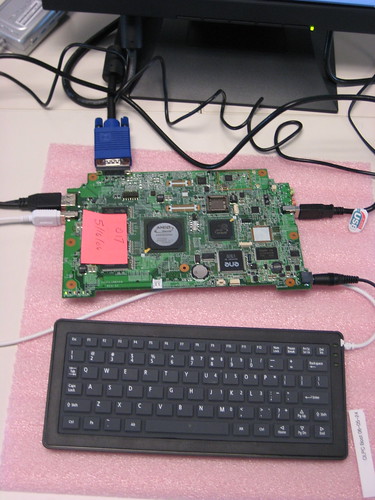
 I attended