Edtech

Jonah and the Cetacea
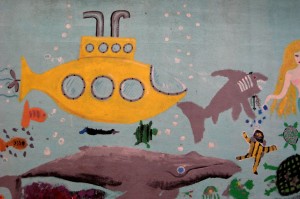
I recently returned from an amazing trip to Cairo, with a 36-hour stopover in Istanbul on the way home. While there, I learned something wonderful about the meaning of my name that continues to make me smile. While I am not a strict Nominative Determinist, I do take Plato’s Cratylus dialogue more seriously than most. I love learning new names, and often ask people what their names mean. Perhaps this fascination stems from the fact that my ambivalent parents gave me 5 (!) names, not including my surname, and my godfather gave me one more after I injured my back.  I have spent a great deal of time contemplating names and attempting to integrate mine into a coherent identity. Growing up I was always the only ‘Jonah’ I knew. In the 90’s the name gained popularity, but I still reflexively turn everytime I hear it (I can only imagine that Johns and Michaels learn to tune these out). The Old Testament’s Book of Jonah is a fabulous story. I’ve studied it closely and continue to find gems of wisdom and mystical insights. I have always appreciated that Jonah was: 1) One of the few (only?) prophets in the Old Testament sent to help the gentiles. 2) One of the only prophets in the Old Testament that anyone ever listened to!  In the closing coda, a mysterious “gourd” casts a shadow over Jonah’s mind (what kind of plant was this magical qiyqayown?), leading him to a transcendental experience in the desert where he learned to appreciate the universal nature of humanity. Great stuff - succinct, but it packs a punch. For a while I have known that Jonah the prophet was called Yunus (????) in the Qur’an. Jonah’s story in the Qur’an is quite similar to the Old Testament, though much shorter  (in the Qur’an Jonah is close friends with Jinns ;-)).  In Hebrew Jonah (??????) means ‘dove’.  Noah sent out 3 Jonahs to see if the flood waters had receded. But, to the best of my knowledge, Yunus does not mean anything special in Arabic. In Istanbul I learned that in Turkish, Yunus means dolphin. What a trip. In the past, in order to read the story of Jonah literally, I used to have to postulate UFOs or Yellow Submarines. I wasn’t quite as skeptical as this critic, but the story never added up on the plane of mundane reality. What if Jonah was saved by a dolphin(s)? Instead of being swallowed by a ‘Big Fish’, he could have been engulfed by a pod of dolphins. Sailors being saved by dolphins was a common motif in the ancient world. For example, Telemachus, son of Ulysses, was saved by dolphins, and to this day, we continue to confirm reports of humans saved by dolphins. Doves and Dolphins. What a name.
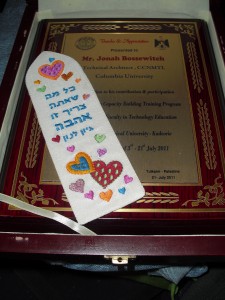
If I forget you, O Palestine...

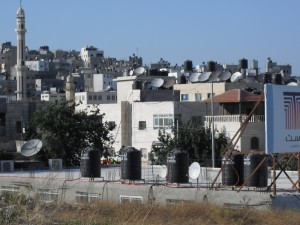
I just returned from the eduventure of a lifetime in Palestine and Israel.  I travelled to the Palestine Technical University of Kadoorie  to consult on a World Bank funded project to help enhance technology education. The details of this project are inspiring and provocative, but before discussing educational technology, media literacy, and capacity building I need to talk about my direct experience of The Occupation. As I anticipated before the trip, my understanding of the Israeli-Palestinian conflict was transformed by my first-person experience of the occupation. Within an hour crossing the Kalandia checkpoint into Ramallah, I began to experience a harshness that is almost impossible to capture in a snapshot. Superficially, life in Palestine seems almost normal. Everyone we met was warm and friendly, and I did not encounter extreme third-world poverty. However, during my visit I learned how virtually every aspect of ordinary Palestinian life is occupied.  Electricity, fuel, mobility, connectivity, information, and water are all tightly rationed and controlled by Israel. Before the trip I had heard about the checkpoints, but it is difficult to capture the feelings of intimidation and harassment until you are stuck in checkpoint-traffic watching a Palestinian adolescent being handcuffed and manhandled on the side of the road. I began to feel the harsh gaze of the guard towers, and the spit-in-the-face of the  Israeli flags, waving  arrogantly. The most shocking reality I learned about is the Palestinian water situation. Many Palestinians only have running water a few days a week. One quick way to tell the Arab homes apart from the settler’s homes is that the Arab homes have big black water tanks on their roofs to capture water while it is running.  In contrast, the settlers homes have water 24x7, and many have swimming pools and lush lawns. I kept thinking of this iconic image: and its visually gripping corollaries: Comparisons between the occupation and South African apartheid are common, but on this trip I began to relate the struggle to Jim Crow, the civil rights movement, and racial profiling and injustice that continue to oppress  US minorities. I also learned about the regulation of information flows. On an Egged bus in Israel, I had a better connection over free wifi than anywhere in Palestine, including the universities. Palestinian telcom companies are currently forbidden from rolling out 3G networks, building new communication lines between cities is notoriously difficult, someone I met was not allowed to import routers, and Palestine cannot connect directly to the Mediterranean backbone.  [Incidentally, a local group of activists is trying to set up free wifi in Ramallah, but they are being thwarted by Palestinian telcoms!] Like their physical borders, all Internet traffic into and out of Palestine must cross through Israel first. Serendipitously, Richard Stallman was visiting Palestine while I was there!  Unfortunately, I missed his lectures, but I met up with a few people who saw him speak, and they reported that his  message of freedom and liberation resonated strongly with his audience. I also connected with ma3bar.org - a society for Arab free and open source software, and ArabEyes – an Arabic-FLOSS translation project . I developed fresh insights into the role of free software in resistance and activism – especially as I appreciated the strength of the human networks that power free software, and the relative safety of engaging in this kind of organising (as opposed to being tagged by the authorities as an peace activist). More about this in future posts. Scholarship such as Eyal Wiezman’s Hollow Land and Helga Souri’s work attempt to describe the Palestinian experience of the occupation, but the situation is so complex and hyper-mediated I recommend that anyone who wants to learn more should visit the West Bank themselves (special thanks to Dalia Otham for the conversations and introducing me to this work). Anyone with the smallest compassionate bone in their body will undoubtedly sympathize with with the Palestinian cause. There is so much more to write. The specifics of our educational technology workshops, travelling and working with my advisor and a fabulous team from TC , the hospitality of our hosts at PTUK, the amazing sweet deserts, my tour of the graffiti on the Palestinian side of the wall,  the culture shock of leaving the West Bank and visiting my sister (and my four amazing nephews and brother-in-law) on a zionist kibbutz, the Israeli friends and family I connected with across the ideological spectrum, my visit to Sheva Chaya’s mystical glass blowing studio/gallery, diving an underwater museum in Caesarea, whitewater rafting down the Jordan with my nephews,  and Mushon’s personal guided tour (complete with analysis!) of the incredible housing protests erupting across Israel. To be continued…

Crossing the line

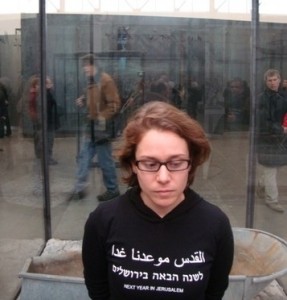
This week I am heading to the West Bank for work (!?!): Enhancing Technology Education in Palestinian Universities (etep). I will be spending a week at Palestinian Universities participating in capacity building workshops around educational technology. The University I am visiting is preparing to set up a group like CCNMTL and we are going to consult and share our experiences around these efforts. I am anxious and excited about the trip. I have visited Israel numerous times in my life, but have never crossed the green line. My knowledge of the situation on the ground has been hyper-mediated, and witnessing the it in person will likely be transformative. I am doubtful that my first-person accounts will lend much more credibility or persuasiveness to future debates, but I anticipate that my own understanding and assurance will grow. There are times and places for protests and flytillas, but I am hopeful that collaborating around shared objectives, working together on projects, and introducing radical pedagogical interventions will have a significant impact on promoting peace over the long-term.

The Interdisciplinary Kissing Problem

websLast week I participated in the architecture school’s visualization seminar and  was treated to a mind-blowing presentation by Tony Jebara, a Columbia Computer Scientist. Jebara is a young associate professor who researches machine learning, graphs, and visualizations, and is also the chief scientist at CitySense.com. His lab “develops novel algorithms that use data to model complex real-world phenomena and to make accurate predictions about them.” They also work on improving the readability of massive volumes of multi-dimensional data, and are currently focusing on making sense of networks of people and places (take a wild guess who else is interested in their work). CitySense is an application that runs on mobile devices and from their location data…

Hot off the Collaborative Digital Press

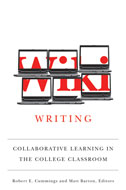
At long last! Wiki Writing: Collaborative Learning in the College Classroom has finally been published. An anthology of peer-reviewed essays on teaching and learning with wikis, the first two chapters in the book are written by myself, my coworkers, and my friends.  Mark Phillipson contributed “Wikis in the Classroom: A Taxonomy,” and Myself, John Frankfurt, and Alex Gail Shermansong teamed up with Professor Robin Kelley, our faculty partner on the Social Justice Wiki, to write “Wiki Justice, Social Ergonomics, and Ethical Collaborations.” Over 3 years since the Call For Papers, and a long and arduous review process, the hard copy of this book is now available for purchase from the University of Michigan Press and at Amazon, and will soon be available to explore free of charge at the Digital Culture Books website. It think they may have grown the trees before killing them for the paper. The half-life of the subject matter certainly warranted a more rapid turnaround, but I guess that’s the sound of dying media letting out its last wheeze. I am also disappointed that the hard copy managed to publish the wrong, older version of my diagram. So, for my first erratum, here is the figure that should have been printed: Social Software Value Space. Gripe, gripe, gripe. Actually, I am thrilled this came together, and think the book looks great and will stand the test of time. I’m also happy the digital version of the book will be available for free, though I am not certain the book made it out under a Creative Commons license. A huge thanks to our editors (Robert E. Cummings and Matt Barton, whom I have yet to meet in person) for persevering and making this happen.

Lost in Controversy

This summer, Bruno Latour was our tour guide - leading the way, not out of The Cave, but beyond the entire Cave System. Along the journey I also learned about a very interesting pedagogical technique intended to take engineering students on a similar journey. Students at Sciences-Politique and Ecole des Mines in Paris, as well as at MIT in Boston are learning to map techno-scientific controversies according to a method which embodies Actor-Network-Theory (without all of the heavy theoretical jargon).  Past projects can be found at the Mapping Controversies web site, and Bruno Latour himself explains the project and its aspirations in this video. Many of the possibilities explored in these new media projects are related to a broader question I have been interested lately concerning the impact that technology is having on epistemology itself. How is technology and new media changing what is knowable and how we go about knowing?  I wrote an essay last Spring, The Bionic Social Scientist: Human Sciences and Emerging Ways of Knowing, which begins to explore these questions, and it is wonderful to see more examples of these ideas materializing around us. The Mapping Controversies pedagogy involves teams of students taking on the role of statistician, investigative journalist, scientist, and webmaster, working to research and represent a controversy. They discover (and depict) that concepts themselves vary depending upon who is speaking about them, and attempt to map these relations and progressions over time. I can imagine this technique displacing the traditional 5 ‘W’s of journalism - The venerable Who, What, When, Where, & Why needs to b upgraded to a multi-dimensional, post-modern, reality. What varies and depends upon who, where, and when, and without the kinds of research and representations that the Mapping Controversies project is pioneering, we will never adequately capture the multiplicities of whys. I don’t know if these kinds of representations are intermediate forms of research, or if one day they will be part of the final production delivered as news to readers, but it is an important question to begin to grapple with. Right now, the Mapping Controversies sites are somewhat anti-social - they are fixed, one-way communications, but from the introductory video, they hope to change this soon. At the moment, each map is also a unique work of art.  While it is premature to confine anyone yet to the paradigmatic blinders of conformity, I also think it is imperative for us to begin to imagine and develop a visual vocabulary that we can re/use when representing these kinds of relations. In the field of information visualization, researchers are beginning to catalog Information Design Patterns that maps like this could build upon. Of course, riffs and variations from these patterns are welcome, where significant and meaningful, but a common starting point will improve the communicativity of these maps. As these patterns solidify, the corresponding implementation patterns can grow along with these efforts, as tools like Ben Fry’s Processing Framework (recently ported from java to javascript, which is much more web friendly, and used extensively in the MOMA’s Design and the Elastic Mind exhibit), will begin to institutionalize the knowledge learned in constructing these maps. And, of course, all of the code and content used to create these projects should be free and open, so the world can learn and improve on their foundations.

Promiscuous Laptops

escher_hands.jpgSo, I published another post on OLPCNews today: Sharing and Not-Sharing Alike User Generated Content I am trying to figure out the best way to aggregate my own work, and am a little stumped. On the one hand, I don’t want to duplicate content, but on the other, I am skeptical of the long term prospects of some of the sites I have contributed to. Guess that’s what happens when you don’t own your own data. Anyway, I am starting to at least keep a running list of links to this kind of stuff. I know these aren’t all traditional “publications”, but it is important that people start regarding some of these kinds of contributions along these lines.

OLPC Field Repair

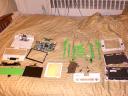
466296547_46b55653ce.jpgAt last month’s incredible Teach Think Play Conference I was fortunate enough to borrow an OLPC laptop from a good friend. As usual, the tangible green machine was a Pop Star (though in this educator crowd, most were not familiar with the project), garnering interest and attention wherever it travels. Sadly, the machine I had borrowed had some serious power issues, and I could not demo Sugar - the linux-based, free operating system developed specifically for the OLPC - to any of the attendees. Since my employer CCNMTL is a participant in the OLPC developer program (thusfar we have only received a raw motherboard, not a complete laptop), I decided to attempt a field repair of the OLPC in the vain hope I might be able to swap boards and get the unit running again. I discovered that the OLPC hardware (at least at this stage) is not quite as easy to disassemble as one would hope - you really need more of a clean room than a Third-World repair shop to work on this model. Still, a few iconic cues directing disassembly, like on a Thinkpad or Apple, would go a long way. Amazingly, there were no moving parts! In any case, I visually documented the disassembly process, but I don’t think I am going to be able to put humpty dumpty back together again any time soon. I guess I owe my friend $100 (well, now $150), since that is the list price of the OLPC.

Teaching, Thinking, and Playing: Day One

Today I attended day 1 of this year’s amazing Cultural Studies conference at Teachers College - Popular Culture in the Classroom: Teach, Think, Play. The morning kicked off with a Keynote by Taylor Mali, a spoken word philosopher-poet who perpetrates lyrical homicide against those who judge others according to their salary instead of the difference people are making in the world. I highly recommend taking a listen to some of his work, as he is working to inspire 1000 new teachers, and is only up to ~160. I presented a hybrid of my SXSW talk, Teaching in the New Vernacular, and Chris Blizzard’s OLPC introduction in a session called: Portable Culture Machines: One Multimedia Studio Per Child (the proposal had been published on OLPCNews). The talk was well attended, and the conference attendees were very excited to see/touch/feel/smell the XO device I borrowed from a friend. Ernest Washington gave a great session on teaching w/ hip hop, but for me the real takeaway was a perspective on education as the “cultivation of emotions” - this talk really connected alot of dots I have been working on lately, especially the “chemical swaddling” conversation I have been having with Philip Dawdy of Furious Seasons. The Media About Youth Consortium, a group print and film journalists (Alissa Quart, Jennifer Dworkin, Maia Szalavitz, Joie Jager-Hyman) spoke about their work and issues they are facing on the publishing front. Jan Jagodzinski gave a fabulous and fun (but substantive and deeply critical )reading of everything from Borat to South Park, and of designer capitalism through the eyes of a Kynic (not to be confused with a cynic). Art Spiegelman, the creative force behind Maus gave a wonderful history of the comic strip (and more generally, the genre of narrative storytelling with text and images) and his wife, Francoise Mouly, the Art editor of the New Yorker, gave back to back talks. Finally, Will Pearson the President of mental_floss (a magazine in the spirit of highlights which entertains while it teaches) closed out the day with a lively talk explaining their history, and why Einstein appears on every cover. And tomorrow’s schedule is jam packed too!