Art

Permanent Records

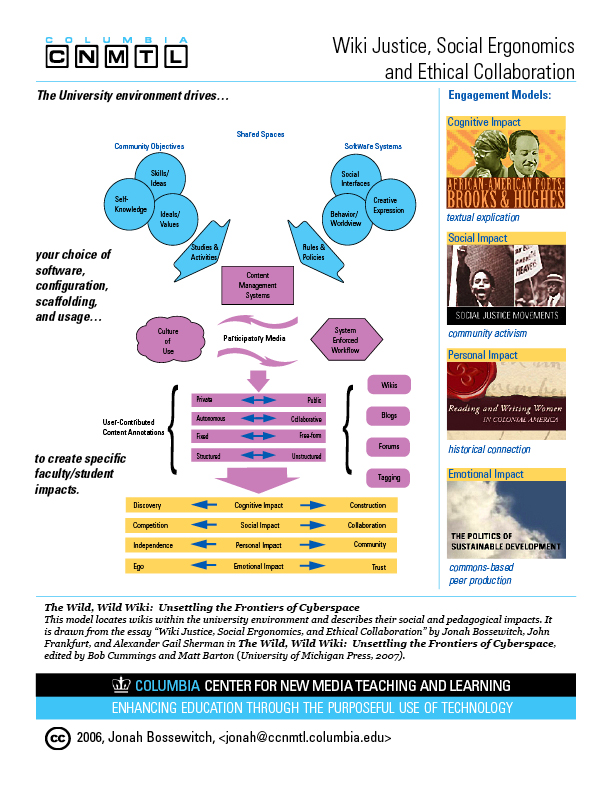
Sonnabend DiagramToday I presented last year’s bioport Part II paper to the 2nd annual Cultural Studies conference at Teachers College. Permanent Records: Personal, Cultural, and Social Implications of Pervasive Omniscient Surveillance I think the distilled version of this model if far more digestible and accessible than the papers. One of my co-panelists is doing some really interesting work with urban youth in the bronx, and gathering incredible interview materials about the perceptions of surveillance by these youth, and their forms of resistance. These stories might help convey the violence of a surveillance society. The conference format was a bit disappointing. I can barely believe academics still read their papers to each other at conferences - there are so many things that Open Source does right, including, knowing how to throw a great conference. Even the variety of presentation formats is an idea that needs to spread - BOFs, lighting talks, presentations and posters all create different spaces and dynamics for interactions between participants. The traditional model is so intimidating that it seems like many people are discouraged from participating. More importantly, the social justice issues and governance models that are being explored by F/OSS projects are really important for the Cultural/Critical studies folks to be considering. It is also shocking how disconnected they are from the freeculture movement, and its theoretical roots. Arguably, the freeculture movement is a shadow struggle, mirroring the struggles for sustainability, and against globalization and the logic of capitalism being conducted in the physical world. But, it may also represent the actual ground on which that struggle is being conducted.

Saints in the Church of Writely?

Two months back I saw Richard Stallman talk at a NYC Gnubies event and I asked him a question that I have been thinking alot about lately – Would a Saint in the Church of Emacs use gmail? To me the question revolves around the growing threat that 3rd party webservices poses to the freedoms that free software is designed to protect. In O’Reilly’s What is Web 2.0 he argues that software is transitioning from an artifact to a service, and that data is becoming the new “intel inside”. In an age when applications have become commodities, could the freedom of my data (in an open format) be interchangeable with the freedom of software? I recently listened to the Chief Open Source Officer at Sun Mircosystems pose a similar question in his talk, The Zen of Free. He talks about the importance of Open Software implementing Open Standards, which is close to the idea I have been advocating, but doesn’t quite go far enough. Using free (as in beer) third party web services is very tempting, but I am worrying more and more about the traditional freedoms that free software protects against - vendor lock-in, proprietary data formats, and freedom to modify policy according to application specific requirements. I would be less antsy about using web 2.0 apps if I had some assurance that I could get my data back out without screenscraping a bunch of html pages. Even services with APIs like flickr and delicious create vulnerabilities, as I was loathe to discover last week. Delicious provides a programmers api, but its api only exposes methods which operate on a single user. Thus, if you want to export a collection of links that have all been tagged with a particular tag, (reasonable if you are engaged with a community in distributed research) you are back to screenscraping! These considerations and more advocate for the need for free (as in speech) versions of many of these services. There are certainly some side-effects of running a centralized service that are inherent in it being centralized, but many communities are making use of these “public” services because of their convenience, and the ease with which they can be “mashed up.” Which brings me back to the design that we have been thinking alot about at work lately. Anders and I presented a talk at pycon demonstrating some of these ideas. Anders did a great job writing our talk up here: Tasty Lightning Crucially, it is imperative not to conflate our advocacy for building components that expose themselves as webservices with building apps against third-party web services. The design we describe resembles a traditional mash-up, except the components involved are locally controlled as opposed to relying upon external, corporate services. For all the usual f/oss reasons it can be important to “own” and run your own services. But this argument also has everything in the world to do with Ulises In Defense of the Digital Divide as Paralogy essay. In this essay Ulises grapples with Lyotard’s critique of new media under the logic of capitalism which has “established commodification and efficiency as the ultimate measures of the value of knowledge.” he continues:

Faster, Better, Cheaper

Originally published on theploneblog.org In this episode, Sean Kelly at NASA compares j2ee, rails, zope/plone, turbogears, django… cue the laughtrack Okay, this is a long one, but it rivals any comparison matrix: better-web-app Plone comes out shining, although arguably it compares apples to pomellas.  Someone with the chops should really cut this baby up into chapters, cause its  a win for dynamic  languages over j2ee, and python, and Plone to boot. (spoiler: he uses the zmi for “hello world” and ArchGenXML for the time tracking app).

Closing Thoughts on MSTU 5510

Ulises recently asked us to summarize our thoughts for the semester in our blogs. Considering that this blog was started for this class, I was surprised by my own initial resentment at being asked to post something so specific here. During the course of the semester, this forum has become a place for me to speak, not to answer. Even when I was posting assignments for class, they were items and issues which I selected and chose. This initial emotional reaction indicates how engaging these tools can become, and helped me answer some of the questions on Uilses’ list. Its been great fun! Best of luck to everyone, and see you on Tuesday.

Plone in an Elevator

Originally published on theploneblog.org How hybrid economies help keep software honest. Last week’s Plone Conference was truly phenomenal - provocative, intense, and fun (big thanks Jon and ONE/Northwest!). One of the most amazing things I experienced last week was alluded to in Eben Moglen’s keynote (to be posted soon)- the manner in which this community has managed to bring together people who don’t ordinarily interact. Throughout the breakout sessions, I continued to question dividing us up according to our respective vertical sectors - Corporate, Non-Profit, Educational, and Government. As I have begun to write about elsewhere, systems like Plone can help balance the flow of communication and power between people in a variety of situations and settings. Content, collaboration, and community are contexts which exist across sectors, and the tools we all need cross over as well (sometimes with slightly different tunings). In many ways lumping together all the folks involved with education is odd. Universities are microcosms of cities, and their IT needs are as diverse as the the rest of the world. However, there are still structural and social similarities that form the basis for common language and culture. After engaging with my fellow educators a the educational panel session and the BOF session I understood the value of us sharing and strategizing, beyond just commiseration. But through it all, there was one thing that united all of the different attendees - a piece of general purpose software called ‘Plone’. It is worth dwelling on this mixture of participants and the varying forces they apply to the software. Lessig and Benkler have both been writing a great deal about hybrid economies lately, trying to understand their rhythms, and how we might be able to design them to succeed. They have been writing generally about the “commercial economy” and the “second economy” (sharing, social production, etc), but the lessons may cross over directly to our community. I realized in Seattle how beneficial diversity can be for software production. Most of the consultants using Plone are there strictly for traditional market considerations - to make a profit. They are helping to keep the software honest. Unlike some other open source projects which exclusively service the educational world, Plone is not sheltered from the raw, harsh forces of the commercial market. This means that some of the people using Plone use it because it helps them get their jobs done efficiently. Others have called this “productivity arbitrage”, and it is a concept that may hold the key to designing successful open source projects. It is challenging to imagine working backwards and trying to design a software ecology which captures the hearts and minds of such a diverse following. No small task. As Rheingold said “There’s been an assumption that since communism failed, capitalism is triumphant, therefore humans have stopped evolving new systems for economic production.” - Is Plone’s ecology an example of one of these new systems, and if so, what are our distinguishing characteristics?

New York's Darker History

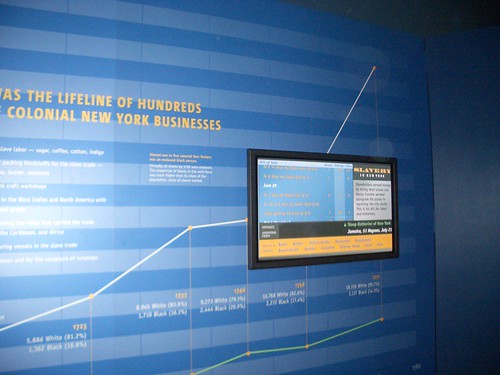
This weekend I attended the masterfully produced Slavery in New York exhibit at the New York Historical Society. The exhibit was deeply moving, and vividly and viscerally captured a portrait of African American history I was not fully aware of previously. I left the exhibit with a new understanding of how the 400 year long institution of slavery was a tragedy fully on par with the Nazi Holacaust. I will save a discussion of the show’s content for another time, but for now I want to focus on the amazing use of educational technology woven throughout the exhibit. From start to finish, the show effectively incorporated video, interactive kiosks, and innovative displays which pushed the boundaries of some of the best work I have seen in this field. The use of screens is a topic that is on my mind from my studies of Lev Manovich this semester, and this exhibit incorporated many cutting edge treatments of the screen. To start with, at the beginning of the exhibit, the visitor is confronted with video commentary of the reactions of past visitors, and at the end of the exhibit a self-service video booth allowed visitors to record their own commentary. I have never seen a self-service video booth like this incorporated into an museum exhibition, and it was very powerful and impressive. Beyond that, their ability to transport the visitor to the reality of the past was greatly enhanced by their translation of historical abstractions to modern day interfaces. In particular, I am thinking of the classified ads advertising slaves for sale and offering rewards for runaways, the presentation of the slave ship logs, and most strikingly, the presentation of the slave economy in a bloomberg-style terminal. The cold economics of slavery were driven home by the scrolling marquee listing the numbers of Negros arriving on incoming ships, and the fluctuating going rates of various skills. The incorporation of video throughout the exhibit, from overhearing the conversation of slaves gathered around a well (in a brilliant interface), to the dialogue between the portraits of ornately framed talking heads, to the interactive choose-your-own-adventure kiosks was incredibly well done, and offered accessibility and deep learning even to the fragmented attentions of the postmodern era. I highly recommend visiting this exhibition, as the web site barely begins to do it justice.

Fraternal Nearness

In his post Social agency and the intersection of communities and networks, Ulises Mejias expounds on the differences between communities and networks, and relates these concepts to the possibility of ontological nearness. The placement of communities within this continuum can be understood more clearly by the immediacy, intensity and intimacy of the interactions. This conceptual apparatus is helpful for me to being to explain a phenomena that I have been thinking about for a while now. Part of the question can be though about as: What motivates the open source developer? Why would someone who works full time, often writing code professionally, choose to volunteer their nights and weekends to the continued production of more code? I think this question is an important one for the educational community, since if we could identify this source of motivation, we might be able to “bottle it” and recreate it within the classroom. My experiences with the Plone community has given me some insight into this question, and I think that the phenomena of Open Source projects would benefit from an analysis using the ideas proposed in Mejias’ draft. While many people imagine that open source communities are purely virtual (the non-possibility of a virtual community notwithstanding) , it is important to recognize the ways in which these networks of individual developers become communities. Open Source projects typically use a variety of Social Software tools to communicate - email and mailing lists, web sites, forums, discussion boards, blogs, and irc, to name a few. They also often hold face-to-face conferences, and some projects even regularly arrange sprints (also). Anecdotally, I found it fascinating to observe a progression in intimacy, to the point where some people’s day jobs are just what they do between conferences and sprints. It is no secret that sprints and conferences help make these communities function, cementing interactions over mailing lists and irc. But an interesting comparison that I would like to propose, which I think can also be described according to the dimensions proposed by Schutz, is the similarity between an Open Source community and a college Fraternity. [Disclaimer: I was never in a college fraternity, so this analysis is partially speculative] Fraternities (and I suppose professional guilds and/or unions which they might be related to) are an example of an extended network/community which is disappearing from the modern urban reality. Some people find these kinds of connections in religious congregations, but otherwise many of us have lost the extended networks of people we know, but not intimately or closely. Like fraternities, Open Source projects typically have a steep gender imbalance, members often go by aliases or nicknames, develop internal languages, acronyms, and lore. The “project” or “organization” becomes an independent object of importance that members become loyal to, and devote their time and resources to supporting. Eric Raymond has written a bit on the motivations and structure of the hacker community. I have also heard alternate accounts of developer motivation, beyond status and recognition, that have to do with escape from “reality” and immersion in an environment that the developer completely controls. There are many potent sociological, ethnographic, and anthropological research questions that this touches on, many under active research (e.g. Effective work practices for Free and Open Source Software development, or wikipedia’s research pages). In summary, I think that Mejias’ framework is very useful, but would benefit greatly from more examples which exercise the ideas. Perhaps we can work these categories into our ssa wiki.


slipery handles

Today I leared that a friend of mine changes her IM handle every time she switches jobs. That’s nothing, she changes emails every time a relationship ends. I don’t know why or when she started doing this, but the more I think about it, the more sense it makes.

"Because its your music, and you paid for it"

This afternoon I attended a talk given by Bill Gates at Columbia University. The talk was a part of his university tour, probably prompted by the well documented braindrain happening at MS right now (Certain well known competitors seem to be following the strategy outlined in Good to Great - get the smartest people you can find “on the bus”, and then let them drive…). Here are my raw notes. I must say that this afternoon’s talk was a bizarre experience. Perhaps its all the theory stuff I have been reading lately, but I was in a very psychoanalytic, read between the lines, kind of mood, trying to pay as much attention to what he didn’t say, as to what he did. First, he has clearly taken some lessons from Steve Jobs. He presented casually and demoed live software. One big difference - while Jobs enjoys demoing creative authoring tools, Gates spends most of his time demoing tools of consumption. He continues to treat his gadgets as receivers, not transmitters, and this is all getting a bit tiring. Next, close to all the software contexts he described were business and work related. There was very little talk about socializing or play (save for the xbox, and socializing in that virtual space). It was eerie that when someone asked him what his greatest accomplishments were, he responded how much he loved work (and working at his foundation). All of his examples for the uses of ubiquitous computing were work/consumer related (auto tracking receipts for expense reports, shopping, collecting business cards when traveling, Location info - while in traffic (presumably while commuting)) – this is all summed up with his grand vision of the future smartphone as replacement for wallet. Isn’t there something else the phone could replace? Could our phones become surrogate brains, man’s best friend, or personal assistants? Can’t we conjure up a better metaphor than wallets for how software will change the world? Will it do anything beyond making us better and more efficient shoppers? The talk kept getting weirder - Gates played a video, which most of the audience thought was very funny. I will have to save my analysis for my Media and Cultural Theory class (or the comments), but it really threw me off. Gates never mentioned Google, Firefox, or Linux. Did acknowledge the wikipedia (by name), freebsd, sendmail, and the NSCA browser. He even made two truly surprising statements regarding IP - after demoing that the new XBox 360 will connect to an IPod, an audience member asked if it would be able to play fairplay protected ACC files. Gates responded that it won’t be able to, because Apple won’t let him (Ha!), to which he added “its your music and you paid for it.” He also stated that “studios have gone overboard in protection scheme”, and " will always have free and commercial software." Before the session, they passed around cards with potential questions (I am still not sure if the questioners were plants, reading these cards…). Here were my, never asked questions:

Serenity Lost

Nothing like a little pulp sci-fi to resonate with a class on emerging tech. I saw Serenity tonight (skip this post until you have seen it, unless you aren’t planning to at all) and was amused at how a central plot line revolved around some information that has been covered up by the authorities, and the struggle to disseminate that message. The simplicity of a single message whose content can change the world, and a single distribution channel from which to broadcast it from is amusing, but poignant. I mean, if you could broadcast one message to the world, what would it be? Are these folksonomies helping in filtering and distributing this information, or are we just ending up on our same disconnected islands of information we started from. I am thinking of the disjoint sets of books that liberals and conservatives read, but there must be many other examples - perhaps the entire blogosphere falls into this category. One thing I have realized as I begin to rely more and more on my rss client, is that once I am lost inside of it, if you aren’t syndicating a feed, you don’t exist. I am quite aware that a full-blown information war is currently underway. The existence (and adoption) of Flickr allow me laugh at the Bush administrations attempts to prevent the publication of Katrina’s casualties, but how did this story get swallowed up? If bittorrent didn’t exist (or was outlawed) and we could not reclaim the “lost” bandwidth of individual broadband subscribers, large file transfers and exchanges would probably have to be mediated through centralized bandwidth providers like akamai or cisco. But this is not quite as simple as centralized vs. decentralized publishing models, since that is only half the equation. The information retrieval needs to happen on the other end, or else you’re screaming into an abyss. I was once lucky enough to find myself in a conversation with the author of citeulike. I casually inquired as to whether he was planning on releasing the engine which powers his site under an open license. He replied that he would, but that it would be a bad idea. citeulike is supposed to be a service, not a product. Its value is actually diluted the more there are that are running. Part of flickr or delicious’ power are in their popularity. They are much more effective the more users they have, leaving us once again in a paradoxical quandary, where we need a decentralized, centralized service. Too many flickrs, and they are all rendered weaker, and too few, and we are back in a situation where our information is in danger of being homogenized, controlled, and filtered.