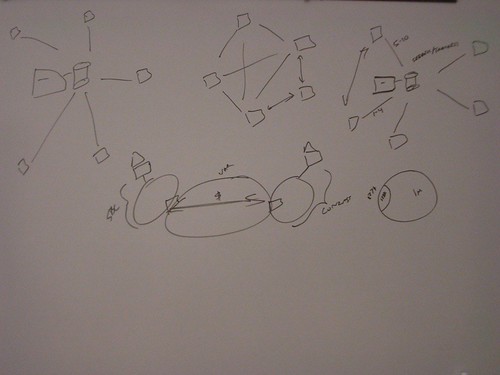
 I had an interesting conversation with Brian Taptich, the VP of Business Development at bittorrent.com and gained an insight into the machinations of the industry.
I learned that “Big Media” only now appreciates how good they had it back in Napster days, when every file download was logged and tracked through the central Napster server. Now that they are starting down the barrel of true peer-to-peer networking (which bittorrent – the protocol, not the company – affords), they have the perspective to appreciate in hindsight the benefits that omni-present surveillence provides for them.
You could even speculate that bittorrent.com’s value proposition is to turn the bittorrent protocol, back into Napster. If they become the central clearinghouse of bittorrent seeds, they can (and will) keep records of all of the network activity. What files are being exchanged, and who is exchanging them.
In bittorrent, the seeds are the servers, and technically these seeds can be distributed all across the Internet. I was really surprised to learn that Brian was actually aware of an obscure branch of Austrian code for the PloneMultimedia product which auto-generates bittorrent seeds (which we helped merge into the trunk at the Big Apple Sprint). Apparently, The Lawyers were getting all antsy about the existence of tools which make seeding all too easy. Right now, it takes a degree of technical know how to create these ad-hoc bittorrent servers, but once the auto-generation tools make it out to the premier blog, wiki, and CMS platforms, there won’t be much stopping them.
The delicate balance between the overly concentrated power of centralized services vs. their practical usefulness is a theme I began to explore in my post on Serenity. I have also imagined other contexts (e.g. Creative Commons licensing) where simply landing an important feature in the top dozen authoring tools could really shift the scales in terms of adoption. I continue to actively wonder what features could be introduced to these tools to promote equality, democracy, and social justice.
Someone should tell the lawyers that the cat’s head has already wriggled out of the bag, and when she gets out she is going to teach her peers the same trick.
I had an interesting conversation with Brian Taptich, the VP of Business Development at bittorrent.com and gained an insight into the machinations of the industry.
I learned that “Big Media” only now appreciates how good they had it back in Napster days, when every file download was logged and tracked through the central Napster server. Now that they are starting down the barrel of true peer-to-peer networking (which bittorrent – the protocol, not the company – affords), they have the perspective to appreciate in hindsight the benefits that omni-present surveillence provides for them.
You could even speculate that bittorrent.com’s value proposition is to turn the bittorrent protocol, back into Napster. If they become the central clearinghouse of bittorrent seeds, they can (and will) keep records of all of the network activity. What files are being exchanged, and who is exchanging them.
In bittorrent, the seeds are the servers, and technically these seeds can be distributed all across the Internet. I was really surprised to learn that Brian was actually aware of an obscure branch of Austrian code for the PloneMultimedia product which auto-generates bittorrent seeds (which we helped merge into the trunk at the Big Apple Sprint). Apparently, The Lawyers were getting all antsy about the existence of tools which make seeding all too easy. Right now, it takes a degree of technical know how to create these ad-hoc bittorrent servers, but once the auto-generation tools make it out to the premier blog, wiki, and CMS platforms, there won’t be much stopping them.
The delicate balance between the overly concentrated power of centralized services vs. their practical usefulness is a theme I began to explore in my post on Serenity. I have also imagined other contexts (e.g. Creative Commons licensing) where simply landing an important feature in the top dozen authoring tools could really shift the scales in terms of adoption. I continue to actively wonder what features could be introduced to these tools to promote equality, democracy, and social justice.
Someone should tell the lawyers that the cat’s head has already wriggled out of the bag, and when she gets out she is going to teach her peers the same trick.

 then they laugh at you, then they fight you, then you win.
Nature has reported that American Association of Publishers (AAP) has hired a seasoned PR veteran to fight against open access scientific articles
Journal Publishers Hire PR ‘Pit Bull’ to Attack Open Access
I guess they are starting to take this “threat” (or rather, eventuality) rather seriously.
then they laugh at you, then they fight you, then you win.
Nature has reported that American Association of Publishers (AAP) has hired a seasoned PR veteran to fight against open access scientific articles
Journal Publishers Hire PR ‘Pit Bull’ to Attack Open Access
I guess they are starting to take this “threat” (or rather, eventuality) rather seriously. Well, I called it:
In in
Well, I called it:
In in 
 Free as in ‘Free of pollutants’, ‘free of politics’, and ‘conducive to human freedom’, not ‘free as in fusion’ or ‘free as in beer’.
On Wednesday night I saw
Free as in ‘Free of pollutants’, ‘free of politics’, and ‘conducive to human freedom’, not ‘free as in fusion’ or ‘free as in beer’.
On Wednesday night I saw  Well, midterms have come and gone, and somehow I managed to complete my two papers on time, somewhere between San Francisco and
  Over Memorial Day weekend I attended Fleet week, and made a few new friends. They happen to be robots, of the autonomous flying variety.
These little gadges come in a wide range of sizes, from wasp not much bigger than two hands all the way up to the predator, which is now armed with hellfire missiles.
For the time being, these robots are unarmed, but are all equipped with survaillance cameras. This explosion in optical feeds helps explain the urgency behind programs like Carnegie Mellon’s
Over Memorial Day weekend I attended Fleet week, and made a few new friends. They happen to be robots, of the autonomous flying variety.
These little gadges come in a wide range of sizes, from wasp not much bigger than two hands all the way up to the predator, which is now armed with hellfire missiles.
For the time being, these robots are unarmed, but are all equipped with survaillance cameras. This explosion in optical feeds helps explain the urgency behind programs like Carnegie Mellon’s  A recent visit to the new