Art

Jingles, Mantras, and Catch Phrases
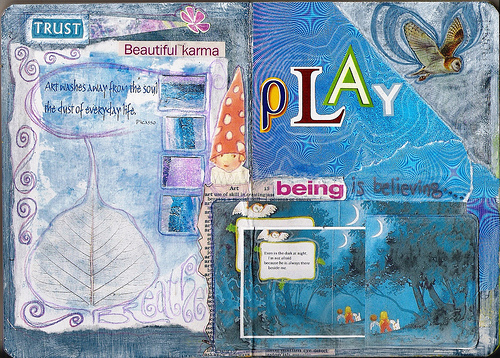
play as beingWell, I’m on day four of our experiment with Play as Being, and have noticed subtle changes in my mood, disposition, and preoccupations. I really like the rhythm of this discipline - in Piet/Parma’s words, this practice is an experiment in trading off duration for frequency. Between work and school I haven’t managed to carve out significant stretches of meditative duration the past few years, but the gentle, persistent redirection of my attention is somehow more manageable, and showing positive traces. I am more confident in my decision making, better at recognizing and balancing desire and self-control, and spending more time thinking about abstract concepts and questions. I have been very excited about this adventure, though I have self-censored and tempered my enthusiasm since I continue to be wary of the seductive siren’s song in the aesthetics of an unfamiliar media. I love learning and experiencing new things, but I sometimes have a tendency to go overboard, so I am trying to take things slow (I put myself in a lower tax bracket than my 1% cohorts - I only pause hourly, and drop by the tea house once every day or two). With the help of a new friend that I met at PyCon, who coincidentally works at Second Life, I am appreciating the value of this type of practice in the interest of cultivating a non-judgemental awareness. Could the mainstreaming of experiences like these become the catalyst for a widespread shift in consciousness? On the cognitive/phenomenal front, I crossed a threshold yesterday and actually experienced some SL memories. Unlike the afterimages (like after a day of playing tetris or picking mellons), these memories had a different quality. And, unlike trying to remember which page I read a story on the 2D web, these memories were vivid and real. I am realizing the ways in which an environment like this hacks my perceptual system, tuned over millennia of evolution to respond to faces and places. This riff has me thinking alot about neural hacking, and the ways in which we all can begin to deliberately program and alter our habits and patterns of perception and interpretation (errr, I guess some people probably just call that learning ;-) ..**. however, the metaphor of software has perhaps pushed our understanding of flexibility and malleability farther than ever: e.g. Mind Hacksand Your Brain: The Missing Manual). I think I can make a good argument that the safest and most effective way to reprogram our consciousness is through the natural interfaces that our mind provides - namely, our natural senses. Contrast this approach with the crude and barbaric attempts to modify mood and behaviour through pharmaceuticals. And compare this approach to the Mind Habbits “game”, which begins with the design question “Can we design an interactive multimedia experience designed to make people feel better?” My work and studies have been conditioning me to be more deliberate and purposeful in my use and design of technology. Second Life continues to present affordances and opportunities for learning and growth, but I still haven’t heard that many stories of this kind of targeted exploration, which specifically leverage’s the unique advantages of an immersive experience. There must be conversations like this happening in serious gaming circles, though in many ways, this project demonstrates that it isn’t the game that needs to be serious, rather the attitude, approach, and context that the participants bring to the table. Finally, here is an enumeration of some of the networks of concepts that this project has activated for me:
The Zen of Life^2

cgon370l.jpgI suppose it was only a matter of time before I experienced something within Second Life that caught my interest. Though I work on and study social software, I haven’t been particularly giddy about metaverses (multiplayer, persistent, 3D immersive environments) for a variety of reasons - perhaps tracing back to the fact that I haven’t really enjoyed playing too many computer games. As a free software developer I have participated in quite a few post-geographic projects where communication is managed quite effictively in 2D. While I recognize the value of ‘presence’ and synchronous communications, I doubted that an avatar added much additional value to a communicative experience. This semester I am personally participating in a digital studio, where we have held some meetings inside Adobe’s Connect, but have found the experience cumbersome, adding little value over irc (or, at least, VOIP + text, like in skype). I usually dread video conferenced meetings, though its sometimes worthwhile to share a browser. At work, we helped set up a Global Classroom for the Earth Institute, which has been receiving rave reviews, but is mostly just a shared video experience (with a few live events). Prior to this week, I have visited second life on a handful of occasions as a guest, but mostly just been reading about it, watching videos, and hovering over other people’s shoulders while they play. All this changed this week, after a chance encounter with a professor, Piet Hut, whose work I encountered years ago as an undergrad. His dialogue with Bas Van Fraassen on The Elements of Reality really helped me crystallize my thinking on a range of philosophical questions, and the perspective explored in this conversation may serve as an effective bridge between ancient and modern metaphysics. Prof. Hut is an astrophysicist at Princeton’s Institute for Advanced Study (which now, more than ever, reminds me of the village) , and he takes phenomenology and mysticism pretty seriously. His interdisciplinary research is really all over the map and I dig his philosophies of science. His writing is usually clear and free of jargon. I have not been keeping up with his work, but when I saw his name on the schedule at the CSSR Neuroscience and Free Will conference, I decided to crash his talk (and I figured there would be coffee and snacks). In his talk he mentioned some of his latest work inside of virtual worlds, including new ways of conceptualizing (scientific) simulations and research. I was quite receptive to this topic, since I have been thinking a whole lot about how Technology is transforming Epistemology, which I have started writing about here, and hope to expand upon at the end of this semester (um… that’s in a few weeks!). His latest project though is another trip entirely - (or, perhaps identical, from the inside-out ;-)). The project, Play As Being is described and tracked on that blog, and is a bit tough to explain in words - you sorta have to try it to understand/believe it. So, I kinda had an enlightening experience inside of SL. I learned about the potentialities of virtual worlds as phenomenological laboratories. While I was there last night I was attentive to my minds restlessness (how weird is it that after 45 minutes I was compelled to stand my avatar up and stretch my “legs”?) and learned a few new RL practices. I brought the lessons back to meatspace today, and was much more mindful of my body and breathing. I’m not on the full 1% time-tax rhythm, but I am working on picking out mnemonic bells so I can introduce a bit more discipline into the flow of my experience. In retrospect, I shouldn’t have been that surprised at the cognitive value of a 3D experience. I mean, I’ve read about The Loci Method in books like The Art of Memory. But the idea of using the environment as a Zen training studio really blew me away. I imagine you really need the right group for the experience to work, but I am quite impressed by this particular purposeful use of this instrument. It took a really good teacher(s), but I have a much better appreciation for effectively using SL as a space to practice mindfulness and contemplate Being. Has anyone else heard of things like this happening w/in SL?

Feeling the Sqeeze

Contrary to some of the disappointment chatter slithering around the blab-o-sphere, I had a phenomenal time at PyCon ‘08. While it is obvious that the conference (not the language ;-) ) had some scaling problems this year, I am confident that our community is self-reflective and humble enough to constructively digest this feedback and heal itself. This year’s conference had over 1k attendees (up from last year’s ~400), including 270+ sprinters who coded throughout the following week. The attendance, as well as the sponsorship exceeded all expectations, and there was a bit of awkwardness around the feeling that attendees captive attention was for sale. I thought the keynotes were solid, though a clearer system for indicating sponsorship will help next year. Lighting talks, usually my hands-down favorite, were a bit of a disaster - sponsors (many with nothing more to contribute than a hiring announcement) were promised priority and on Saturday some attendees were bumped off the schedule. I would also have appreciated a really inspirational keynote speaker, as well as additional efforts to raise awareness around the range of social justice issues our craft impacts. For me, this conference provided an opportunity to cut through traditional hierarchical communication channels and interact directly with senior developers across a wide variety of sectors. I spoke to people working in leading organizations servicing education, libraries, non-profits, journalism, scientific computing, desktop computing, mobile computing, embedded computing, enterprise consulting, interactive marketing, entertainment, defence, gaming, and many more. I spoke to systems administrators, language designers, programmers, architects, computer scientists, project managers, educators, and entrepreneurs. And all of this diversity was united by the common programming language we all use and love - Python. Python, the language, is itself open-source, and many projects written using python are free and open as well. The language, and its surrounding ecology has a distinct personality, and some of its normative values (at least its aesthetic ones) are captured in these principles, known as The Zen of Python. Approaching this conference from the sociological vantage point of a freshman doctoral student in communications, I certainly paid more attention to the reinforcement of cultural practices at this gathering than I used to. Many of the talks actively encouraged respect, sharing, playing nicely, and coding responsibly. In some cases these topics were the topic of the talk, not even the subtext. But the best part certainly had to be catching up with old friends and making new ones. For those of you that don’t know developers well, our craft involves the invention of the prototypical abstractions, the perpetual refinement of analytical distinctions, and the endless quest for their elegant synthesis. It only takes the slightest verbal nudge to shift the conversation to a metaphysical or theological domain, brining to bear the full brunt of these analytical methods on age-old questions. Maybe its just the developers I hang out with, but they are unquestionably a wise and philosophically-minded bunch. They also tend to love technology, python or otherwise, and are an incredible source to tap into for discussing and speculating emerging trends - from storage to cloud computing, from the browser wars to singularities, this crowd has knowledgeable opinions on them all. And as for the future of Python… well, I know that every year for the past ten have been the year of the linux desktop, but Python is incredibly positioned right now. There aren’t really that many contenders poised to displace Java, like Java displaced C/C++ (or Cobol, in the enterprise), but Python is going strong. From Sun’s and Microsoft’s very serious commitments to jython and IronPython, to Google and NASA’s commitment to Python, to MIT’s recent selection of Python as the language that CS 101 is taught in (and a robust educational community w/in the Python world) , we better figure this conf scaling thing out quickly, because next year is sure to be even bigger.

A panel of prophets?

psychic Last Thursday I participated in a panel at an event entitled “The Future of Digital Media: Predictions for 2008.” The event was recorded and will soon be posted, but in the meantime here is a page about the event with more details and some pictures. The even was hosted by Ember Media, held at The Armory and featured their CEO Clayton Banks keynoting some predictions for the coming year. The predictions didn’t contain too many shockers (though I have blogged 1.5 years ago here about where I think the set-top box is headed - hint: straight into your pocket, and Clayton’s legislative prediction about a minimum, symmetrical bandwidth goal is something I find hard to imagine in a country where we can’t get network neutrality, municipal wi-fi, or even rural connectivity right). After the keynote, Clayton asked myself and my fellow panellists - Kay Madati, VP of Community Connect, and Alan Stern, Editor CenterNetworks - a series of smart questions. It’s been a little while since I’ve hung out with this many entrepreneurs and it was refreshing. I definitely appreciated the opportunities to discuss privacy, the politics of bandwidth, and economics of sharing and test the theoretical chops I have been sharpening in grad school. Reflecting on the evening, I was a bit frustrated at what seemed like a get-rich-quick entitlement that some of the questions implied. At one point I wanted to shout - 9 out of 10 restaurants in NYC fail - why do you think your digital media company deserves anything different? Micropayments?!? I remember hearing that elusive siren song back in ‘99 at MaMaMedia… and smarter folks than I agree that free is a stable strategy… in fact, when copies are free, you need to sell things which can not be copied. Try concentrating on creating real value in the world, and trust me, the wealth will follow. But, I suppose not all of us have incorporated alchemical wisdom into our daily lives. Thanks to everyone who was involved in organizing this event - it was a great success!

A round trip ticket, out of this world

dancpengfront.jpg Since I am total flosstitute I do lots of my work on the beautiful OS X desktop, though the servers I administer are all linux, and on my new thinkpad laptop I finally bit the bullet and wiped the windows partition (it came with vista, so there wasn’t much deliberation). My only encounters with windows nowadays are through virtualization, so I feel like I have that demon safely caged. One of the things I love about the mac are the little easter eggs you can find if you hunt around long enough (or more likely accidentally stumble upon). One of these black-ops is the music visualization software that comes with iTunes (at least on OS X). I seem to recall something about a Christian fundamentalist writing it originally, right before joining the navy and serving on a submarine crew. Thing is, he couldn’t get this piece of software out of his head, and winded up leaving the military to work on this software full time. I think Madonna used to use early prototypes at her private parties, and one way or another he started working at Apple, apparently on the iTunes team. (this is all from memory, and I couldn’t find a source, in case anyone has heard this story also). In any case, I occasionally remember to check in on this tool, and it’s gotten better with ever release of OS X. I think last year I discovered that if you run it in full screen mode it seems to use a much improved rendering engine, and maybe even a different algorithm. None of this prepared me for the experience that I had Tuesday night. A few months back I learned about a wicked cool piece of software on Alexander Limi (the Plone founder’s) blog. The software is called nocturne, and is pretty friggin cool on its own. It’s not much more than a simple set of macros that invert the hues of your display - to either black and white, inverted color hues, or even submarine red. It’s really nice if you want to use your computer at the end of the day, but don’t want to deal with all the energy of a full backlight. So anyway, I had this kooky idea (no drugs involved!) to turn on the iTunes music visualizer with nocturne in night mode, and I simply could not believe my senses. I was witnessing the audioloom - an idea I had begun to think about a few years back that originated with the simple question - can synesthesia be learned? I became very interested in the natural relationships between color and sound, noticing that both seem to come in octaves (think of the color wheel - a venn diagram defining 3 singles, 3 doubles, 1 triple, and the background, making 7+1… just like the western musical scale!). I even remember what sparked this question. I was playing with a new set of Christmas lights, the kind with a remote control that makes the lights dance in different patterns. The important part of this experiment was leaving the lights ordered neatly in the box, instead of making a tangled mess. With this arrangement, when I played music, I could swear that the photons were dancing to the beat ;-) In any case, I was intrigued by the possibility that there might be a fundamental ontological relationship between sound and color, but even with this foray into metaphysics, I thought there might be a natural mapping between these two types of sense data, one that might be empirically determinable. I did some research on synesthesia, and read a great book called The Man Who Tasted Shapes. My idea began to take shape as a multi-phase project. Phase I was this screensaver on steroids, but Phase II is a musical instrument that plays light instead of sound. As with all fun ideas, there is nothing new under the sun, and many philosophers/inventors ranging from Aristotle to Newton to Benjamin Franklin have taken a crack at this problem (timeline), but the idea was ahead of its time… Until now. So, back to Nocturne’s night mode. When I went full screen with non-monotone inverted hues, I swear to god it felt like I was entering a wormhole. Right out of that scene in Carl Sagan’s Contact, except without the extraneous seat that the stupid humans built. I was transfixed, and will freely admit that on this first trip I spent a solid 2 hours staring at the screen and listening to my favorite tunes. Every time a song would end, I would wonder what another of my favorites would look like. I think the difference between day mode and night mode is that the visualizer outputs mostly dark. By inverting the hues, the screen explodes with backlit energy. Enough to keep your eyes working overtime. It was kinda like watching TV, except that instead of being hypnotizing, it was mesmerizing. I mean, I was grooving on my favorite music, but my eyes weren’t jealous of my ears - everyone had their work cut out for them. Unlike TV, the audioloom experience requires active processing, as your brain frantically struggles to find patters in the sequences and segues. Since I don’t think the shapes and transitions are computed deterministically, there is an element of Art combined with the engineering mathematics displayed on the screen. It made me wonder if this feeling would normally have required 10 years of devoted study in an ashram to replicate before this technology came along. One way or another, the experience was transcendental, and I just hope I haven’t stumbled upon the Videodrome, or the mysterious plot device in Infinite Jest… In any case, I plan to continue my experiments and keep you posted with updates. It is quite a relief that I might not actually need to implement this invention one day. Just goes to show, ideas kept secret, go stale.

Nostalgia Train

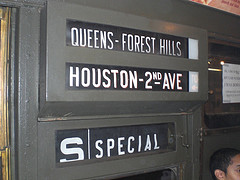
nostalgia_train.jpgYesterday I took a ride on the the S train - not the shuttle, the special. The MTA conducted a vintage run of some 1930s trains this month, including many of the original advertisements and maps. Amazingly, these trains were not replaced until the late 70s… I must have ridden on some of these as a child. I definitely remember the lights flickering on and off and the wicker seats. More pictures here.
Creep-Ola

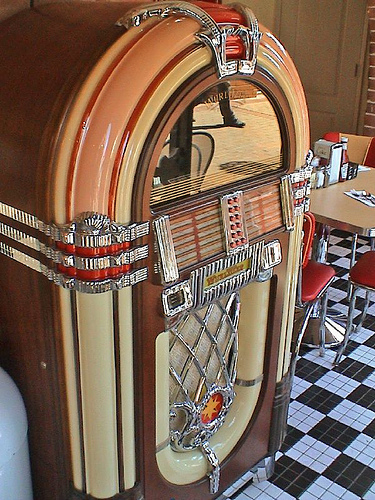
classic_jukebox.jpgLast Saturday night I was at a bar downtown for a friend’s birthday. I decided to pick out a few songs (no, I didn’t use the obnoxious “play now” feature). After selecting my songs, the Rock-Ola internet jukebox asked me if I wanted to take a quiz. It asked me for my gender and age bracket, and then asked me what issue I thought was the most important one in the 2008 presidential elections (I think the choices were the environment, ending the Iraq war, health care, social security, & What Election?). I was mildly surprised that this machine was collecting this kind of data, until I realized that they must be attempting to correlate musical taste with political leanings (they knew the songs I chose). This could come in quite handy when trying to directly target political advertising, or even redistricting. I couldn’t easily figure out who owns Rock-Ola, or where this information is going, but I hope to figure it out soon. The “right” playlist might one day qualify you for suspicious behavior?

Promiscuous Laptops

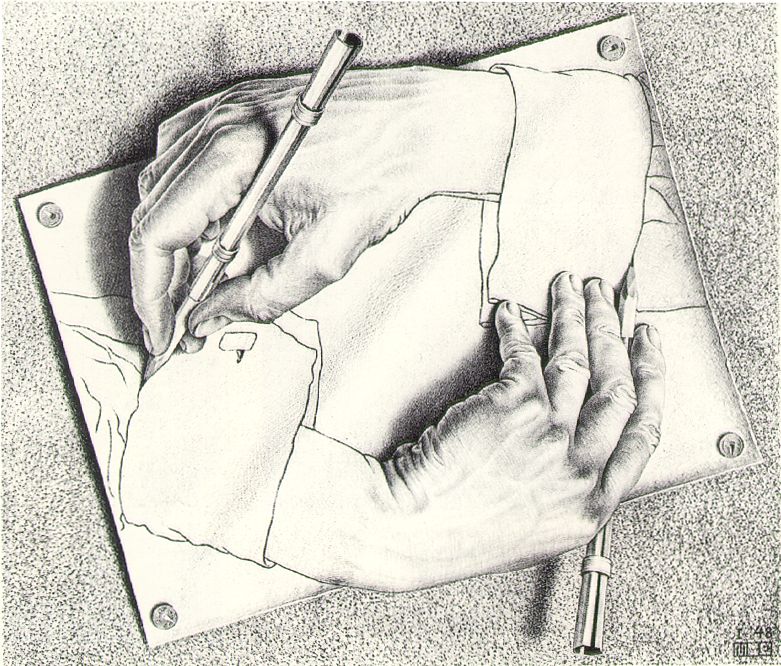
escher_hands.jpgSo, I published another post on OLPCNews today: Sharing and Not-Sharing Alike User Generated Content I am trying to figure out the best way to aggregate my own work, and am a little stumped. On the one hand, I don’t want to duplicate content, but on the other, I am skeptical of the long term prospects of some of the sites I have contributed to. Guess that’s what happens when you don’t own your own data. Anyway, I am starting to at least keep a running list of links to this kind of stuff. I know these aren’t all traditional “publications”, but it is important that people start regarding some of these kinds of contributions along these lines.

OLPC Field Repair

466296547_46b55653ce.jpgAt last month’s incredible Teach Think Play Conference I was fortunate enough to borrow an OLPC laptop from a good friend. As usual, the tangible green machine was a Pop Star (though in this educator crowd, most were not familiar with the project), garnering interest and attention wherever it travels. Sadly, the machine I had borrowed had some serious power issues, and I could not demo Sugar - the linux-based, free operating system developed specifically for the OLPC - to any of the attendees. Since my employer CCNMTL is a participant in the OLPC developer program (thusfar we have only received a raw motherboard, not a complete laptop), I decided to attempt a field repair of the OLPC in the vain hope I might be able to swap boards and get the unit running again. I discovered that the OLPC hardware (at least at this stage) is not quite as easy to disassemble as one would hope - you really need more of a clean room than a Third-World repair shop to work on this model. Still, a few iconic cues directing disassembly, like on a Thinkpad or Apple, would go a long way. Amazingly, there were no moving parts! In any case, I visually documented the disassembly process, but I don’t think I am going to be able to put humpty dumpty back together again any time soon. I guess I owe my friend $100 (well, now $150), since that is the list price of the OLPC.

Teaching, Thinking, and Playing: Day One

Today I attended day 1 of this year’s amazing Cultural Studies conference at Teachers College - Popular Culture in the Classroom: Teach, Think, Play. The morning kicked off with a Keynote by Taylor Mali, a spoken word philosopher-poet who perpetrates lyrical homicide against those who judge others according to their salary instead of the difference people are making in the world. I highly recommend taking a listen to some of his work, as he is working to inspire 1000 new teachers, and is only up to ~160. I presented a hybrid of my SXSW talk, Teaching in the New Vernacular, and Chris Blizzard’s OLPC introduction in a session called: Portable Culture Machines: One Multimedia Studio Per Child (the proposal had been published on OLPCNews). The talk was well attended, and the conference attendees were very excited to see/touch/feel/smell the XO device I borrowed from a friend. Ernest Washington gave a great session on teaching w/ hip hop, but for me the real takeaway was a perspective on education as the “cultivation of emotions” - this talk really connected alot of dots I have been working on lately, especially the “chemical swaddling” conversation I have been having with Philip Dawdy of Furious Seasons. The Media About Youth Consortium, a group print and film journalists (Alissa Quart, Jennifer Dworkin, Maia Szalavitz, Joie Jager-Hyman) spoke about their work and issues they are facing on the publishing front. Jan Jagodzinski gave a fabulous and fun (but substantive and deeply critical )reading of everything from Borat to South Park, and of designer capitalism through the eyes of a Kynic (not to be confused with a cynic). Art Spiegelman, the creative force behind Maus gave a wonderful history of the comic strip (and more generally, the genre of narrative storytelling with text and images) and his wife, Francoise Mouly, the Art editor of the New Yorker, gave back to back talks. Finally, Will Pearson the President of mental_floss (a magazine in the spirit of highlights which entertains while it teaches) closed out the day with a lively talk explaining their history, and why Einstein appears on every cover. And tomorrow’s schedule is jam packed too!