Mindful Occupation: Part I
 On September 17th 2011, sleeping giants stirred as the perception of social and and economic injustice in the US finally crossed a critical threshold. And the people spoke.
During the first week or two of the Occupation of Zuccotti park I was following along closely, but not yet fully engaged or plugged in. The movement erupted at the beginning of the semester, just as a good friend and I were embarking on a study of digital activism and collective action in the 21st Century. #Occupy quickly became both a primary source and case study as we scrambled to track the tools and tactics that were rapidly deployed.
Within days the movement launched multiple web platforms, was taking online donations, was broadcasting a 24-hour streaming video, and started publishing a broadsheet newspaper. Protesters were sharing and exchanging citizen-generated-multimedia-speech using services distributed across the internet, and organizing themselves and their expressions around shared tags. The mainstream media disgraced itself as one of the first (genuine) networked-grassroots movement redefined activism by breeding wikis and folksonomies, with Blue Stockings and Indymedia.
Public Space: The Final Frontier
The protester’s literal occupation of space quickly went metaphorical, as everything from yoga to religion were soon “occupied.” At one point I came across a call to #occupypsychiatry, although no one seemed to know exactly what that meant. By that point many activist groups had descended on the park, and were tabling, distributing pamphlets, and competing to get their messages out while the media’s spotlight was shining brightly in their vicinity.
In the early days of the occupation, while the weather was still mild, Zuccotti was a cross between a party and a seminar. Epic discussions around substantive issues sprung from every flagstone, and the best of Zuccotti suggested what a university could and should be. The occupiers rediscovered public space, and honest-to-goodness publics were formed.
It occurred to me that, far more important than any message that #occupy might broadcast were the internal dialogues and communications between and among activists. Especially in these early, fragile stages, teach-ins and skill shares helped forge the alliances and friendships that would propel the movement through the winter and beyond.
One of the nights in the park I found myself in a conversation with someone from the sanitation working group, and was struck by the humility of someone focusing their energy on sustaining the community instead of clamoring to be heard by the rest of the world. Through some of the mad pride networks I am connected to, I started hearing stories about protester burnout and emotional crisis at the occupations.
Frayed Edges
Given the exacerbating conditions - lack of sleep, poor nutrition, exposure to the elements, and don’t forget the police brutality - it is unsurprising there were many frayed edges amongst the protesters. Although the movement had scorned resolving conflicts by turning to the criminal justice system, it had not formed an analogous consensus about resolving emotional crises by turning to the psychiatric system. Around the country reports of forced hospitalization (and medication) emerged, and people kept reaching out for materials that offered alternative perspectives towards handling emotional trauma and navigating crises.
Over the summer I had been been working towards setting up on-demand publishing solutions for some of The Icarus Project’s publications. I had spent months trying to track down original indesign files, fonts, and assets, in order to recreate these publications according to the specifications the ondemand publishers mandated.
In early October I attended the provocative Mobility Shifts conferences on digital learning, and attended a workshop on the Booki software that explained the practice of book sprints. Booki is essentially a wiki platform that was designed to support collaborative book authoring. The application supports chapters, tables of contents, and pagination, and pumps-out ebooks and print-ready pdfs. [In the course of this project I have learned a lot about digital publishing and the future of open zines, but I’ll save those thoughts for another post.]
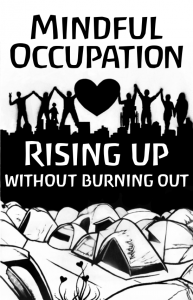
Another good friend of mine was also in the midst of working on an #Occupy pamphlet, The 99%’s Guide to the Current Clusterf#*k, and that night something clicked. I imagined working together with radical mental health activist to remix a zine (aka pamphlet) that would present alternative perspectives on activism and mental health. I got really excited about a concrete way to contribute to the occupation. I bounced the idea off of some friends and we were all really jazzed about the project. That night, Mindful Occupation: Rising up Without Burning Out was conceived.
[to be continued]
On September 17th 2011, sleeping giants stirred as the perception of social and and economic injustice in the US finally crossed a critical threshold. And the people spoke.
During the first week or two of the Occupation of Zuccotti park I was following along closely, but not yet fully engaged or plugged in. The movement erupted at the beginning of the semester, just as a good friend and I were embarking on a study of digital activism and collective action in the 21st Century. #Occupy quickly became both a primary source and case study as we scrambled to track the tools and tactics that were rapidly deployed.
Within days the movement launched multiple web platforms, was taking online donations, was broadcasting a 24-hour streaming video, and started publishing a broadsheet newspaper. Protesters were sharing and exchanging citizen-generated-multimedia-speech using services distributed across the internet, and organizing themselves and their expressions around shared tags. The mainstream media disgraced itself as one of the first (genuine) networked-grassroots movement redefined activism by breeding wikis and folksonomies, with Blue Stockings and Indymedia.
Public Space: The Final Frontier
The protester’s literal occupation of space quickly went metaphorical, as everything from yoga to religion were soon “occupied.” At one point I came across a call to #occupypsychiatry, although no one seemed to know exactly what that meant. By that point many activist groups had descended on the park, and were tabling, distributing pamphlets, and competing to get their messages out while the media’s spotlight was shining brightly in their vicinity.
In the early days of the occupation, while the weather was still mild, Zuccotti was a cross between a party and a seminar. Epic discussions around substantive issues sprung from every flagstone, and the best of Zuccotti suggested what a university could and should be. The occupiers rediscovered public space, and honest-to-goodness publics were formed.
It occurred to me that, far more important than any message that #occupy might broadcast were the internal dialogues and communications between and among activists. Especially in these early, fragile stages, teach-ins and skill shares helped forge the alliances and friendships that would propel the movement through the winter and beyond.
One of the nights in the park I found myself in a conversation with someone from the sanitation working group, and was struck by the humility of someone focusing their energy on sustaining the community instead of clamoring to be heard by the rest of the world. Through some of the mad pride networks I am connected to, I started hearing stories about protester burnout and emotional crisis at the occupations.
Frayed Edges
Given the exacerbating conditions - lack of sleep, poor nutrition, exposure to the elements, and don’t forget the police brutality - it is unsurprising there were many frayed edges amongst the protesters. Although the movement had scorned resolving conflicts by turning to the criminal justice system, it had not formed an analogous consensus about resolving emotional crises by turning to the psychiatric system. Around the country reports of forced hospitalization (and medication) emerged, and people kept reaching out for materials that offered alternative perspectives towards handling emotional trauma and navigating crises.
Over the summer I had been been working towards setting up on-demand publishing solutions for some of The Icarus Project’s publications. I had spent months trying to track down original indesign files, fonts, and assets, in order to recreate these publications according to the specifications the ondemand publishers mandated.
In early October I attended the provocative Mobility Shifts conferences on digital learning, and attended a workshop on the Booki software that explained the practice of book sprints. Booki is essentially a wiki platform that was designed to support collaborative book authoring. The application supports chapters, tables of contents, and pagination, and pumps-out ebooks and print-ready pdfs. [In the course of this project I have learned a lot about digital publishing and the future of open zines, but I’ll save those thoughts for another post.]
Another good friend of mine was also in the midst of working on an #Occupy pamphlet, The 99%’s Guide to the Current Clusterf#*k, and that night something clicked. I imagined working together with radical mental health activist to remix a zine (aka pamphlet) that would present alternative perspectives on activism and mental health. I got really excited about a concrete way to contribute to the occupation. I bounced the idea off of some friends and we were all really jazzed about the project. That night, Mindful Occupation: Rising up Without Burning Out was conceived.
[to be continued]


 The
The  I recently learned about a fascinating trend in litigation that is quietly transforming courtroom testimony, and is spreading fast and far - video depositions.
I talked with a consultant who helps attorneys process video depositions. In the courtroom, attorneys are juxtaposing live testimony with segments from depositions. Video clips of witnesses reinforcing (or contradicting) themselves are far more powerful than merely reading back the transcript. The courtroom has always been about performance, but these videos have taken this to a new level, as savvy lawyers manipulate appearances and emotions. Increasingly all depositions are being recorded, just as they are transcribed.
Apart from the ways that courtroom proceedings are being transformed, I am also intrigued by the software that is undoubtedly in development to support these operations. In addition to conventional A/V support, working effectively with hundreds of hours of video involves archiving, indexing, distributing, editing, and clipping. At about a day or two of testimony per witness, and dozens of witnesses per trial, the numbers add up pretty quickly.
As cases accumulate, and multiple associates begin working with and analyzing video, law firms will quickly recognize the desirability of networked, collaborative, video annotation environments. Some large firms (and their vendors) may have already begun developing solutions. However, the consultant that I spoke with was storing video locally on a laptop hardrive and tracking it with an Access database, so opportunities are knocking. Without a doubt many of the tools that will be highlighted at the upcoming
I recently learned about a fascinating trend in litigation that is quietly transforming courtroom testimony, and is spreading fast and far - video depositions.
I talked with a consultant who helps attorneys process video depositions. In the courtroom, attorneys are juxtaposing live testimony with segments from depositions. Video clips of witnesses reinforcing (or contradicting) themselves are far more powerful than merely reading back the transcript. The courtroom has always been about performance, but these videos have taken this to a new level, as savvy lawyers manipulate appearances and emotions. Increasingly all depositions are being recorded, just as they are transcribed.
Apart from the ways that courtroom proceedings are being transformed, I am also intrigued by the software that is undoubtedly in development to support these operations. In addition to conventional A/V support, working effectively with hundreds of hours of video involves archiving, indexing, distributing, editing, and clipping. At about a day or two of testimony per witness, and dozens of witnesses per trial, the numbers add up pretty quickly.
As cases accumulate, and multiple associates begin working with and analyzing video, law firms will quickly recognize the desirability of networked, collaborative, video annotation environments. Some large firms (and their vendors) may have already begun developing solutions. However, the consultant that I spoke with was storing video locally on a laptop hardrive and tracking it with an Access database, so opportunities are knocking. Without a doubt many of the tools that will be highlighted at the upcoming 
 Today I attended a