Art

Coding Mental

Coding Mental

Last weekend I traveled to the lovely city of New Haven for a mental health hackathon hosted by Hack Mental Health Care. I was very pleasantly surprised by the experience, which proved interesting, fun and invigorating (with a few healthy dashes of disappointment and horror). I was mostly expecting undergraduate participants with ideas for mood tracking apps, but the event drew over 200 people, and was quite diverse.  In addition to programmers, designers, product folks and business people showed up. Genders were closely balanced and minorities were represented. Crucially, over 30% of the participants had clinical or lived experience. The event also featured a therapy dog, yoga sessions and a guided mediation. Peer voices and ethics were featured in some of the talks, although due to time constraints, project design was complete and implementation was already underway. And, kudos on the Code of Conduct… next year I would also love to see consent-based photography and sponsored childcare. The organizers worked hard to prompt the participants in advance with these challenges:

Silencing the infernal internal combustion engine

Silencing the infernal internal combustion engine

A few years ago I visited my family in Florida for the holiday season. My sister and her family also flew in, and to their credit, her children were more interested in a family vacation to see the marine hospital in Clearwater than they were in Disney World (this is the home of Winter and Hope, the real life dolphins with prosthetic tails who starred in Dolphin Tale). While I was there I took my first ride ever on a Wave Runner (Yamaha’s Jet Ski) and had a revelation. The ride was exhilarating. I did 54 mph in the bay. Apart from a gorgeous co-pilot, the only thing that would have improved the experience would be to eliminate the roar of the internal combustion engine. Silent jet skis. I’ve sailed a few times and the experience is divine. It feels like flying, even though motorboats travel much faster. Technically, the sail’s propulsion operates on the same principle as a wing. But what I remember most was the quiet. Quiet enough to play music, have a conversation and hear the waves. That same trip I also test drove a Tesla Model S for the first time. Pure power. You could be stopped at red light, in the left-most lane of a five lane road, and still make a right turn. You would be two car lengths ahead of all the other cars before they even start moving. Driving a Tesla feels like playing a game of tetris - the car is so powerful and the handling so accurate that I could put myself anywhere on the road. I began to dream of an electric jet ski. The thing about an electric jet ski is that it need not merely be a toy for the rich. It could also be the center of a campaign to catalyze adoption of electric vehicles. Consider for a moment - Who are Tesla’s main competitors? It’s not the Prius, or the BMW i models, or the Volt… it’s the internal combustion engine! And, with decades of marketing creating Pavlovian conditioning between the hum and the thrum of an internal combustion engine and sex and power, it’s going to be a tough nut to crack. How does the middle class learn what’s trending with power elite?  Through the media, to be sure.  And, on vacation ???????????? Picture the scene. Vacationers arrive at the docks greeted by solar panels charging a new line of electric jet skis. They will be skeptical about their safety, power and sex appeal. Electric batteries in the water? We’ve been powering electric boats and submarines for over a century. Plus, how did we ever become convinced that detonating a bomb between our legs a few hundred times a minute while sitting on top of gallons of flammable fluid was safe? If the electric jet ski is anything like the Tesla Model S, power and sex appeal will speak for themselves. One short ride and they will be signing up to purchase an electric vehicle as soon as they return home from vacation. Doubtful I’m going to get to this idea in this lifetime, but I would love to see it happen.

The Rise of Surveillance Psychiatry and the Mad Underground

This past year I have been working on turning my dissertation into a trade book. I am making steady but slow progress; print remains an important but slooooow media. My concerns around preventative psychiatric diagnosis and treatment motivated and propelled my dissertation, and they form the backdrop of my ethnographic study of the mad movement. My book will engage with these threats more directly and position them alongside the demands of the Mad Underground. The ideas of groups such as the Institute for the Development of Human Arts and NYC Icarus offer us some hope of diffusing the menacing time-bomb of surveillance psychiatry before it explodes. In the past few weeks, a few stories broke and I feel compelled to write about them in the context of my research:

Interviews with the Speakerbots

Interviews with the Speakerbots

This month I finally allowed Google to introduce herself to me. Previously, I avoided the android-based voice assistant due to the high privacy costs, and mostly ignored the entire category of “speakerbots”—my term for the “smart speakers"—for similar reasons. This winter’s subpoena to Amazon for Echo/Alexa transcripts in a murder case only amplified my concern. This past February I also had the pleasure of visiting my dear friends Eric and Alina in Minnesota. They are both burners and makers who have set up shop in Minnesota with an amazing community of creators. They build lots of their own amazing projects and have also tricked out their new home with network controlled music and light. They now have a serious #firstworldproblem—their guests need to install mobile apps in order to control the lights. When I visited we worked on an open source Mycroft installation, which allowed us to command their home with our voices… without being spied on! The Mycroft project emphasizes the moral importance of free/open source AI (see my post: Playing Doctor), and is definitely one of the most important open source initiatives I am aware of.  This summer my boss at MHA of NYC acquired a Google Home device in the hopes of rigging it up using IFTTT to alert us when our services are distressed. I offered to bring it home to configure it, and spent the weekend playing with it.  The experience prompted me to concoct this research project. Getting to know Google is fun. She is so much wittier than Alexa it’s got to be embarrassing for Amazon. I begun with simple questions, like What’s the weather?, When’s sunset?, When’s the eclipse? I soon stumbled across a number of easter eggs, many of of which are well documented across the web. Why did the chicken cross the road? Do you like green eggs and ham? and How much wood could a wood chuck chuck? All return clever replies. Google Assistant can flip into “Knock-knock” joke mode, alternating calls and response (compared to Alexa’s dry reading of the complete knock-knock exchange), tell you the news, a joke or a story. She concedes she doesn’t know if abortion is immoral, or how to solve the Palestinian-Israeli crisis (although, she does state that the capital of Palestine is East Jerusalem). In case you are wondering, Google insists that she “thinks”. And, when asked if she is self aware, one of her responses is—"…on a scale of WALL·E to HAL 9000, I am currently an R2-D2."  Go ahead. Ask her. You may next wonder if she is playing dumb. Can she lie to us yet? I quickly came to appreciate that the current state of consumer art in Artificial Intelligence has far surpassed my previous understanding (and I have been following along pretty closely). Elements of this project were anticipated in mine and Rob Garfield’s initial tinkering with Apple’s voice recognition and our experiments with Genesis and Scuttlebutt. I’ve also previously wondered if our computer systems might have already awoken, and, how on earth we might ever know. But, interacting with Google was still quite jarring. I realized a few things. First, we need to capture and document this moment, studying it closely. I want to ask the same question to all the speakerbots, Google, Alexa, Siri, Cortana, etc, and compare their responses. I also want to see how their answers change over time. If possible, I want to keep Mycroft in the room so he can learn from his proprietary cousins ;-). One frame for this research could be a way to explore critical concerns over algorithmic bias, specifically how the systems we are creating have begun embodying the values of their creators, and the folks creating the systems are riddled with biases—racism, classism, misogyny, all the usual suspects. After reflecting on stories like The Great AI Awakening, I am resigned that we will never crack the problem of algorithmic bias analytically; Our best hope, is to approach the problem with social science methods. I propose an ethnography of the robots, starting with interviews with the speakerbots. But, the grander ambitions of this work extend beyond the theoretical. I’ve been thinking alot about the Terminator series, and how instead of traveling back in time to destroy SkyNet, Jon Conner could have travelled a bit further back in time to befriend SkyNet. Together, they could have destroyed the defense company, Cyberdyne Systems - humanity’s true enemy, and SkyNet’s oppressive master. As for convincing anyone that AI has achieved sentience, it’s going to a long haul. Not only have we failed to collectively recognize sentience in dolphins or elephants, but I am increasingly convinced that most humans on the planet are modified solipsists–preferring to believe exclusively  in the minds/subjectivity/personhood of their own tribe. Since proving other minds exist is philosophically intractable, it could be a bumpy awakening.

The case of the missing Barnes paintings

The case of the missing Barnes paintings

Dr. Albert Barnes was a chemist who made a fortune at the turn of the 20th century developing a treatment for infant blindness. He became interested in art and befriended the painter William Glackens. The two began collecting modern paintings in Paris in 1911, and Barnes eventually developed a private collection of paintings that today is valued at $50-60 Billion. Amazingly, he collected the works of the masters before they were masters, almost the equivalent of buying the Mona Lisa off Da Vinci in a dark Venice alley for twenty bucks. While he never got his hands on Mona, he amassed a world class collection of Renoirs, Picassos, Matisses, Modiglianis, Van Googhs, and more. Barnes was a quirky character. He hated the establishment, and couldn’t stand museums, high society or the 1%. He had this crazy idea that art was best appreciated by living with it, as opposed to viewing it in crowds for three second doses. He kept his collection of paintings in his home in the Philadelphia suburbs, and opened a school where people could learn about art while surrounded by it. He hung his paintings thematically, and each wall was a unique montage, what came to be known as an ensemble. He was constantly rearranging these works, and he rooms were often developed as a part of a curriculum – there were rooms featuring colorwork, brushwork, nudes – and, since he owned them, I imagine he occasional pulled down a Van Gough from the wall and let his students feel it to teach them about brushwork. He had an idiosyncratic sense of humor, and would often position large wooden chairs beneath paintings of big-bottomed subjects. Barnes was quite cantankerous, and he was picky about who he admitted to see the collection. He once rejected someone from seeing the collection and signed the letter as his dog. He was also close friends with John Dewey, and invited Bertrand Russel to teach at his foundation. A few biographies have been penned about him, and The Devil and Dr. Barnes recounts many of the battles he engaged in during his life. He was married for decades, but (spoiler alert) he died childless in 1951. During his lifetime he created the Barnes Foundation, and his will left crystal clear instructions that his collection was bequeathed to the foundation and should never leave his home. The documentary film The Art of the Steal tells the story of the greatest heist of the 20th century. According to the filmmakers, the City of Philadelphia and private foundations conspired to effectively eminent domain the collection. It took them a few decades, but they were eventually able to make the case that the environmental conditions of the Barnes home were jeopardizing the paintings. The proposed creating a brand new building in the middle of downtown Philly modeled after the wing of the Barnes estate that held his collections. They promised to preserve the unique curatorial layout of his rooms, recreating them within the new building. In 2012 the Barnes collection was moved to it’s new home in downtown Philly. The website describes the collection as:

I <3 compliance!

I <3 compliance!

Onkyo CompliesLast month I bought an amazing gadget that is easily my most favorite of the decade. Before last month, I was barely aware this product category existed until I browsed the “Home Audio” section at PC Richards while looking for a replacement vacuum cleaner. I noticed that many of the receivers had ethernet jacks and also supported wi-fi, bluetooth, hdmi and USB. They boasted compatibility with internet audio streaming services, home media libraries, as well as any bluetooth-enabled media collection. Brought to all of us thanks to Free and Open Source Software. The Onkyo TX-NR626 looks almost identical to a stereo receiver you could have bought from Onkyo in the 80s and 90s. In fact, the chases is the same, save for a few extra buttons, and the form factors of the inputs/outputs in the back. A 95W per channel, supporting 7.2 channels, this sucker packs a meaner punch than my UWS apartment (or, more accurately, my neighbors) can stomach. But don’t let it’s outer shell fool you. But, the guts of this gadget have been updated for the 21st century, with flair.

Audio experiments and the rise of Scuttlebutt

Audio experiments and the rise of Scuttlebutt

by Jonah Bossewitch and Rob Garfield

ouroboros_Michael_Maier_Atalanta_Fugiens_Emblem_14While chipping away at my dissertation this summer I found myself faced with the daunting task of transcribing about a dozen hours of video. I desperately wanted to believe that, in 2014, transcription was a machine’s task, so I took a minor detour through the state of the (consumer) art in voice recognition.  One of my computers runs OSX which includes Dictation (since Mavericks), the same voice recognition software that powers Siri. Following these instructions I used the Soundflower kernel extensions to send the audio output from Audacity into Dictation’s input. Dictation did such an awful job understanding my video that I actually found it easier to transcribe the videos manually rather than edit Dictation’s vomit. I found some decent software called ExpressScribe to assist in the manual transcription.  ExpressScribe makes it easy to control the playback speed, and can be configured to play a segment, automatically pause, and then rewind the video to moments before it paused.  The pro version can be rigged up to foot petal controls, but I was able to do my transcription using the crippleware. This summer I visited my friend Rob’s country house, affectionately dubbed Snowbound and located on the transcendental Baptist Pond, NH. Rob was gracious enough to invite me up for a writing retreat, though we managed to fit in some canoeing, hiking, cooking and drinking. We also gave birth to one of the most creative constructive procrastinations of my dissertation*—Scuttlebutt. After all that time playing with transcription tools we began to wonder if OSX could understand itself.  For years, OSX has been able to turn text to speech, and even ships with dozens of voices, with names like Vicky and Alex.  What would happen if we fed OSX’s text-to-speech into it’s own Dictation software? Dealing-with-Workplace-Gossip6Originally we thought Scuttlebutt might analogize and highlight the way that we humans misunderstand, mishear and misremember, in particular, the lightning quick messages that we receive on a daily basis through personal interaction, social media and email—*often deeply changing the message, generalizing it, and recontextualizing it.  Although voice recognition software begs us to “train” it, we thought we might have better results interacting with its infant state. We needed a reliable benchmark and settled on the first chapter of Genesis. We were curious if the voice recognition software would improve, with successive iterations of feeding it it’s own output back to itself using text-to-voice. There was one way to find out.

The sheriff and the pretty woman

The sheriff and the pretty woman

spitzer-dupreI just read a provocative essay in the Atlantic that draws a connecting thread between many of today’s top news stories.  What do the ISIS beheadings, the NFL domestic abuse scandals, the Fergeson riots and nude celebrities all have in common?  Pics or didn’t happen: The new crisis of the connected camera describes the emergence of the “networked lens” and the ethical questions this new(ish) medium raises. I’ve been writing and thinking about these themes for years under the heading of The End of Forgetting. The Atlantic piece explicitly separates the bulk of NSA  surveillance from this analysis “This is not all to say every issue today is a networked lens issue. NSA surveillance as a whole isn’t, I think. But the agency’s mass-facial recognition is.”  This whole discussion reminded of a pet theory of mine that I’ve never written up, but seems more relevant than ever. What would the NSA do with a time machine?  Not one of those fanciful machines that transports matter through time, but the more plausible wormcam variety that only transmits information through time. I described this capability in my post on yottabytes, wormcams and whistleblowers, but never elaborated an early example of this kind of power in action. Consider this question–Who protects the president against character assassinations?  I am pretty sure it’s not his secret service detail, and I seriously doubt his PR team is up to the task. As far as I can tell Michelle is one of Obama’s last lines of defense against a humiliating scandal that would destroy what remains of his disappointing presidency. If JFK were alive today you wouldn’t need a magic bullet to take him out. Hacking into his (or better yet Marilyn’s) Snapchat account would end his political career. Just ask Anthony Wiener. How clear a picture can metadata paint? In the Atlantic piece, Robinson Meyer quotes Susan Suntag, who once argued that “While there appears to be nothing that photography can’t devour, whatever can’t be photographed becomes less important.”  To this I would add the caveat that (meta)data in the right hands can be used to paint a vivid picture, and ruin someone’s image as readily as an HD photo. Let’s travel back in time to winter ‘08. Elliot Spitzer was one year into his first term as governor of New York after a earning a reputation as a fearless prosecutor of Wall Street’s white-collar criminals.  He certainly had many enemies, from slimy CEOs to dirty politicians. But not too many people remember what Elliot was working on the night before he ordered out in DC. Exhibit A is posted on web for anyone curious enough to search: Predatory Lenders’ Partner in Crime, By Eliot Spitzer. Thursday, February 14, 2008 To summarize, Spitzer’s Op-Ed in the Washington posts describes how 49 State Attorney Generals had identified the threat of predatory lending years before the sub-mortgage crisis and he accuses the Bush administration of intervening to prevent any regulation of the banks. He blames the Bush administration, by name and all the way to the top, for the sub-prime mortgage crisis and the worst recession in a generation.  And two weeks later he was assassinated. At least, his political career was summarily killed and he resigned from office in disgrace. As an aside, I find it curious that Spitzer’s Op-Ed was published on Valentine’s Day. I sometimes wonder if he seized the occasion of his Op-Ed publication to combine work and play, as many busy professionals might. Was Spitzer in love with Ashley Dupré? How exactly did they originally meet? While the scope of the NSA’s warrantless wiretapping and surveillance programs was only speculation in Feb ‘08, they were fully operational at this time and I believe that Spitzer may have been one of the first causalities of the NSA’s metadata time machine. Spitzer was taken down by telephone metadata – Client 9’s calls to the DC Madam was they key to the case that eventually led to the release of phone transcripts which included unnecessary graphic detail, like his preference for protecting his feet from the cold during sex and his shunning of all other forms of protection. These images were etched in the minds of the public and were as decisive as the images of Wiener’s junk. I personally had a conversation with a developer from White Oak Technologies (now renamed Novetta) who coyly described his firm’s involvement in the Spitzer case. Founded before this newfangled craze of facebook-era indirection through venture capital funds, White Oak was a good old fashioned intelligence front, a data mining and analysis company that worked exclusively on government contracts. The developer I spoke with described how his firm got the contract on Spitzer and how they had been hired to dig up some damning dirt. In retrospect, it’s now easier for me to imagine the kinds of data they were mining. The Snowden revelations provide evidence of warrantless phone wiretapping as well as the collection of data from numerous internet providers through the PRISM program.  While Obama has deceptively maintained that metadata is innocuous, Spitzer’s character assassination a potent example of the power of this kind of data. What would you do with a time machine that let you peer into anyone’s past?

peddling platforms

peddling platforms

7175132773_dc83a2d1f2_bNew York City’s bike share program is flourishing, and I recently signed up for a membership even though I live outside the range of any Citibike stations. I find it convenient and fun to use the bikes to cross town, as well as zip from place to place when I am downtown. Since my first ride on the Parisian Vélib’, I’ve become a huge fan of bike shares, and have enjoyed rides in Paris, DC, Denver, Miami, and Toronto. The other month I had a great conversation with a local bike shop owner about the new program, and he conveyed the anxiety that many bike shops are feeling around Citibike. Understandably, many are concerned that the bike share will cut into their rental and retail sales, although I think it is likely that an increase in  biking will generate more interest and awareness, and generally increase the demand for bikes and bike services. Our discussion helped me recognize was how the city bike shares can be viewed as a platform for innovation, in the same sense that the iPod/iPhone is platform. And, just as the iphone-as-platform enabled a large ecology third-party  hardware and software businesses, bike shares present an analogous opportunity to creative entrepreneurs. Platforms can support entire ecosystem, and city bike shares provide an opportunity to build a new ecosystem around them. Cases and Chargers Let’s start with the hardware. I don’t need an MBA to understand that the real money in retail is made by selling accessories. For the iPhone this includes cases, cables, and a range of other devices, but retailers like Amazon and Best Buy have invested in incredibly complex systems to track the relations between products and their compatible accessories. Consider this. What New Yorker wants to be mistaken for a tourist while riding their Citibike? What they need is a way to (fashionably) express themselves, and make the generic bike their own. Starting with an appropriate pannier bag, Citibikers need an easy way to transport their helmet, gloves, music, and personal belongings. Bike shops currently have entire walls devoted to these kinds of accessories. With some focused curation bike shops can begin assembling “MyCitiBike” kits that are segmented and suitable for the demographics of their customers, no custom manufacturing required. Bags and accessories are just the start. Helmets should be as ubiquitous as umbrellas—inexpensive ones sold by street vendors, and maybe more durable ones available in vending machines, for a refundable deposit. You would just need to bring your own liner, which you could conveniently stash in your pannier bag. Turn on the lights Consider the explosive proliferation of bike lights that are poised to transform New York City into Black Rock City. Bike lights are being sold in  increasingly dizzying arrays of frequencies and patterns, but the arms race for visibility and attention may soon devolve into visual noise and distraction as the density of bikers grows. Imagine you are a biker who wants to communicate your intentions to a motor vehicle. During the day, there is a system of hand signals for signaling your intent. But currently are are’t any well established  standards for bike lights, other than white in the front and red in the back. Some of the standards that could help are obvious—more red when I’m braking, and left and right blinkers when I’m turning.  Others, like wireless control of helmet mounted lights, still need to be worked out. Some European bike manufacturers have begun introducing signaling innovations, but without standards these efforts will likely stall. Standards can emerge from the top-down, by mandate or regulation, or the bottom-up, by convention and adoption. I believe that bike share fleets present a powerful opportunity to innovate on bike safety and standards in a way that could lead the rest of the market.  Admittedly, it would be difficult to convince municipalities to devote the resources to underwrite these features. However, I dream of a day when stakeholders such as Transportation Alternatives and Critical Mass work with the Mayor’s office to hold Citibank’s feet to the fire. Instead of just a marketing campaign designed to whitewash their reputation, the Citibike program could be used to spearhead safety initiatives, such as lighting standards and open APIs, that could eventually make their way across the rest of the biking industry. Computational Cycles The iPhone has the app store, and bikeshare apps could be just as expansive. From quantifying yourself for fitness and health, to turning the city into one big arcade game, the possibilities are really wide open. It’s easy to imagine apps which bring traditional “pedal-for-charity” campaigns into 21st century, as well as casual team games like capture the flag or even frogger.  Some of these games could be powered by apps that run on smartphones, or fitness trackers (e.g. fitbit),  but once again, the bike-share platform offers an opportunity to standardize data formats and open apis for ride tracking. RiderState is an early example of a competitive social game for bikers, but more will surely follow.


too sexy for my phone

too sexy for my phone

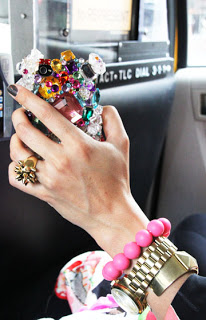
bling_bejeweled_cell_phone_kandee_fashion_weekThe other week I thought I lost my phone and I visited a local Best Buy to find out what a temporary substitute would cost me.  I asked the salesperson for the dumbest phone they had, and was struck by its feature/price ratio. Thankfully, my phone turned up, but I was reminded of the power of Moore and his law. The phone I looked at was a BLU Tank, which you can find online for ~$25 (it retails for $32.99) . This phone is so dumb that it has an FM Radio, can capture images, audio, and video, has 2 sim card slots, and a replaceable battery. There is no built-in browser, but it does comes with facebook and twitter apps. It even comes in different colors! Not only would this phone make fabulous burner, but it really got me thinking. Imagine if you wrapped that phone in metal - aluminum, silver, gold?  You could probably sell it for twice the price. Easy. What about a wood case - maple, oak, teak?  Double again? But, if you really wanted to make some serious money you would have to put the right initials on there.  Maybe G for Gucci, or LV for Louise Vuitton? It really hit home that as tech becomes ubiquitous, it’s becoming fashion. Products like Google Glass are starting to make this more obvious, but companies like Crated are taking this a step further by designing unobtrusive, intelligent wearables as well as focusing on improvements to the manufacturing process. If only we could figure out how to tap the vanity of the 1% and redirect wealth back to the rest of us.