isomorphic surprises: stickies, tasty, and the importance of user contributed content
I have been thinking alot about tagging lately, especially how a complete tagging system - comprised of user-item-tag triplets, is isomorphic to rdf’s subject-predicate-object triplets. It is amusing to think about how egocentric Web 2.0 is - The subject is always me. Web 2.0 might be made of people, but not just any people - Just the most important one in the world.
Today I had a fun time trying to explain to people on irc the power and importance of user contributed content annotations within plone. Crucially, user content annotations are per-user, per-object, and in many cases a single user might want to annotate a particular object with more than one annotation.
Interesting annotations can come in many flavors. There are free form notes, fine grained annotations (anchored to particular phrases - think msword trackback - or geometrical coordinates on the target - nice for image annotations), keyword annotations (aka - tags), etc ect. There many problems that can be solved with custom per user content annotations, including quiz and poll results, per student answer submission, and lately we have been working on allowing users to clip audio and video by annotating start and end times on media objects.
It is important not to confuse per-user tagging with DC:Subject - the dc metadata is shared across all users (like categories in the wikipedia) and in that sense, is global. While we are on the topic of tags, it is useful to talk about the vocabulary that drives the tagging. Vocabularies can be fixed or free, individual or collaborative, and personal or shared. All of these variations are interesting in different cntexts, and have to do with whether or not I see your tags, or if we each are developing our own ontologies.
In educational technology annotations are a big part of the problems we are trying to solve, but there are tons of use cases in the world at large. Additionally, a high performance, robust tagging engine can power personal content organization, like gmail’s labels.
Which brings me to the products we have been developing at CCNMTL. We have been using PloneStickies, a general purpose content annotation framework, in production for over a year now. Built using AT References, it allows us to create per-user AT objects connected to the target object. AT Schema Annotations won’t do the trick here since, like DC:Subject, these annotations are instance-wide. Z3 annotations might work, but by building AT derived stickies, we pick up search, workflow, permissions, and the richness of AT. This allows us to quickly and easily develop custom stickies, like the StickyClip.
PloneStickies has a ways to go, but the basics work great. It is not yet super useful out of the box, since the portlet it ships with only allows users to attach a single free form StickyNote to the target object. But it is great to develop applications with. It ships with with some super snazzy css stickies, complete with colored/resizable/title-barred/drop-shadowed/roll-upable/transparent-when-dragging notes, which can preserve their own x-y position and state across sessions and never fall off your screen. It now supports attaching multiple stickies to a target, but does not yet provide a mechanism for the target object to place the stickies itself.
At first we thought we could implement a Plone tagging solution using this framework - just create a StickyTags made out of keyword fields, and voilà - plonr. Trouble was, since tagging is such a symmetrical model, its tough to build an efficient zodb implementation (for me, at least) that can handle all the querrying we wanted to do.
Enter the tasty microapp and the PloneTasty proxy (about 90% done). Tasty is a stateful (sqlobject) turbogears component that exposes a REST api, ships with its own snazzy ajax tagging client, and can be used across frameworks, languages, and platforms. We are even hoping it can help make the world a better place.
So StickyTags (which doesn’t exist) and PloneTasty are two implementations of the same concept, with StickyTags being the AT/zodb implementation and PloneTasty/tasty the new microapp design (mashup architecture?) we have been working on and are pretty psyched about.
And if you act now, you get the knife set and the lint remover too, for just 3 easy installments.
 Originally posted on theploneblog.org
Free Software Developers at Work and Play
I haven’t posted much here lately, but I have been writing. I recently
finished my first semester as a doctoral student in Columbia’s school of journalism and one of the papers I completed draws directly on my experiences in the Plone Community. A few years ago I remember being struck at how different open source development was from what I (and presumably others) imagined it to be. I kept pitching human interest stories to journalists, ones that might emphasize the playfulness, the sprinting, and the organizational experimentation, but got very few nibbles. So, I finally wrote some of this up myself before it all fades from memory:
Fabricating Freedom: Free Software Developers at Work and Play
The paper was for a wonderful class this semester at the New School taught by Paolo Carpignano (The Political Economy of Media - here is the syllabus).
The class was all about the shifting relations between fabrication and
communication, or more colloquially, work and play. We opened with Marx
and Hannah Arendt and closed with Yochai Benkler and danah boyd. The piece I wrote is personal and anecdotal, but reflects on all that our community has taught me about free software, free culture, organizing, consensus building and the day to day politics of software development.
enjoy.
Originally posted on theploneblog.org
Free Software Developers at Work and Play
I haven’t posted much here lately, but I have been writing. I recently
finished my first semester as a doctoral student in Columbia’s school of journalism and one of the papers I completed draws directly on my experiences in the Plone Community. A few years ago I remember being struck at how different open source development was from what I (and presumably others) imagined it to be. I kept pitching human interest stories to journalists, ones that might emphasize the playfulness, the sprinting, and the organizational experimentation, but got very few nibbles. So, I finally wrote some of this up myself before it all fades from memory:
Fabricating Freedom: Free Software Developers at Work and Play
The paper was for a wonderful class this semester at the New School taught by Paolo Carpignano (The Political Economy of Media - here is the syllabus).
The class was all about the shifting relations between fabrication and
communication, or more colloquially, work and play. We opened with Marx
and Hannah Arendt and closed with Yochai Benkler and danah boyd. The piece I wrote is personal and anecdotal, but reflects on all that our community has taught me about free software, free culture, organizing, consensus building and the day to day politics of software development.
enjoy. Originally published on theploneblog.org
Open source software as pedagogical scaffolding, and F/OSS ecologies as a dialogical knowledge communities.
This is a fun post recognizing the role of open source software and breaking routines in learning new programming patterns and paradigms.
Originally published on theploneblog.org
Open source software as pedagogical scaffolding, and F/OSS ecologies as a dialogical knowledge communities.
This is a fun post recognizing the role of open source software and breaking routines in learning new programming patterns and paradigms.
 Originally publihsed on theploneblog.org
How hybrid economies help keep software honest.
Last week’s
Originally publihsed on theploneblog.org
How hybrid economies help keep software honest.
Last week’s 
 Originally published on theploneblog.org
Preliminary report on the Big Apple Sprint
July fourth has come and gone, but the fireworks set off at
Originally published on theploneblog.org
Preliminary report on the Big Apple Sprint
July fourth has come and gone, but the fireworks set off at 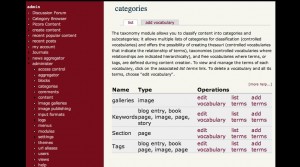 Druapl supports multiple vocabularies, which can each be associated with one or more content types. Vocabularies can be flat, one level deep, or N-levels deep (hierarchical). They can be fixed or free form (meaning content authors can make up new categories upon content creation). The core tagging system does not support the creation of tags per-user, per-object - only per-object.
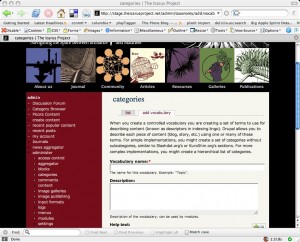
Category Management - Add a Vocab:
Druapl supports multiple vocabularies, which can each be associated with one or more content types. Vocabularies can be flat, one level deep, or N-levels deep (hierarchical). They can be fixed or free form (meaning content authors can make up new categories upon content creation). The core tagging system does not support the creation of tags per-user, per-object - only per-object.
Category Management - Add a Vocab:
 Category Management - Add/Edit a Term:
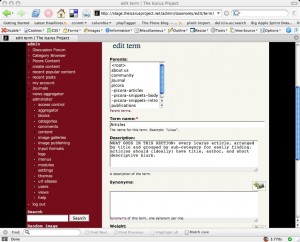 The Drupal taxonomy system is very powerful, but its power is very open ended and does not necessarily lead users towards a uniform experience. The confusion around categories and taxonomies is best exemplified by the
 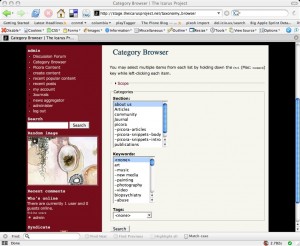 Once vocabularies are created, and terms added, content can be associated with these terms:
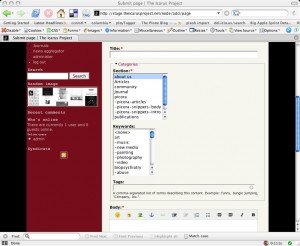 Working on this site really drove home the value in separating the navigation axis (section) from the thematic axis (keywords), and separating these dimensions was easy to accomplish with the taxonomy/category tools built into drupal. In particular, once the scheme was developed, managing vocabulary lists (even hierarchical ones) is intuitive, albeit slightly clunky. I further chose to introduce a free-form tagging dimension for member contributed posts which may or may not fit into the fixed taxonomy. This is similar to myspace and facebook allowing for free-form hobbies and interests, and banking on a large enough user base that there will be overlap and potentially interesting intersections.
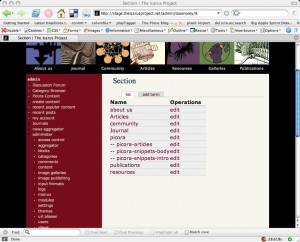
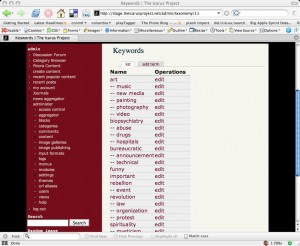 The system still does not allow for the intuitive modeling of a many-to-many relationship, which I continue to think is the litmus test which will mark of a truly powerful taxonomy UI. There is still quite a bit of programmer know how involved in setting up this system so that it operates the way that content administrators expect, and arguably there are too many degrees of freedom introduced by such a general purpose modeling capability (if you think about it, a tagging system can essentially allow web administrators to model relationships which used to require programming custom applications against an rdbms).
Nonetheless, Drupal’s taxonomy/category/vocabulary system definitely captures a few use cases more elegantly than Plone’s current core does. But perhaps the real lesson is the importance of not mixing navigation space and content space, which can be kept separate in Plone, but is all too easy to conflate (in Drupal too!).
Note: most things I describe in this case study could have been accomplished within core Plone - I think the most interesting things here are the administrative UI for multiple vocabulary management, the different types of vocabularies, and how central they are in the construction of a Drupal site.
The system still does not allow for the intuitive modeling of a many-to-many relationship, which I continue to think is the litmus test which will mark of a truly powerful taxonomy UI. There is still quite a bit of programmer know how involved in setting up this system so that it operates the way that content administrators expect, and arguably there are too many degrees of freedom introduced by such a general purpose modeling capability (if you think about it, a tagging system can essentially allow web administrators to model relationships which used to require programming custom applications against an rdbms).
Nonetheless, Drupal’s taxonomy/category/vocabulary system definitely captures a few use cases more elegantly than Plone’s current core does. But perhaps the real lesson is the importance of not mixing navigation space and content space, which can be kept separate in Plone, but is all too easy to conflate (in Drupal too!).
Note: most things I describe in this case study could have been accomplished within core Plone - I think the most interesting things here are the administrative UI for multiple vocabulary management, the different types of vocabularies, and how central they are in the construction of a Drupal site.