 Today I attended a barcamp-style CrisisCamp in NYC where volunteers from around the world gathered physically and virtually to brainstorm, organize, coordinate, and work to help alleviate the suffering in Haiti (CNN CrisisCamp coverage). When people talk about crowdsourcing relief to this disaster, CrisisCamps around the country helped assemble the the sources (and faces) in these mysterious crowds.
Self-Organized Collaborative Production and Action
It was amazing to see these strangers converge, congregating around the familiar communication modalities of wikis, mailing lists, irc, and now twitter and google wave. While these torrential rivers of information are overwhelming, some subcultures are developing strategies for managing and synthesizing these flows. A main organizing hub is http://crisiscommons.org/ , and the hashtags #cchaiti and #haiti are being used to ’tag’ disparate social media around these efforts.
Today’s NYC event drew over a dozen people, techies, community organizers, students, Hatians, UN reps, librarians, union workers, journalists, and beyond. I have been closely following ushahidi/swiftapp project, and their http://haiti.ushahidi.comcollaborative filtering curation strategy is in full swing. Open Street Maps is proving to be an essential piece of infrastructure around mapping data, and the New York Public Library has rescheduled the launch of their amazing new map rectifying tool to help make sense of Hatian geography - shockingly, there are very few maps of Haiti, and their collection might significantly help when overlaid on satellite imagery. This can assist relief workers who need to know what neighborhoods are called, and which buildings were where, etc. If you are familiar with Hatian geography, you can help rectify maps here.
The Sahana Disaster Management Project is also looking for python developers to help scale their software.
Strategic Communication Flows
Strategically, I was struck by the asymmetry of information flows. Many of the efforts seemed to focused on collecting Hatian data, and representing it to Americans and NGOs working on the ground in Haiti. But, not too many Hatians have iphones…
There seems to be very little focus on creating flows of information back into Haiti - information from the outside world directed to Haitians, or, on creating infrastructure for Hatians to communicate with each other. Beyond that, I am not aware of any coordinated efforts to establish non-corporate-mediated, 2-or-more-way channels of information between Hatians and Hatians in the diaspora.
I was reminded of the recent Iranian uprising. A wonderful moment of microblogging glory, although few Americans appreciated how the Iranians were able to receive lifelines of information from outside of Iran (like where to find proxy servers), and were also using the platform to communicate with each other, within Iran.
I was struck by what an important role traditional mass broadcast media might play in a crisis situation. People on the ground need information, desperately. They need to know which symbols indicate that a house has already been searched, where the next food/water/medicine drop will be, and that the biscuits are good, and not expired. They also need entertainment, and news -
à la Good Morning Vietnam. And messages of consolation, emotional support, solidarity, and even song and laughter. Maybe even Bryant Park style movie nights.
Hybrid Networks
Electricity and ISPs are largely down. There are trickles of bandwidth available, and some Hatians have made it onto facebook and cellphones.
So, what could a hybrid, analog-digital network look like? Low-power FM? High-speed copy machines? Blackboards?
It’s actually not that hard to imagine a hybrid network, composed of people, FM radio, blackboards, printing presses, portable video projectors, cell phones, SMS, and Internet. Really, whatever is available.
The Earth Institute and UNICEF Innovation has been deploying RapidSMS on the ground in Africa, and they are working in villages where a single cell phone operator brokers vital information to a blackboard in the town square, transforming a cell phone into a mass broadcast device. Reminiscent of the Wall Newspapers in communist russia.
And if there were a low power FM Radio station set up, the DJ could presumably retransmit messages coming in over the Internet or the cell phones (kinda the reverse of the activist who retransmitted police scanner transmissions over Twitter at the G20 summit protests).
Hatians would know that if they needed to get a message out to a loved one in Haiti, they could get to the radio station and it might be transmitted, back into local community. Messages would travel over human and technological networks, routed intelligently by humans where technology leaves off.
What would the programming on this radio station look like? They could have hourly news and announcements, read out community messages submitted by listeners, convey messages of condolences and support from the outside world, play music, pray, talk radio, “call in” shows, anything really. Most importantly, this radio would be locally produced, with the local community deciding what to play. There was a precedent for local radio, KAMP, in the astrodome stadium after Katrina. The station was set up with the help of the fantastic Prometheus Radio Project volunteers, though authorities tried to shut down the “pirate” lifeline.
Turning Messages in Bottles into Skywriting
Today I met someone who is working with local Haitian communities in NYC. We are both very concerned with CNN dominated the coverage, frittering away their 24/7 news coverage on looping segments, and circling like vultures waiting for violence to erupt. We have to understand the danger of a single story.
We were both very interested in creating alternate channels of communication for Hatians to speak for themselves, and engage in dialogue with their relatives in the diaspora.
Here is one project we could run over the kind of hybrid analog-digital/human-machine sneakernet described above.
Hatians could send video messages in a bottle. The community here could gather to watch and reply to those videos. Say the videos and the replies were limited to 3 minutes each. The original message and the reply could be bundled and sent back to Haiti - not unlike sending a letter before the postage service - you would give it to someone heading to the recipient’s town.
Initially, a few flip cameras on the ground in Haiti, with the video transmitted home over the Internet, or even back to the states by sending the memory cards home with a courier. Eventually, when bandwidth begins to open up, we might be able to imagine a live, synchronous, stream. But, before then, we can imagine ansynchronous video messages being sent back and forth, between Haiti an Haitian communities in the diaspora.
On the Hatian end, the replies could be projected and played back to groups gathered around projectors at night. On our end, distribution is trivial, but the message might easily get to the precise person it was intended for through community social networks. A Haitian could send a video message in a bottle to Brooklyn, and it would not take long for their relatives to know they were safe. Replies could include message of hope, compassion, and support.
Most importantly, independent lines of communications could be opened. As a secondary benefit, if the messages were disseminated publicly (say, on you tube), secondary waves of help could create journalistic highlights, extract crucial data to feed the informatics systems (sourced to the originating testimony), and we could start hearing each others voices.
At the moment, our aid feels like we are tossing a homeless person a few dollars while averting our gaze, when what they really need is for us to look them in the eye, recognize their humanity, and have a conversation with them. We are electronically strip searching the people of Haiti, when (forgive the Avatar reference) we need to see each other.
Theory and Practice
A few closing thoughts to this already rambling post.
I attended the event for many reasons including:
Today I attended a barcamp-style CrisisCamp in NYC where volunteers from around the world gathered physically and virtually to brainstorm, organize, coordinate, and work to help alleviate the suffering in Haiti (CNN CrisisCamp coverage). When people talk about crowdsourcing relief to this disaster, CrisisCamps around the country helped assemble the the sources (and faces) in these mysterious crowds.
Self-Organized Collaborative Production and Action
It was amazing to see these strangers converge, congregating around the familiar communication modalities of wikis, mailing lists, irc, and now twitter and google wave. While these torrential rivers of information are overwhelming, some subcultures are developing strategies for managing and synthesizing these flows. A main organizing hub is http://crisiscommons.org/ , and the hashtags #cchaiti and #haiti are being used to ’tag’ disparate social media around these efforts.
Today’s NYC event drew over a dozen people, techies, community organizers, students, Hatians, UN reps, librarians, union workers, journalists, and beyond. I have been closely following ushahidi/swiftapp project, and their http://haiti.ushahidi.comcollaborative filtering curation strategy is in full swing. Open Street Maps is proving to be an essential piece of infrastructure around mapping data, and the New York Public Library has rescheduled the launch of their amazing new map rectifying tool to help make sense of Hatian geography - shockingly, there are very few maps of Haiti, and their collection might significantly help when overlaid on satellite imagery. This can assist relief workers who need to know what neighborhoods are called, and which buildings were where, etc. If you are familiar with Hatian geography, you can help rectify maps here.
The Sahana Disaster Management Project is also looking for python developers to help scale their software.
Strategic Communication Flows
Strategically, I was struck by the asymmetry of information flows. Many of the efforts seemed to focused on collecting Hatian data, and representing it to Americans and NGOs working on the ground in Haiti. But, not too many Hatians have iphones…
There seems to be very little focus on creating flows of information back into Haiti - information from the outside world directed to Haitians, or, on creating infrastructure for Hatians to communicate with each other. Beyond that, I am not aware of any coordinated efforts to establish non-corporate-mediated, 2-or-more-way channels of information between Hatians and Hatians in the diaspora.
I was reminded of the recent Iranian uprising. A wonderful moment of microblogging glory, although few Americans appreciated how the Iranians were able to receive lifelines of information from outside of Iran (like where to find proxy servers), and were also using the platform to communicate with each other, within Iran.
I was struck by what an important role traditional mass broadcast media might play in a crisis situation. People on the ground need information, desperately. They need to know which symbols indicate that a house has already been searched, where the next food/water/medicine drop will be, and that the biscuits are good, and not expired. They also need entertainment, and news -
à la Good Morning Vietnam. And messages of consolation, emotional support, solidarity, and even song and laughter. Maybe even Bryant Park style movie nights.
Hybrid Networks
Electricity and ISPs are largely down. There are trickles of bandwidth available, and some Hatians have made it onto facebook and cellphones.
So, what could a hybrid, analog-digital network look like? Low-power FM? High-speed copy machines? Blackboards?
It’s actually not that hard to imagine a hybrid network, composed of people, FM radio, blackboards, printing presses, portable video projectors, cell phones, SMS, and Internet. Really, whatever is available.
The Earth Institute and UNICEF Innovation has been deploying RapidSMS on the ground in Africa, and they are working in villages where a single cell phone operator brokers vital information to a blackboard in the town square, transforming a cell phone into a mass broadcast device. Reminiscent of the Wall Newspapers in communist russia.
And if there were a low power FM Radio station set up, the DJ could presumably retransmit messages coming in over the Internet or the cell phones (kinda the reverse of the activist who retransmitted police scanner transmissions over Twitter at the G20 summit protests).
Hatians would know that if they needed to get a message out to a loved one in Haiti, they could get to the radio station and it might be transmitted, back into local community. Messages would travel over human and technological networks, routed intelligently by humans where technology leaves off.
What would the programming on this radio station look like? They could have hourly news and announcements, read out community messages submitted by listeners, convey messages of condolences and support from the outside world, play music, pray, talk radio, “call in” shows, anything really. Most importantly, this radio would be locally produced, with the local community deciding what to play. There was a precedent for local radio, KAMP, in the astrodome stadium after Katrina. The station was set up with the help of the fantastic Prometheus Radio Project volunteers, though authorities tried to shut down the “pirate” lifeline.
Turning Messages in Bottles into Skywriting
Today I met someone who is working with local Haitian communities in NYC. We are both very concerned with CNN dominated the coverage, frittering away their 24/7 news coverage on looping segments, and circling like vultures waiting for violence to erupt. We have to understand the danger of a single story.
We were both very interested in creating alternate channels of communication for Hatians to speak for themselves, and engage in dialogue with their relatives in the diaspora.
Here is one project we could run over the kind of hybrid analog-digital/human-machine sneakernet described above.
Hatians could send video messages in a bottle. The community here could gather to watch and reply to those videos. Say the videos and the replies were limited to 3 minutes each. The original message and the reply could be bundled and sent back to Haiti - not unlike sending a letter before the postage service - you would give it to someone heading to the recipient’s town.
Initially, a few flip cameras on the ground in Haiti, with the video transmitted home over the Internet, or even back to the states by sending the memory cards home with a courier. Eventually, when bandwidth begins to open up, we might be able to imagine a live, synchronous, stream. But, before then, we can imagine ansynchronous video messages being sent back and forth, between Haiti an Haitian communities in the diaspora.
On the Hatian end, the replies could be projected and played back to groups gathered around projectors at night. On our end, distribution is trivial, but the message might easily get to the precise person it was intended for through community social networks. A Haitian could send a video message in a bottle to Brooklyn, and it would not take long for their relatives to know they were safe. Replies could include message of hope, compassion, and support.
Most importantly, independent lines of communications could be opened. As a secondary benefit, if the messages were disseminated publicly (say, on you tube), secondary waves of help could create journalistic highlights, extract crucial data to feed the informatics systems (sourced to the originating testimony), and we could start hearing each others voices.
At the moment, our aid feels like we are tossing a homeless person a few dollars while averting our gaze, when what they really need is for us to look them in the eye, recognize their humanity, and have a conversation with them. We are electronically strip searching the people of Haiti, when (forgive the Avatar reference) we need to see each other.
Theory and Practice
A few closing thoughts to this already rambling post.
I attended the event for many reasons including:

 Last week I attended the second half of the US Social Forum - not exactly a conference, but more of a convergence or a process, where 20,000 people gathered in Detroit to build coalitions, alliances, and movements. The World Social Forum began as a response to the World Economic Forum - Why should the power elite be the only ones planning humanity’s future?!?
The USSF web site and the People’s Media Center (made possible by some righteous radical techies, the Design Action Collective, riseup.net, and May First/People Link) should give you a flavor of what the event was all about. But, be aware that the streaming video and social media barely scratches the surface of the experience.
The forum is organized around 2-hour long workshops, and over 100, 4-hour long People’s Movement Assembly’s. The sessions were in depth and quite intensive. The format is designed to encourage small group interactions and for people to connect and get to know each other.
The assemblies were geared around crafting resolutions and actions - I attended parts of the transformative justice and healing PMA, and it was really well facilitated. During the closing ceremony the assemblies synthesized their resolutions, scheduled actions, and asked for commitments of solidarity around their issues. I don’t think that this forum represents the Left’s answer to the Tea Party, but I did gain a much better appreciation for the scope of issues comprising The Agenda(s). And, considering that anyone passionate about an issue was welcome to participate, the assemblies offered an authentic glimpse into everyone’s priorities. It felt like a determined effort to take things into account, and put them in order.
Here are some of the resolutions that emerged from the Progressive Techie Congress Principles and the Transformative Justice and Healing assembly.
Collective Liberation and Radical Mental Health
The main draw for me to the conference were the Icarus Project workshops and the convergence of Icaristas, in person. We took over and transformed a house in a Detroit suburb, and mad dreaming and plotting ensued. The place was quickly transformed into a safe space for people to brilliantly navigate the madness of the forums, and it was quite amazing to spend quality time, face to face, with friends and allies. I gravitated to the heath tracks, taking up issue of self-care, mutual aid, and wellness. I also caught some great music, ate some amazing homemade food (and not bombs), visited some incredible collective living spaces, and was pretty inspired by everyone who cared and showed up.
This Icarus workshop I attended (there was another that I missed, plus a screening of Crooked Beauty) was eagerly anticipated and well attended - the participants were open and receptive to the core messages, and there was a palpable desire to embrace these issues locally. The session leaders shared their personal stories and modeled peer-support as we broke into groups (photos, highlight reel to be posted shortly). People shared details of their individual and organizational neuro-diversity and how dysfunctional feedback loops undermine many organizing efforts. The relationship between personal and collective liberation emerged from the workshop and will travel far beyond Detroit’s (shrinking) city limits.
Detroit is pretty beat up - we stayed two blocks away from a refinery that belched flames into the night sky - but there are some wonderful people and projects that were really cool to experience. It’s also the only city I have ever been to that has a monument to organized labor.
If I can’t dance, I don’t want to be part of your revolution - Emma Goldman, Radical Feminist
Last week I attended the second half of the US Social Forum - not exactly a conference, but more of a convergence or a process, where 20,000 people gathered in Detroit to build coalitions, alliances, and movements. The World Social Forum began as a response to the World Economic Forum - Why should the power elite be the only ones planning humanity’s future?!?
The USSF web site and the People’s Media Center (made possible by some righteous radical techies, the Design Action Collective, riseup.net, and May First/People Link) should give you a flavor of what the event was all about. But, be aware that the streaming video and social media barely scratches the surface of the experience.
The forum is organized around 2-hour long workshops, and over 100, 4-hour long People’s Movement Assembly’s. The sessions were in depth and quite intensive. The format is designed to encourage small group interactions and for people to connect and get to know each other.
The assemblies were geared around crafting resolutions and actions - I attended parts of the transformative justice and healing PMA, and it was really well facilitated. During the closing ceremony the assemblies synthesized their resolutions, scheduled actions, and asked for commitments of solidarity around their issues. I don’t think that this forum represents the Left’s answer to the Tea Party, but I did gain a much better appreciation for the scope of issues comprising The Agenda(s). And, considering that anyone passionate about an issue was welcome to participate, the assemblies offered an authentic glimpse into everyone’s priorities. It felt like a determined effort to take things into account, and put them in order.
Here are some of the resolutions that emerged from the Progressive Techie Congress Principles and the Transformative Justice and Healing assembly.
Collective Liberation and Radical Mental Health
The main draw for me to the conference were the Icarus Project workshops and the convergence of Icaristas, in person. We took over and transformed a house in a Detroit suburb, and mad dreaming and plotting ensued. The place was quickly transformed into a safe space for people to brilliantly navigate the madness of the forums, and it was quite amazing to spend quality time, face to face, with friends and allies. I gravitated to the heath tracks, taking up issue of self-care, mutual aid, and wellness. I also caught some great music, ate some amazing homemade food (and not bombs), visited some incredible collective living spaces, and was pretty inspired by everyone who cared and showed up.
This Icarus workshop I attended (there was another that I missed, plus a screening of Crooked Beauty) was eagerly anticipated and well attended - the participants were open and receptive to the core messages, and there was a palpable desire to embrace these issues locally. The session leaders shared their personal stories and modeled peer-support as we broke into groups (photos, highlight reel to be posted shortly). People shared details of their individual and organizational neuro-diversity and how dysfunctional feedback loops undermine many organizing efforts. The relationship between personal and collective liberation emerged from the workshop and will travel far beyond Detroit’s (shrinking) city limits.
Detroit is pretty beat up - we stayed two blocks away from a refinery that belched flames into the night sky - but there are some wonderful people and projects that were really cool to experience. It’s also the only city I have ever been to that has a monument to organized labor.
If I can’t dance, I don’t want to be part of your revolution - Emma Goldman, Radical Feminist


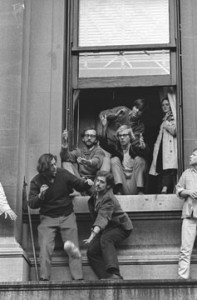 At the beginning of the semester I shopped a class offered in the Columbia CS Dept on
  A
A